Showing posts with label Dario Argento. Show all posts

Oct 31, 2014

Phenomena, Creepers

a Must watch in any good Halloween party.
Did you think we wouldn't review a horror flick on Halloween? Think again! Instead of praising vomits like Annabelle as well executed horror films, here at the SPAM Alternative headquarters we'll offer you a true horror film, not a shitty cock sucking bummer so, fasten your seatbelts for today's offering to Satan!

PHENOMENA ranks amongst Dario Argento's finest films. Some state that it is his best film, some do not, hence the neverending argument to whether today's review or SUSPIRIA or PROFONDO ROSSO are to be considered number one in the filmography of this great Italian master. 

Now, any connoisseur knows the difference between watching a European horror film and an American (rip-off) horror film. Dario Argento is perhaps, the king of the Giallo genre, and is definitely  the go to director if you are to introduce a friend to this brilliant perspective of what is making a horror film a good film that'll give you chillls from start to finish. Nevertheless, if you're a complete moron who's life is deeply based in stereotypes, I'm pretty sure your mental capacity is already too diminished to understand and enjoy the grandeure of a real good film. If that is your case, please leave this humble blog at once. 

Is he dead already?
Satan is in her eyes!
Needless to say, Dario Argento is a macabre master of technique, and with Phenomena he reuses a previous premise (many times has this plot happened with Argento with the young girl going to a boarding school of some sort with a murderer in the midst after the main girl), but with startling, uproarious but effective results. We should find some of this as amusing- a chimpanzee as a companion/servant to Scottish wheelchair bound emptamologist Donald Pleasance, and Jennifer Connelly's character, Jennifer, who can communicate and bring the wrath of swarms of insects- and I'm sure Argento, knowing what he's doing, recognizes the finer points of the insanity in his work. But he also turns up the screws in terms of the 'creep' factor (hence it's American re-edit dubbed Creepers), with sequences that edge on the self-conscious and the sublimely terrifying.

Simplistics of the plot, if there is one to speak: a young girl is sent to a boarding school while her famous father is off in the Philippines. She befriends a scientist who specializes in insects, and also in theories pertaining to a certain psychopath who may or may not be killing people in the dead of night- when young Jennifer is out sleepwalking! She's deemed crazy and meant to be taken to a mental hospital, but she has other plans up her sleeve, or up swarming in the air. There's a confident, fresh Connelly in the lead, as well as Pleasance who's always dependable as the prophetic veteran of this ilk (once or twice you wonder if he'll say "I shot him six times!") But it's what Argento puts his young lady through that makes or breaks Phenomena for the viewer. As with other films of his "classic" era like Opera and Suspiria, he doesn't tether himself to logic; it would only get in the way of his big ideas and abstractions, his visual of Jennifer looking down that white hallway, the little fly buzzing along with her, and of course the eventual lair of the killer.

My dear, we have a murder to catch.
I see dead bugs.
That lair, I should add, is the kind of place that, as Argento directs it, gets scarier as it goes along. Not the kind of scary where you always go BUMP in the night, but more where you suddenly get in a frame of mind, where the psychopath has the audience in a grip much like Jennifer. It's interesting to note a common stylistic trait we see here, which is a cliche to be sure, with the killer's POV as something characteristic of the material. It should be a big gag, but for Argento it's all part of the game he's weaving. While there aren't as many random things that happen as in Opera, and we don't get any kind of 'deep' murder mystery as in Deep Red, it's never too misleading. By the time Argento plunges us into that pit with the maggots we're squirming in our seats, and feeling an edge of exhilaration to wonder how the hell she (or another chap who happens to be in the room) will get out alive. But as if to seal the deal on making this a near-classic horror film, Argento does a crazy double-twist, one that had me raising eyebrows, laughing uncontrollably, and with a feeling that, as twisted as it's become, justice has been served.

Even with the 80's metal music not in cue to the scenes most of the time when they pop up (the Goblin music fares much better), and even with the lapses in judgment or the occasional poor acting turn, Phenomena should be something of a must-see for die-hards of Italian giallo, or just anyone wanting something a tinge 'different' in their slasher movie. And what makes a difference more than insects! 

Here's the movie trailer:

Oct 13, 2014

Profondo Rosso: Deep Red

Halloween  marathon? This is n°1 in your list.
Since Halloween is just around the corner, the S.P.A.M. Alternative team has lately been reviewing wonderful horror films for your enjoyment and "add to cart" list for partying hard with friends and forkin easy gals after a couple of drinks. Today's entry is 1975's Profondo Rosso, AKA Deep Red, a lesson on how a good horror film is made based sorely on creativity rather than on budget and (I puke just by typing this) CGI.  I'm pretty sure everyone's planning a party with the horror classics from the 80's (Fredy Krueger, Jason Vorhees, Michael Myers, you know the type) BUT, truth be told, all those American horror classics we remember so fondly wouldn't exist if it wasn't for the original source from which they plagiarized a lot of stuff: The Italian Giallo genre.
 
Deep Red is the favourite Argento film of many fans mainly because it has a coherent plot with genuine scares and comedy thrown in along the way. It also paves the way for Suspiria in the use of colours and interiors/buildings, especially the beautiful haunted house, as part of Argento's renowned aesthetic.

Frequently Argento's killers do not seem credible because the plot does not contain a narrative, typically supplementing narrative for set killing scenes instead. In Deep Red there are the same killing scenes but they are better connected to the story of the killer (or killers).

Mediums & charlatans.
Yes, dolls in horror are a thing of the past.
Briefly a former actress, who is a paranoid schizophrenic, murders her husband when he suggests she should seek further psychiatric help. The murder is witnessed by their young son, Carlo(Gabriele Lavele). This scene is part of the denouement as the film begins 20 years later with a psychic inadvertently stumbling across the identity of the woman, who in turn murders the psychic to keep her identity and previous murder hidden. This first death is witnessed by Marcus (David Hemmings) as he returns home, bumping into Carlo who, coincidentally, plays piano in a local bar. Marcus rushes to assist the dying psychic unaware that as he does he glimpses the killer reflected in a mirror in the apartment. Marcus investigates the psychic's murder as he is constantly niggled by an elusive memory of something important - namely the face he glimpsed in the mirror.

The way Marcus glimpses the killer is the cleverest detail in this film. The killer, unable to exit the apartment before Marcus appears, poses as one of a number of faces in a painting. This is what Marcus sees reflected in the mirror. Later when he looks again the painting troubles him because he knows it is different somehow but does not realize it's missing the face of the killer. This detail is usually missed on first viewing of the film and its revelation, towards the end, rightly inspires admiration of Argento.

Don't fucking die on me!
...and it's gone!
One theme of the film is femininity and its connection to mental health and/or evilness. Marcus's sidekick in the investigation is Gianni, an ambitious female reporter played by Daria Nicolodi in her first collaboration with Argento. She speaks of her independence at various points in the film whilst bemoaning being single and arm wrestles Marcus to show her strength in one of their many comedy moments. There are suspicions she might be the killer throughout the film though ultimately she proves to be a benign female presence.

The antagonist and murderess is Carlo's glamorous agreeing mother who seems absentmindedly narcissistic, repeatedly confusing Marcus with being an engineer whilst lauding her past achievements. She is described as evil and childish and we see her playing, as a child might, with dolls enacting deaths she then perpetrates on her real life victims. Her death at the end is suitably gruesome and presents her as somewhat pathetic. A question remains as to how much Carlo might have been involved with his mother's murderous antics. Carlo is a disturbed young man drinking himself to an early death. Likely the consequence of witnessing his father's murder and living with his disturbed mother.

Girls who read get me horny.
Phone sex? bring it on!
The theme of femininity and evil is furthered by the caretaker's daughter. Her father minds the haunted house that contains important clues. We see him brutalise his daughter and her respond with the torturing and killing of a lizard. With her Argento sows the seeds of another female child mind with murderous intent.

The effects upon this young girl and Carlo of maladaptive parenting reflect a serious side to Argento's screen writing that is easy to overlook amidst the fantastic carnage and he comes closest to psychologically exploring what makes a serial killer in Deep Red than in any of his other films. This elevates the film above a stylish gore-fest.

There are two cuts available of the film: the director's cut is about 20 minutes longer and the better of the two as it lingers more with the narrative that makes this a coherent and intelligent film.

I know who the killer is!
Murdering eye.
Profondo Rosso has been praised many times as the number one film in Dario Argento's filmography, I for one, have a hard time deciding whether it's Suspiria or the aforementioned. Anyways, this is film making at its finest, believe you me, any film that has Argento's signature on it won't disappoint, moreover, any Italian film from the 70's will give you a 101 lesson on what a good movie feels like. So if you're looking for a different Halloween movies night, please add this to your cart.

Here's the movie trailer:


Sep 25, 2014

Suspiria

The colors of a masterpiece.
Suspiria (1977) is perhaps the tour du jour movie in Dario Argento's filmography. a simple story and the unique usage of colors, gives it an artful flavor that makes the movie beautiful to watch. Argento uses the colors of blue, green, red, and yellow in an unique manner. The director uses the old technicolor technique that was in use during the 1950s. This aspect gives the movie a fairy tale appearance.

In the first 20 minutes, Dario Argento wanted to build up suspense and tension that was normally reserved for the climax of a film. The main character and story are built up in good fashion. The shoots of Suzy Bannion (played by Jessica Harper) inside the taxi cab gives the viewer a feeling of claustrophobia and dread. The image and music in the opening moments add high voltage suspense to the film's pounding intensity level. The shots through the woods are fabulously done.

So...
Welcome to your nightmare.
The double murder sequence is one of the most bloody scenes in modern horror films. It still retains its shock value after twenty four years. This one sequence makes any murder scene in a teen horror film today look both tame and lame. The only murder sequence from an Argento film to match this in its brutality is the arm removal scene in Tenebre (1982). The murder of the first victim is extremely violent and yet stylishly filmed, and no CGI was needed.

Dario Argento owes his debt in making Suspiria to the early animations of Walt Disney and the art of Jean Cocteau. The main source of influence is the Disney film of Snow White & the Seven Dwarfs (hard to believe isn't it?) The Snow White film would influence many Italian horror movie makers because of the impression it made on them as a child. The story of Suspiria was to originally take place in a children's school. This was changed because of the possible controversies this would cause in the film community of Italy.

Watch it on Blu Ray, it looks simply perfect.
Holy shit!
In filming the murder scenes, the director wanted to pump them with intense horror that wouldn't let up. He wanted to create scenes of fear that would be carried by its gory visuals and ear pounding music. The murder scenes in the motion picture are given their own personal style. On doing this film and these murder scenes, Argento has said "Fear is a 370 degree centigrade body temperature. With Suspiria I wanted 400 degrees". The murder sequences are one of the main things that make the film a gem of a horror movie.

Suspiria adds some movie lore to witchcraft mythology. The movie looks at the mythology of witches and witchcraft with keen interest. Its one of the best films on the subject of witches. Argento was fascinated by the subject of witches and used that fascination to film his own take on the subject. Another source of influence is a section from the Thomas De Quincey's drug induced fantasy essay, Confessions of an Opium Eater called Suspiria De Profundis which translates as "Deep Sigh".

I'm only a ballet dancer, what is this shit?
Some headache.
Daria Nicolodi gives an important contribution in co writing the screenplay. Suspiria is the only film where Daria Nicolodi had creative imput on an Argento flick. Part of the film was inspired by Nicolodi telling Argento about her Grandmother's experiences at a finishing school where black magic was practiced during the late hours of the night. Daria Nicolodi was to play Sara, Suzy's friend but got injured during shooting. The story is there to give structure to the visuals & music.

The death of Daniel, the blind piano player is set up with suspense. The scene takes an unexpected turn when he is attacked by his own dog. This is because the scene at its opening points to him being killed by a witch. Dario Argento along with cameraman Luciano Tovoli uses complex camera movement to make this scene work. This scene must have impressed Lucio Fulci when he saw the film that he would play homage to it in The Beyond(1981).

How's it hangin'?
All this blood has gotten me horny y'know.
There has been a great debate among Argento fans on whether Deep Red(1975) or Suspiria is the director's masterpiece. Some see Suspiria as the masterpiece in the film cannon of Dario Argento. Others regard Deep Red as his true masterpiece. In my opinion, Tenebre (1982) is the masterpiece of Dario Argento because it's complete in motifs that were seen in his films up to that point. Nevertheless, Deep Red and Suspiria are Argento's top horror films of the 1970s.

I find it intriging that Suzy and Sara resemble sisters and have names that begin with the letter S. Suspiria was influenced by an obscure horror pic called La Residencia/The Finishing School(1968). Supiria contains a tinge of the giallo genre with a scene in the opening moments. The Goblin gives out another amazing soundtrack following their excellent score for Profondo Rosso. Luciano Tovoli does a fantastic job as the cinematographer in showcasing the nightmarish world of today's film in review. 

Overall, go watch it now!

Here's the movie trailer:


May 15, 2011

Tenebre

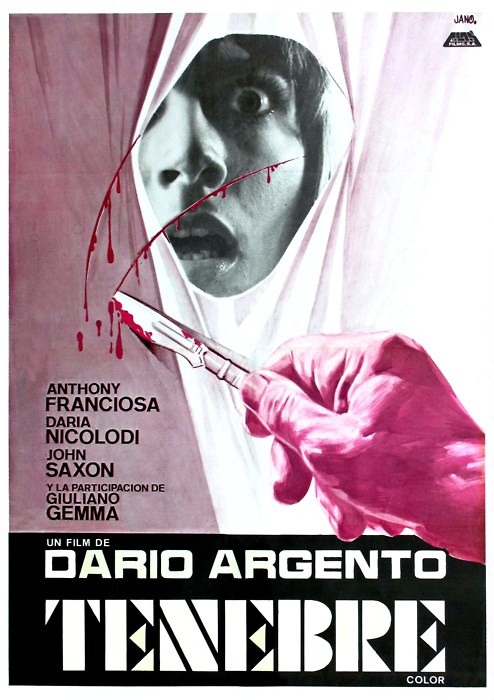
Original movie poster.
Tenebre AKA Unsane comes packed with an amazing 80's style score, innovative camera-work, and wonderfully gory murders courtesy of a black leather gloved bookworm killer. Tenebre delivers everything you could ask for in a classic Italian giallo. Like many Italian murder mysteries, the story takes some time to develop, but if you can accept the convoluted plot, there's plenty of fun to be had.

The story focuses on Peter Neal (played by Anthony Franciosa) who is a best-selling novelist who becomes involved in real life murder mystery when the victims of some unknown killer are found with pages from his latest book Tenebre stuffed in their mouths. The unknown killer seems to be fond of Mr. Neal's work and in a way he's willing to kill his victims using the ideas from the book, so here you can predict how the police will request Neal's help to unravel the next killing.
A shame Argento's didn't use Lara Wendel's full potential.
Argento was wrong I gotta say it.
According to thousands of fans & movie reviewers like yours truly this is one of director Dario Argento's best movies, Tenebre is packed to the rafters with the kind of stuff that make good giallos such a trip to watch. As pretty girls (more nude scenes could have been great) are stalked and killed by a raspy-voiced maniac, the director offers genuine clues and red herrings aplenty, allowing the audience to have fun trying to figure out who the killer is. The movie's stunning cinematography is accompanied by one of Goblin's greatest scores, transforming what may have been mundane moments into pure works of art (in one amazing scene the camera simply prowls slowly around the outside of a building, but with Argento in control, it is simply breathtaking!).
The perils of being a horror writer.
Argento's red blood style.
A pity hot chicks like this last so little in the film.
Killer Dog after Lara Wendel hot body.
Murder has never been such a produced element in many movies but here even the most grisly deaths are stunningly captured. A particularly memorable moment has a young girl stumble into the house of the killer, before being chased through a garden; this scene is shot from the axe-wielding maniac's point of view, and is incredibly effective.
Bukkake fantasy?
Red high heels fetish anyone?
Dude where's my arm?
Finish Him!
Fans of gore are also catered for with several gruesome murders, the best of which involves bucket-loads of arterial spray decorating most of a wall. Juicy!

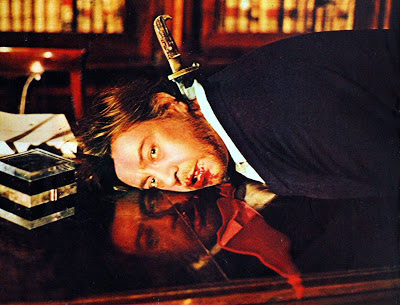
Finally by the end of the film Mr. Argento reveals the identity of the killer in a suitably silly finale, before offing the murderer in a fittingly gruesome manner.

Check out Tenebre and witness one of the great works from one of Italian horror's finest. Here's the trailer:


See you on the next movie review, and remember this is cinema!