Writing reviews is taking longer these days. Not because I'm lazy or busy with my adult life or something. I always disliked people saying things "I don't have time for that anymore". That's not true. When you truly want to do something, you do it anyway.
Today's review, I hope is finished and posted by my Birthday next Wednesday, is about another giant robot Animé that almost made into the roaster of shows that made Voltron. Legend has it, some toys were licensed in hopes of a future release with the Voltron tag on them. Long story short, nothing happened and Lightspeed Electroid Albegas would eventually reach western audiences as its own thing. The show was produced by Toei Animation, and originally aired in Japan from 1983 to 1984. The series was also later moderately popular in Latin America, Spain and Italyduring the late eighties. 45 episodes were produced, clocking in at approximately 25 minutes each. The series is also known by other translations of its title, such as "Arbegas", "Arebegas", "Lightspeed ElectroGod Arbegas" and "Arbegas: El Rayo Custodio".
Hotaru's suit is a bit tight today.
State-of-the-art Mecha.
The plot is the classic, clichéd at this point, story of three teenagers, Daisaku Enjōji, Tetsuya Jin, and Hotaru Mizuki, who create award-winning robots as part of their school competition. At this time, the evil Derringer (デリンジャー, Derinjā), an invading alien race, plots to control the universe so its ambition is also to conquer Earth. To combat this threat, Hotaru's father, Professor Mizuki, takes the three robots and modifies them for battle. Hence, Albegas, thesuper robot, is born. The Japanese fascination for forcing teenagers into the most dangerous work is a trope of any Animé involving robots, transforming or not. Daisaku is the sometimes hot-headed leader, while Tetsuja compensates with more of a loner/mature approach . On the other hand, Hotaru is the beatiful woman everyone falls for, which leads to several episodes where she is faced with stereotypical situations that can only occur to a woman just because she is one. Other characters bring the comic relief to life, but it gets a bit tiresome by half. For example, professor Mizuki is an overweight single lady that is always looking for candidates for marriage. Moreover, she's too dumbed down to be a teacher of any kind. Then you have the most annoying of all: Goro Kumai who's nothing but a pale copy of Mazinger Z's Boss. His quest for earning Hotaru's love is dead lame. Now, don't get me wrong, not everything is bad in Albegas. The character and mecha designs are good. 80s good. Some episodes are excellent as well, but the episodic nature of the show makes it really difficult to get to the 45th episode.
School can wait.
Combiners!
Plot wise, it is not very clear at first why the Derinja have targeted Earth as their next expansion project. The episodic nature makes the bad guys seem very childish. They build one "mecha fighter" after another, then try to root for it until it's torn to pieces, and they're back on ground zero to survive another day. On the other hand, the good guys motivations are equally childish: "Bad monster comes to attack the city, heroes protect city, and blast monster into oblivion". One thing that always had my attention during the episodes is the fact you never see the police or military doing something to stop the alien attacks. Although they're seen defeated in the first episode, boom! next episodes we have no clue where the hell are they. Besides, Professor Mizuki is a man with a reputation for knowing what to do, so nobody ever questions his decision of sending underage kids to battle monsters while they should be in school doing chores instead. By the way, I know it's a fictional show aimed at kids before you tell me I'm being too harsh on it.
Each episode runs around 24 minutes counting the opening. The formula gets tiresome very quickly: Open episode, heroes either wait for something to happen, or one of the main characters has been tricked/manipulated by the Gerinja to deliver vital information to their operation, whatever the operation is. Then, one hero realizes something's out of place and tells the others, giant monster shows up, battle unravels, Albegas sword wins the day, everyday, always.
Hotaru is good at everything...
...Even providing light fanservice.
Out of all characters, Hotaru Mizuki remains the most interesting. Here's why: She's a good student, an excellent tennis player, the most responsible from the team, and quite a great pilot. Moreover, she gets more character development since she's the only female in the group. Men follow her, yet she chooses to ignore them. She's the school most beautiful student, and yet she doesn't give a rat's ass about it. She's a humble character with feelings. On the other hand Daisaku and Tetsuya are merely the male stereotypes of a heroic figure that doesn't seem to have anything else to do with their lives but to kill monsters, and occasionally try to see girls showering or in their underwear. A very common stereotype from the past. Kids would device plans to see their classmates undies during breaks, and there was nothing sexual about it, it was just a game of humiliation. Bad taste, I know.
Unfortunately, Hotaru also falls prey to stereotypical situations just because she's a female character. Kidnap, mind control, falling in love with the enemy without knowing it, not being strong enough as to escape by herself, and frequently having to deal with men chasing her just because. Her commitment to the cause is commendable, though.
You can still find the toys on E-Bay.
Too young to smoke, young enough to pilot a giant robot.
Plot holes are very frequent on the show. We never see why these kids were chosen to pilot state-of-the-art mecha probably the military would have handled better. The only explanation is on the first episode where these kids participate in a robot building contest in school, and win. Later these robots would be repurposed, very quickly to fit the episode, into Albegas by professor Mizuki, who with all his scientific knowledge and expertise, chooses his daughter and her two best friends to do what no adult is willing to do because they know better.
Morishita Kouzou directed the show, and to date he's the managing director of Toei animation. His resumé includes work ranging from earlier mecha animé like Kotetsu Jeeg, Magne Robot Ga-Keen to popular franchises like Dragon Ball Z & Saint Seiya. As above mentioned, the animation quality, including character, mecha & background designs are all superb according to the decade standards. The transformation sequence where the Alpha, Beta & Gamma robots combine into Albegas gets permanently attached to your brain, and although is reused in every episode, you never get tired of it. Neon retro grids in the background, pieces fitting together zooming in and out, and the final superhero pose with bursts of energy scream "Buy the toy while it's hot".
Still waiting for giant robots to lead the war on peace.
Retro grids hit different when you're 40 something.
Now, contrary to the belief an episodic show has no clear ending, Lightspeed Electroid Albegas does come to a satisfying conclusion in its final episode, or so it seems. Being a show aimed at children, killing all the bad guys while blowing their home planet to pieces, seems like a fitting end. Nevertheless, even an adolescent mind would question whether this is the right solution to the conflict, as our heroes basically do the same the Derinja are doing to planet Earth with far worse consequences. Anyway, it was the 80s and the producers weren't expecting the show to build a lasting legacy amongst Anime connoisseurs. These shows were made to test how well toys would sell provided the right animated story. Let's not forget the Dyaclone toyline had been out for 3 years in Japan, and the next year, 1984, Hasbro would license the Car-Robots toyline along with the Microman's Micro Change toyline from Takara to create the Transformers, igniting the worldwide robot craze of 1985.
Science with the cool schoolkids.
Beta as piloted by Tetsuja.
Gamma as piloted by Hotaru.
Voltron II
When World Events Productions began work on Voltron: Defender of the Universe, the intention was to adapt three anime into one shared universe. The series began with a run of episodes based on Beast King GoLion, followed by a run based on Armored Fleet DaiRugger XV. The intention was then to feature Albegas
as a third arc, with the mecha of the three shows being retconned into
having all been variations of Voltron. However, due to the
unenthusiastic response to "Vehicle Voltron" episodes, plans to adapt Albegas fell through.
In spite of this, Matchbox released a toy of Gladiator Voltron labeled Voltron II, in addition to Voltron I (Vehicle Voltron) and Voltron III (Lion Voltron).
Decades later, and to appease fans who wanted to see a spawned feature from the Voltron II
toy, Gladiator Voltron made a brief, one-panel appearance in Devil's
Due comics in 2004. Character dialog indicated that it was an earlier
failed attempt in the efforts to duplicate the Lion Force Voltron's technology (efforts which, in this continuity, resulted in the creation of the Vehicle Force).
All three Voltrons appeared together in the fifth issue of Robotech/Voltron, during a page which showed potential alternate dimensions.
Hello fellow connoisseurs! No! I wasn't dead! (at least not yet) I was just too busy working from home 24/5. Now that I've adjusted to working through my computer from Monday to Friday, I feel healthy enough as to deliver a brand new post about another awesome Animé that everyone should watch based on its historical value alone.
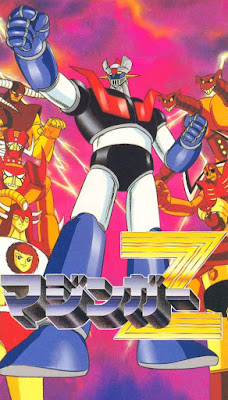
Enter Mazinger Z, the archetype of giant robots Animé!
Background.
マジンガーZ, AKA Mazinger Z, (known briefly as Tranzor Z in the United States) is a Japanese super robot manga series written and illustrated by Go Nagai. The first manga version was serialized in Shueisha's Weekly Shōnen Jump from October 1972 to August 1973, and it later continued in Kodansha TV Magazine from October 1973 to September 1974. It was adapted into an anime television series which aired on Fuji TV
from December 1972 to September 1974. A second manga series was
released alongside the TV show, this one drawn by Gosaku Ota, which
started and ended almost at the same time as the TV show. Mazinger Z has spawned several sequels and spinoff series, among them being Great Mazinger, UFO Robot Grendizer and Mazinkaiser.
Mazinger Z: Infinity, a theatrical film sequel, taking place 10 years after the original series, was animated by Toei Animation and released in theaters on January 13, 2018.
Synopsis.
The villainous Dr. Hell has amassed an army
of mechanical beasts in his secret hideaway, the island of Bardos
located in the Aegean Sea. He is capable of controlling mechanized
beasts with his cane, and instructs them to unleash devastating attacks.
However, Dr. Hell doesn't do all the dirty work by himself; he has his
loyal henchman Baron Ashura to carry out his devilish plans.
There are also those that will see to it that evil does not prevail.
Kouji Kabuto is the young and feisty teenager with a score to settle:
his goal is avenging the murder of his grandfather by Dr. Hell. And he
might just be able to pull it off, as he is the pilot of Mazinger Z, a
mighty giant robot made out of an indestructible metal known as
Super-Alloy Z.
Mazinger Z boasts several powerful special attacks. By channeling
Photonic Energy through its eyes, and unleashing the Koushiryoku Beam,
it can cause great destruction. But things get really cool when Mazinger
Z launches its Rocket Punch attack. Dr. Hell and his minions might have
just found their match!
The magnificent blu-ray box artwork.
How many characters can you spot?
Review.
It’s hard to think of a clearer Japanese contribution to
animation and science fiction than the creation of the giant robot genre. For the millions of
kids that grew up outside Japan in the 80s and 90s, and were lucky enough to witness some classic Animé on the tele, big robot shows were an introduction to a whole new style of "cartoon". Although there were American cartoons featuring robots, the storytelling was nothing like what kids had seen before. Moreover, a lot of fans, experts and forums across the internet (they can't be wrong) agree the origin of the genre can be traced to a single comic — Go Nagai’s Mazinger Z. By the time the series debuted in 1972, readers had already been dazzled by incredible robots like the remote-controlled Tetsujin 28 (another true legend) and especially the sentient Astroboy (Tetsu-Wan Atom). But those robots’ strength was always just out of the reader’s grasp. Mazinger Z was
the first series to put a kid protagonist inside the cockpit of a
giant robot, and Toei’s 1973 animated series became a huge hit
domestically, both in terms of ratings and in merchandising revenue. Such hit would later come to Europe, South and North America.
But what made it so interesting? what makes it relevant today? The 48 year old series followed the adventures of Kouji Kabuto, the hot-headed,
motorcycle-riding 16 year-old and pilot of the series’ namesake super
robot. Mazinger Z is forged out of Super Alloy Z (whose
critical component, Japanium, can only be found at the base of Mt. Fuji)
by Kouji’s grandfather, Juuzou. The story more or less revolves around
Kouji fighting off the evil Dr. Hell’s weekly mechanical beasts —
ancient robot monsters from a pre-Grecian civilization. However, is not like the traditional "enemy of the week" type of show. Mazinger Z did have an ending and few surprises to keep viewers craving for more.
Blu ray matters.
A very young Go Nagai.
Design wise, the art style is cartoonish by today's Anime standards. If you compare it to other classic shows from around the same time like Mobile Suit Gundam (Gundam 0079 for the uninitiated) or later entries like Super Dimension Fortress Macross or Armored Trooper V.O.T.O.M.S. you'll see the animation style moved on to a more industrially detailed mechanical design which still remains as the standard for Mecha/Robot animation. However, this is by no means a critique stating Mr. Go Nagai's designs were lacking. As a matter of fact, this particular "cartoonish" style was very prominent during the 70's, and you can see it in most of the other Giant Robot shows made in the same decade, and speaking of unique, Mazinger Z featured two female robots, whose main weapon was missiles coming out of their breast, AKA the "boob missiles". An insult by today's politically correct standards, or an oddity from another time. Moreover, the show had a particular set of characteristics never seen before by an audience outside Japan: In the first episode, Kouji’s
mother and grandfather are both killed in front of the viewer at the
hand of Baron Ashura, a half-man half-woman character never seen before by the western crybabies. But, wait! there's more death!
Dr. Hell burns to a crisp the rest of Kouji's father research team
alive in full detail. This idea of showing real death in
kids’ cartoons may be old news today, but in the 70's (and 80's outside Japan) it was a groundbreaking concept. Have you ever heard someone call Animé "Dark & Gritty" or "Not kids stuff"? Well, there you have it! The concept of death & graphic violence in Japanese animation has been around for longer than you think. Despite this, Nagai’s creations became a hit in Europe and
South America, because kids from all over the world wanted to see graphic violence, death and weaponized breasts!
The good guys.
The bad guys.
Nagai reportedly got his idea for piloting a robot from watching
frustrated drivers in a traffic jam, imagining a car that could sprout
arms and legs and walk over the other vehicles. “What I had in common
with the children that were seeing robots was that I wanted to have this
incredible power,”he told Web R25
in 2009. “I didn’t equate giant robots with weapons, I wanted to give a
teenaged character a suit of armor that would turn him into a hero,” he
added.
After the massive success Mazinger Z had (and still has) in Japan Go Nagai would continue to provide the world with more original stories. Although he did make more Giant Robot Manga (Getter Robo, Steel Jeeg, Grandizer, and a lot more) He didn't shy away from exploring other genres. As a matter of fact, Devilman, Devilman Lady, Violence Jack & Cutie Honey, some of his most popular creations, are not part of the robot genre he helped create. In addition, he even made one of the earliest Ecchi mangas! Harenchi Gakuen (Shameless School) in 1968. This dirty manga would later be adapted into Animé, live action film (4) & a television drama. This man has pretty much done everything there is to be done in the industry!
The action figure!
The statue!
By the way, did you know that Go Nagai is nothing but a pen name? The actual name behind this wonderful universe is Kiyoshi Nagai. If Osamu Tezuka is the father of manga, Go Nagai is the cool
uncle who lets the kids sneak sips of his beer and always tells the
funniest dirty stories. The Roger Corman of manga and anime active since 1967, he has had a great influence on the world of Manga and Anime, as he effectively pioneered many of their most representative genres.
Nagai
began his career after he fell sick in college and believed he had
colon cancer, as he wished to leave something to be remembered for. By
the time he found out he did not have cancer, he was set on his career.
Ironically his first efforts at getting published were sabotaged by his own mother! Fortunately, he caught the attention of Shotaro Ishinomori, (creator of Cyborg 009) who helped him get started. Nagai eventually funded his own company called Dynamic Productions.
Nagai is known for intentionally breaking taboos. Even his milder material
has a humorously deranged quality to it. His early works got him in
trouble with the PTA, and even today some of them can contain
controversial material. Nevertheless, most of his TV work is technically
safe in the interest of placating censors even in Latin America and
Europe (though not the US).
Vintage poster. Awesome!
Girl power.
Over the past 40 years, the author’s works have grown and multiplied. Mazinger Z was the jumping-off point for a raft of related material, including Great Mazinger, Z Mazinger, UFO Robo Grendizer, Getter Robo, Psycho Armor Govarian, and God Mazinger. Later, other series like Mobile Suit Gundam and Neon Genesis Evangelion
were able to refine the giant robot formula by making their robots more
realistic; having a limited supply of ammunition, and needing onscreen
repairs after tough battles. In contrast, realism was never high on
Nagai’s list of priorities. He tried to make his characters as
outlandish as possible, and shunned writing long story arcs in advance,
preferring to make things up as he went along. “Nowadays, the trend is
for the characters to have complex personal relationships, but I think
things should feel straighter. That’s why my robots are more fun than
what they have now,” said Nagai in an interview with the Sankei Shinbun.
It was never Nagai’s intention to teach the youth, just to give them
the feeling of being big and powerful. “Kids want to turn into adults
fast,” said Nagai. “I just wanted to take that feeling and turn it into a
human riding inside a robot.”
Today we'll take a look at what's probably the manliest Animé of all time:
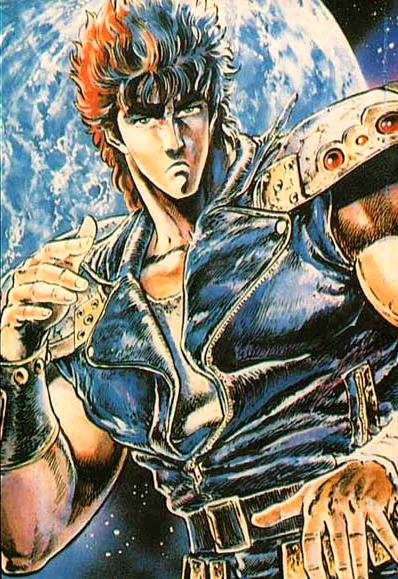
北斗の拳AKAFist Of The North Star is a Japanese manga series written by Buronson and illustrated by Tetsuo Hara. Serialized in Weekly Shōnen Jump from 1983 to 1988, the 245 chapters were initially collected in 27 tankōbon volumes by Shueisha. Fist of the North Star was adapted into two anime television series produced by Toei Animation, which together aired on Fuji TV and its affiliates from 1984 through 1988, comprising a combined total of 152 episodes. It has since expanded into a media franchise, including several anime films, an American live-action film, OVAs, video games, and a series of spin-offs centering on other characters from the original story. It also has a number of video games and pachinko machines produced by Sega Sammy. As of this year, Fist of the North Star is one of the top twenty highest-grossing media franchises of all time, estimated to have generated more than $20 billion in total franchise revenue.
The original manga was published in English by Viz Communications as a monthly comic book, and later by Gutsoon! Entertainment as a series of colorized graphic novels, although neither translation was completed. English adaptations of other Fist of the North Star media have been licensed to other companies, including the TV series and the 1986 film.
Manga to the left, Anime to the right.
Best Anime quote of all time.
Background.
Hokuto no Ken was first adapted into a weekly anime series by Toei Animation. The series aired on Fuji Television from October 11, 1984 to March 5, 1987, lasting 109 episodes. It was immediately followed by a sequel series, titled Hokuto no Ken 2,
which aired from March 13, 1987 to February 18, 1988, lasting for 43
additional episodes (a combined total of 152 episodes between both
series).The full series was never released on VHS
in Japan, although three hour-long compilation movies were produced by
Toei Video covering the first, second and fourth story arcs in that
order. On July 24, 2002, Universal Music released a Region 2 DVD box set containing all 152 episodes spread across 26 discs. These discs were later released as individual volumes from May 21, 2003 through January 21, 2004. Three "best of" DVD compilations were also released in 2005, each featuring seven key episodes from the series. On March 28, 2008, Avex
released a 25th anniversary edition box set featuring new video
transfers of all 152 episodes remastered in high definition, once again
spread across 26 discs. This set also features two additional discs of
bonus content (including the aforementioned compilation movies).
This show aired with English subtitles on Nippon Golden Network in the late 1980s. The first 36 episodes of the first series were translated and dubbed by Manga Entertainment
in 1999, although only 24 episodes were released on VHS (spread across
eight tapes). All 36 episodes of the dub version were aired on Showtime Beyond in the United States and on Sci-Fi Channel in the United Kingdom, and were later released on DVD in 2003 (spread across six individual volumes). In 2008, the US subsidiary of Toei Animation produced an official subtitle-only translation of all 152 episodes, which were released on various paid download and streaming websites available only for North American customers. Discotek Media announced on October 2, 2009 that they have licensed the entire Fist of the North Star TV series.
The first two boxsets were released in that year, and the latter two in
2011. The episodes use the same transfers from the 2008 DVD box set in
Japan, although it did not contain any of the special features. The
first set featured the first 36 episodes along with Manga
Entertainment's English dub, and a Japanese audio option with English
subtitles; these subtitles were adjusted from the translation of Toei's
streaming episodes. Discotek later released all discs from all four
boxsets (a total of 21 discs) together in one set, Fist of the North Star: The Series - The Complete Series Collection, on March 25, 2014. They were released on a Standard Definition Blu Ray set (with a total of 3 discs) with the same name on October 31, 2017.
Rey.
Toki.
Review.
What can be said that hasn't been said before about one of the most important franchises to ever come out of the Japanese industry? The answer: Not enough.
109 episodes of manliness, an OVA claiming to be the most violent ever, a second series, more OVAs, a movie made in the USA (yes, you read that right), and the list goes on, and on forever. Usually overlooked for its super powered characters, this Animé has a lot more heart and feelings than others that claim to have been made as tearjerkers for stinking otakus hiding in their parents basement. In a nutshell, the world has been turned to shit after the final nuclear assault in 19XX (yes, that's the exact date). The military, the cops and any form of government have been entirely erased from existence. The only reason to go on living, is essentially rebuiliding the planet from scratch, so a lot of abandoned cities and farms have been inhabited by the survivors who strive to find water and seeds to grow their food and well, survive! However, there's one motherfucking catch: Since the resources are so limited, every town has been enslaved by powerful sons of bitches who don't give a shit about how many children, men and women they have to rape, torture and murder in order to build their newfound kingdoms of ultraviolence. And that's pretty much the setting to the first story arc. Kenshiro, a mysterious loner who is the heir of the hokuto shin ken martial art, happens to be walking by, until his mission (to recover his girlfriend Yuria from the hands of his motherfucker brother Shin) is delayed due to a bunch of fucktards abusing the innocent. Kenshiro will not take your shit. He's a man of good feelings, and wants the world to be the peaceful place people deserve. In his world, scumbags have no place.
Fuck you scumbag!
Talk to my fist!
Contrary to popular belief, Kenshiro is not a violent man. In fact, he always gives his enemies the chance to quit their evil ways and leave in peace. Obviously, our hero is exceptional to this world of brutality, so even when they know they don't stand a chance against him, thugs won't surrender, and so the legend of the fist of the North star is born.
Like most Animé from the early 80's, the episodes are organized in "story arcs" that usually last from 10 to 20 episodes. My strong suggestion to newcomers is to endure the first 22 episodes, because once Shin's arc is over the series really becomes interesting, as a set of very interesting characters is added to Kenshiro's life. On the contrary, if you've only seen the first story arc, you may be disappointed to find out that THAT story arc is the least interesting out of the whole series. And that's a big problem for FOTNS' reputation, since many reviewers have only seen the first story arc and based their opinions only on that single portion of the series. Others have stated that the Animé is based upon the 1986 animated movie, and that the entire series is from the 1990's plus and unsatisfying finale (based on the limited amount of episodes available back then, not today, and certainly not yesterday). So, whenever you want to check the quality of an Animé/OVA you should definitely try it yourself first as the internet is filled with wrong information. Especially, when it comes to old series like today's Animé in review.
Revelations.
Lin & Bat. Kenshiro's protegees.
Moving on to the main characters, the following paragraphs can be of help: Kenshiro: The hero of the series. Heart of gold. Doesn't like violence. Likes children, women, hardworking men. Hates thugs, bullies and injustice. His fighting technique is the hokuto shin ken. Bat: Pink haired little fella that becomes Kenshiro's driver during the first story arc. He's a kid with good intentions but too weak to start fighting like our main character does. Lin: The little girl that is rescued by Kenshiro in the first episode. She portrays the lost innocence of the world, and likes flowers. She's not as weak as she seems. In fact, she grows stronger with the cause of freedom and is willing to sacrifice herself for the sake of others. Rei: Kenshiro's coolest brother. His technique is a visual spectacle as he fucking chops the shit out of his enemies mercilessly. He's a good man and sees there's good in Kenshiro so he joins him on his quest for peace and justice. His fighting technique is the nanto suicho ken. Toki: He's the second of the four Hokuto brothers. He is a pacifist who seeks to
use Hokuto Shinken as a healing art. Toki's self-made technique, Hokuto Ujoken,
is an art that is capable of healing or destroying that which it is
used on. When fatally wounded with this style, the victim experiences
feelings of euphoria and compassion, instead of horrific pain. He
sustained severe Radiation sickness
while protecting Kenshiro, Yuria and a large group of children. His
illness precluded him from becoming the Hokuto Shinken successor and
remained with him for the rest of his life.
Mamiya: She's a female village leader who bears resemblance to Kenshiro's fiancée,
Yuria. She has limited skill in the martial arts, and uses weapons such
as bladed yo-yos, bow and arrows, and emeici
in combat. In the past, Yuda slaughtered Mamiya's parents and kidnapped
her with the intent to make her his concubine, branding her with the
"UD" mark on her back. She eventually managed to escape, and in her
humiliation, renounced her womanhood and became a warrior. Mamiya
recruits Ken and Rei as guardians of her village and later accompanies
the two for several arcs of the story.
Family portrait.
Powerful men & woman.
Plot wise, the 109 episodes are divided into four untitled story arcs:
First Story Arc (episodes 1-22)This part of the series focuses on the introduction of Kenshiro and his
meeting with two orphans, Bat and Lin, who follow him throughout the
series. It follows Ken's journey to save his fiancée, Yuria, who was
kidnapped by his old rival Shin who calls himself "King". He fights the
top lieutenants in Shin's empire in order to find his whereabouts.
Kenshiro then goes to Shin's capital city of Southern Cross, leading to
his final battle against Shin in an attempt to save Yuria.
Second Story Arc (episodes 23-57)This part features Kenshiro's encounter with Rei, their developing
friendship and Rei's relationship with Mamiya. It also introduces
Kenshiro's fellow Hokuto brothers, Jagi, Toki and Raoh.
Third Story Arc (episodes 58-82)This part follows Kenshiro as he tracks down his surviving Hokuto
Shinken brothers-at-arms: Shu, a selfless man who once saved the young
Kenshiro; Toki, who has dedicated his life to healing; Souther, the
self-proclaimed Holy Emperor of Nanto.
Fourth Story Arc (episodes 83- 109) which chronicles the actions of Kenshiro and the South Dipper Five Chariot
Stars in their efforts to protect Yuria, the Last General of Nanto and
prevent Raoh (Ken-Oh) becoming the ruler of the post-apocalyptic world.
Kick some seeds pal!
As long as it works.
The visuals, which I've read online to be "dated" are nothing but spectacular. From characters, to backgrounds, to vehicles to fight scenes, everything is fantastic and respectful of the Manga. Even at moments where Kenshiro cries, you see he's uber manly in doing so. On the other hand, the fighting techniques and the hundreds of deaths look really cool too. Exploding heads, torsos, twisted hands, and massive bleeding add a lot of spices to the spectacle. Besides, the hair styles are also quite cool. The overall character & vehicle design goes in line with some of the Cyberpunk style other Animé and films have mastered.
Music wise, fuck! this series features one of the best opening songs of all time! "Ai wo Torimodose!!" by Crystal King (eps 1-82) the hard rocking guitars would make Iron Maiden jealous! Not to mention the accurate lyrics that sum up the entire series in one song. "Silent Survivor" by Kodomo Band (eps 83-109) is the second opening song in a more eightish pop rock fashion than the earlier but also, super cool, and manly because this show is all about being manly.Still, it's kinda hard to let go of "You wa shock!" after 82 episodes. "Yuria... Eien ni" by Crystal King (eps 1-82) and "Dry Your Tears" by Kodomo Band (eps 83-109) are the fantastic ending theme songs.
Awesome manly art.
You are already dead!
Another satisfactory feature this Animé has is how bad guys are finished. 100% of them are killed in the most violent, gruesome and cool looking ways. Fist of the North Star is not a show where bad guys go to jail or face a sentence. They're beyond saving, so death by martial arts is the only way. Obviously, What makes this show great is the fighting. Ken normally goes up against
a group of people that think they are tough and then get killed in one
hit. Which is funny and badass, but makes for quick fights. Another
great part is comedy/badassness. Ken hits someone, and they think its
nothing. Ken says they are already dead. Then they die. Other parts are
when he'll hit them and tell them they have a few seconds to live. Then a
counter will pop up. Or when he tells them they are not worthy of
knowing his name. Then there is when he does a rapid fire kick or punch
and goes "a ta ta ta ta ta ta ta!". Eventually you might find yourself
doing it with him. One great part was when a bad guy thought he knew
Hokuto. He went up to Ken and hit him. Ken stood there said he was dead
in a few seconds. The bad guy counted off then died. It isn't limited to
Ken everyone else kills just as quick. There has never been a character
as awesome as Kenshiro and their probably never will. In addition, all characters are actual adults (save for Bat & Lin) so for people that are sick and tired of teenage characters playing adult roles, this is the Animé you're looking for. As a matter of fact, the Manga is sold with the "adults only" warning. In FOTNS you won't find any of that stupid teenage shy love that is resolved by the final episode, or any kind of over sexualization of underage characters, which is usual in most recent Animé.
Kenshiro sports a beard in the film version.
And there's actual red colored blood in there too.
Overall, Hokuto No Ken is so badass it makes your beard sprout biceps it's like
Dragonball Z, Jojo's bizarre adventure, and One Punch Man before those
even existed. The Mad Max setting, you know, the Australian films from 1979 & 1981, only adds to the coolness factor along
with very badass villain designs like Raoh or Jagi if you wanna watch Manimé watch the one that started it all, the archetype that brought you Jo Jo's Bizarre Adventure, Berzerk & Toriko. Moreover, I really recommend reading the Manga because it's simply magnificent. There's a recent "Ultimate Edition" (available in many languages) that is printed in high quality paper featuring some colored pages and extra info to read on each of the 18 volumes from such collection.
Be warned though, if you watch this Animé you may end up being a manlier man. Please! do not watch with your girlfriend, as it's highly likely Kenshiro will steal your girl and make you look like a weak crybaby. Last but not least, let's take a look at our video section for this month's Manly review:
Here's opening 1: Here's opening 2: Here's ending 1: Here's ending 2: Cristal King playing "Ai Wo Torimodose" Live! Kodomo Band's original "Silent Survivor" videoclip: Cristal King "Yuria...Eien Ni" Live! Fist of the North Star movie trailer: Fist of the North Star movie trailer (Streamline VHS):
Fist of the North Star Japanese movie trailer:
Fist of the North Star's 1995 Live Action Movie trailer: Fist of the North Star Nintendo NES gameplay:
Fist of the North Star 6 Super Famicom gameplay:
Fist of the North Star 7 Super Famicom gameplay:
The Sega Master System videogame: The Sega Mega Drive videogame: Fist of the North Star Playstation 4 videogame trailer: A collection of Japanese TV videogame ads:
The NES/FamiCom videogame TV ad:
The Pachinko slot game TV ad:
Another Pachinko TV ad: The official body wash TV ads: