Showing posts with label TV. Show all posts

Jan 7, 2022

Charlie's Angels

The Blu Ray box cover featuring all the angels.

I have been intending to review Charlie's Angels for years! It's been ages since the last time I wrote about a "retro" TV show. Trying to find the right approach, apply the rules that were the standard in 70s television, and avoid today's political correctness, plus all the social changes the world has undergone since then, had this review in storage, or in full lockdown in my head. 

Obviously, for a show this big, you can find thousands of reviews on it made by professional critics and avid fans. However, only here you can find one made by a neverwas/mighthavebeen reviewer that may see the pros this show still has to offer. You see, most of the information available for the series revolves around being a "jiggle TV show" which is merely a superficial perception that diminishes the good intentions this show had when it was made in 1976.


The original Trio of angels.
 

First of all, the concept of "Jiggle TV" it's very offensive. when people use this term, they mean the show was made exclusively to show "jiggling tits & ass", which is not the case of Charlie's Angels. While it's true the actresses all meet "supermodel" clichéd standards, episodes didn't have money shot scenes accenting their physique for 46 minutes. Actually, behind all the beauty these actresses had, there were stories, and most of them placed the angels as empowered women who faced evil men and beat them in their own game. This is usually overlooked, by most reviews you see about the show. 

Now, I'm not saying my review is the best, I'm just saying I'll try to focus on the pros the show had, so that the very few people still visiting blogs, are encouraged to watch this show one more time or even discover it for the first time. As a matter of fact I'm in the middle of season 4 as I'm typing these words, so my review will feel pretty fresh.

We want you to watch our show.


"Once upon a time, there were three little girls who went to the Police Academy; and they were each assigned very hazardous duties. But I took them away from all that, and now they work for me. My name is Charlie.  "

Charles Townsend.

These are the legendary opening lines that introduce our heroines to the audience on every episode, thus setting the basics of the show. 


The angels team from season 1 to 3.

Charlie's Angels ran for five seasons from 1976 to 1981, delivering a total of 110 episodes. The show has been released on DVD & Blu Ray and it's also available in some streaming platforms plus the usual reruns on TV around the world.

The series portrays the adventures of three female police officers who are rescued from their mundane duties by a mysterious multi millionaire named Charles Townsend, who hires these gorgeous girls as operatives in his new private investigation agency. Charlie's assistant, John Bosley (David Doyle), acts as a liaison with the ladies since the enigmatic Charlie never reveals himself in person. The three beauties, Sabrina Duncan (Kate Jackson), Jill Munroe (Farrah Fawcett), and Kelly Garrett (Jaclyn Smith), frequently go undercover as strippers, models, or whatever during the course of their investigations. When Jill leaves Charlie's agency to pursue an auto racing career, she is replaced by her younger sister, Kris Munroe (Cheryl Ladd). After Sabrina departs to start a family, she in turn is replaced by Julie and later by Tiffany Welles (Tanya Roberts).
 
Strong women scare weak men away.


From what I gathered through elder relatives and other reviewers, there wasn't a woman watching this show who didn't secretly wish she looked like one of these beautiful, curvaceous ladies. Kate Jackson played Sabrina, the 'smart angel' and often the brains of the operation. The blonde & bubbly Jill was portrayed by Farrah Fawcett and notable mainly for her hairstyle, which spawned a popular new look in the late 1970's. Kelly, the truly pretty & sweet one and the only angel permanent to the series, was played by the lovely Jacklyn Smith. Cheryl Ladd (who went on to do some pleasant little Danielle Steele TV movies) was cast as the perky and charming young rookie, Kris, my personal favorite, and then there is Julie, a street smart but classy New Yorker with an Ivy League education, played by Shelley Hack, who later starred briefly in another series, Jack and Mike. Finally, the role of the red haired model turned detective, Tiffany (whom I personally saw less of and never quite 'bonded' with), was given to Tanya Roberts.

 
Season 4 Angels with bonus guest star.

 
Some say this series contradicts feminist philosophies, since it isn't really a show whose point is to depict that women can possess beauty, intelligence, and strength...all three. While I can understand that sex appeal may or may not be a "skill" the angels use to solve their cases, I can say that we shouldn't be too harsh on Charlie's Angels. The film & TV industry, even today, is always looking for the best looking actors (male & female) to tell their stories. Beauty is clearly a stereotype linked to success, wealth and ultimately a happier life. Red Hot Chili Peppers' Californication verse "It's understood that Hollywood sells Californication" here makes perfect sense. It's fiction we're seeing, not reality, and let's face it, the film industry beauty standards haven't changed that much since the 70s. Charlie's Angels was neither a softcore TV show nor a straight forward porn series, so that "jiggle TV" tag will not be discussed here any longer. On the other hand, standards in beauty have diversified since then. We no longer have the Caucasian look as the definition of ultimate beauty. While it's true the Angels always wear beautiful designer fashions and however harrowing their circumstances, their make up never smudges, a nail never breaks, nor a single hair stray out of place, the stories are not about how nice they look wearing whatever they're wearing. The stories are indeed about dealing with crime, and 90% of the time they're fighting against evil men, and as above mentioned, beating them in their own game.

Some claim that Charlie's Angels does support the feminist cause because our P.I. ladies are single, smart, independent, capable, and mutually supportive. They don't wait around for a man to rescue them when danger befalls, but instead depend upon each other. And that's the point a lot of reviewers tend to forget about the show. They only focus their attention on the beauty of the actresses instead of seeing what the show was really about. Besides, like I said before, this is a show made in the 70s. Standards were different than today's, we can't crucify producers and writers for what they did then.
 
 
Season 5 Angels.

 
According to Women & HollywoodOn the top 100 grossing films of 2019, women represented:
  • 10.7% of directors
  • 19.4% of writers
  • 24.3% of producers
  • 70.4% of casting directors.

So even though we're decades ahead of the 70s, the industry hasn't changed that much regarding women inclusion, even though the ladies account for a 50% of moviegoers. A sexist shame that still permeates the world. We need more Wonder Women and less Supermen.
 
All that being said, Charlie's Angels is a generally fun & entertaining show to watch. There's mystery, assorted engaging adventures, occasional exotic locales, and an effective chemistry of friendship & co-operation between these female private investigators. Moreover, all the 70s clichés can be seen here. Rollerskating, eccentric wealthy people, drugs, prostitution, muscle cars, fashion,  etc. 
 
Men won't harm the world anymore.


Now let's take a look at some of the things you probably didn't know (or didn't care) about Charlie's Angels:

-Kelly Garrett ( Jaclyn Smith ) was the only Angel to last the entire series. Between season 1 and 2, Jaclyn appeared to have had a bit work done, albeit subtle-looking yet forevermore drastically altering her (still beautiful) face: Kelly's eyes were big and round in S1, whereas they are, all of a sudden, much smaller and almond-shaped in S2. This is achieved via a mini brow lift. A shorter haircut for Kelly helped to further conceal the puzzling changes to her appearance but, whereas she obviously looked youthful and juvenile in season 1, her face, all-of-a sudden, became way more mature and "sophisticated" just a mere couple months later, in S2.  
 
-John Forsythe was called in at the last minute to voice Charlie, when the original actor (Gig Young) who had been cast turned out to have a drinking problem. Producer Aaron Spelling called Forsythe past midnight on a Friday, and begged him to come to the studio immediately, as the pilot was to be broadcast after the weekend. Forsythe ended up recording his first voice-over in his pajamas.  
 
Frenemies.
 

-The Angels all drove Ford automobiles. Jill, and later Kris, drove a Cobra, Kelly drove a Mustang, and Sabrina drove a Pinto. For the record, Bosley drove a Thunderbird. 
 
-When Farrah Fawcett left the series, her absence was explained by having her character Jill become a professional racing driver on the Grand Prix circuit in Europe. Kate Jackson's absence was explained by having Sabrina getting married and starting a family.  
 
-Drew Barrymore owns the screen rights to the series. 
 
Dress for the job you want.
 

-On her first day at the studio, Cheryl Ladd wore a specially designed t-shirt with the phrase, "Farrah Fawcett Minor" as her way of breaking the ice of replacing Farrah Fawcett-Majors.
 
-When Farrah Fawcett left the series, this began a series of lawsuits, in which the producers sued her over breach of contract. However, the suits ended, when Fawcett agreed to make a total of six guest appearances the following two seasons, so she would be let go.  
 
80s Fashion on season 5.
 

-Jill, Kelly, and Sabrina were all former members of the Los Angeles Police Department. Kris worked for the San Francisco police, and Tiffany was with the Boston police. The only Angel who was never a cop was Julie, who was originally a model. 
 
-The house used as the filming location for the Charles Townsend Private Investigations office façade address is: 189 N. Robertson Blvd., Beverly Hills, CA 90211.  
 
Everyone's favorite Angel.

 
-Kate Jackson was the only Angel to receive an Emmy nomination. In fact, she was nominated two consecutive years, but never won. 
Kate Jackson (Sabrina Duncan) is the only Angel who never wore a bikini or swimsuit in the series.  
 
-This show was in the top ten for its first two seasons: 1976 to 1977 number five, 1977 to 1978 number four, competing in a three way tie with "60 Minutes (1968)" and "All in the Family (1971)." After season three when Kate Jackson was fired, the audience tired of the annual cast changed and ratings dwindled. 
 
Season 2 kicked ass.
 

-Shelley Hack's absence was explained as a result of her character Tiffany Welles' decision to move to the East Coast.  
 
-When the show first started both Farrah Fawcett and Jacklyn Smith were paid $5000 an episode, due to their limited experience as actresses, while the more experienced Kate Jackson was payed $10,000 an episode. Eventually as time went on Smith, who stayed with the show for all five seasons, salary grew so that by the fifth season she was making $75,000 an episode making her one of televisions highest paid stars. In fact only four other stars made more money than Smith that being Carroll O' Connor, Alan Alda, Larry Hagman, and Linda Gray. 

Now let's get into our classic video section:


Season 1 opening:


Season 2 opening:


Season 3 opening:


Season 4 opening:


Season 5 opening:


Sep 12, 2020

The Avengers (TV Series)

R.I.P. Dame Diana Rigg.


I'm really sad to publish this review this late. I'd been planning it for months. Unfortunately, this week I was devastated by the terrible news: Dame Diana Rigg, dead at 82...

Emma Peel is one of the earliest memories I have of seeing an empowered woman do justice by herself with a tremendously avant-garde set of skills. Not that anyone cares but, Today,  I'm a 38 years old man, I wasn't even born when the show originally aired, so thanks to the 80s  frequent reruns of old TV shows,I got to meet one of the most important female characters of all time. 

*Bare in mind, today's review is about The Avengers Seasons 4, 5, & 6. The seasons that had an official international release (over 90 countries) and coincidentally, the seasons that featured Dame Diana Rigg's character.


"But aren't The Avengers*  the blockbuster superhero films?"

No. The Avengers we're talking about today, is a British espionage television programme created in 1961. It initially focused on Dr. David Keel (Ian Hendry), aided by John Steed (Patrick Macnee). Hendry left after the first series; Steed then became the main character, partnered with a succession of assistants. His most famous assistants were intelligent, stylish and assertive women: Cathy Gale (Honor Blackman), Emma Peel (Diana Rigg), and Tara King (Linda Thorson). The series ran from 1961 until 1969, screening as 46 minute episodes for its entire run. The pilot episode, "Hot Snow", aired on 7 January 1961. The final episode, "Bizarre", aired on 21 April 1969 in the United States, and on 21 May 1969 in the United Kingdom. The Avengers was produced by ABC Television, a contractor within the ITV network. After a merger with Rediffusion London in July 1968, ABC Television became Thames Television, which continued production of the series, though it was still broadcast under the ABC name. By 1969, The Avengers was shown in more than 90 countries. ITV produced a sequel series, The New Avengers (1976–1977), with Patrick Macnee returning as John Steed, and two new partners. In 2004 and 2007, The Avengers was ranked No. 17 and No. 20 on TV Guide's Top Cult Shows Ever.


Mrs. Peel & Mr. Steed.


Spies with class.

Background.

The show was sold to the American Broadcasting Company (ABC) in 1965, and The Avengers became one of the first British series to be aired on prime-time US television. The ABC network paid the then-unheard-of sum of $2 million for the first 26 episodes. The average budget for each episode was reportedly £56,000, which was high for the British industry. The fourth series aired in the US from March to the beginning of September 1966.

The US deal meant that the producers could afford to start shooting the series on 35mm film. The use of film, rather than the videotape of the earlier episodes, was essential, because British 405-line video was technically incompatible with the US NTSC videotape format. Filmed productions were standard on US prime-time television at the time. The Avengers continued to be produced in black and white.

The transfer to film meant that episodes would be shot using the single-camera setup, giving the production greater flexibility. The use of film production and the single-camera production style allowed more sophisticated visuals and camera angles, and more outdoor location shots, all of which greatly improved the look of the series. As was standard on British television filmed production through the 1960s, all location work on Series 4 was shot mute, with the soundtrack created in post-production. Dialogue scenes were filmed in the studio, leading to some jumps between location and studio footage.


Mrs. Peel Lotus.


Mr. Steed mighty steed.

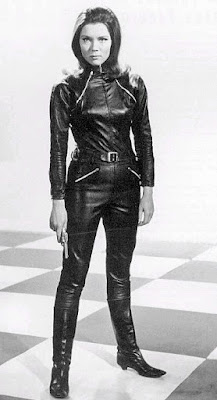
New female partner Mrs. Emma Peel (Dame Diana Rigg) debuted in October 1965. The name of the character derived from a comment by writers, during development, that they wanted a character with "man appeal". In an early attempt to incorporate this concept into the character's name, she was called "Samantha Peel", shortened to the awkward "Mantha Peel". Eventually, the writers began referring to the idea by the verbal shorthand "M. Appeal", which gave rise to the character's ultimate name. Emma Peel, whose husband went missing while flying over the Amazon, retained the self-assuredness of Gale, combined with superior fighting skills, intelligence and a contemporary fashion sense.

After more than 60 actresses had been auditioned, the first choice to play the role was Elizabeth Shepherd. However, after filming one and a half episodes (the pilot, "The Town of No Return", and part of "The Murder Market"), Shepherd was released. Her on-screen personality was deemed less interesting than that of Blackman's Gale, and it was decided that she was not right for the role. Another 20 actresses were auditioned before the show's casting director, Dodo Watts, suggested that producers Brian Clemens and Albert Fennell check out a televised drama featuring the relatively unknown Rigg (she had earlier guested in an episode of The Sentimental Agent that Clemens had written). Rigg's screen test with Macnee showed that the two immediately worked well together.

A prologue was added to the beginning of all the fourth-series episodes for the American broadcasts. This was to clarify some initial confusion audiences had regarding the characters and their mission. In the opener, a waiter holding a champagne bottle falls dead onto a human-sized chessboard, a dagger protruding from a target on his back. Steed and Mrs. Peel (dressed in her trademark leather catsuit) walk up to the body as the voice-over explains: "Extraordinary crimes against the people, and the state, have to be avenged by agents extraordinary. Two such people are John Steed, top professional, and his partner Emma Peel, talented amateur. Otherwise known as The Avengers." During this voice-over, Steed pours two drinks from the wine bottle and Mrs. Peel replaces her gun in her boot. They clink glasses and depart together as the screen fades to black and the opening titles begin. 


Empowered woman.


Yet very delicate.

Review. 

Dame Diana Rigg said in a 2015 interview "Emma Peel was avant-garde". However, she acknowledged, this was the result of mere causality since none of the producers, writers and people involved in the series production thought "ahead of their time". Implying the industry was at its most sexist (she was under payed. Camera men made more than She did!) back then, this product of causality empowered millions of women that saw themselves reflected in Emma Peel's impressive skills. As a matter of fact, I think that's what made the character remain in everyone's hearts for decades to come.

Although Patrick Mcnee was brilliant as John Steed, the masculine secret agent wasn't an original idea, even by the time the series originally aired. On the other hand, Emma Peel was nowhere near a damsel in distress. She knew Kung-fu, Judo, she was an expert in sciences, quick-witted and never, ever had to answer to a man. She drove her own sports car, had a wardrobe that established new standards in fashion, could easily use any weapon at hand, and didn't exploit her physique to get whatever she wanted. She was the archetype of feminine empowerment and, I, a stinky greasy unworthy male, could see that even when I was a small kid. The industry needs more Emma Peels and less [insert whatever name you can think of here].

Now, the combined talents of McNee & Rigg provided our screen with one of the finest couples ever seen on TV, and it shows. They were so good together, producers allowed to improvise their lines and even write their own dialogs whenever they came across a dead body, and boy did they come across dead bodies throughout the 51 episodes they partnered together.

World famous Emmapeelers.


Ready for action!

Setting aside the above mentioned talent of their protagonists, The Avengers was indeed a marvelous series where genre variety played a key role establishing the show as one of the greatest of all time. Besides the relatively obvious espionage episodes full of Soviet spies and her Majesty's traitors, there were cyborgs, mad scientists, horror stories, Aliens, secret societies, absurd yet terribly dangerous characters, corruption, frame-ups, blackmail, eccentric murderers, feminist killers, butlers, Arabian princes, state-of -the-art  weapons, food poisoning, high tech murdering houses, and amongst all of that 19 gallons of Champagne!

After Rigg decided it was her time to move on from the series, "because She didn't want to play the part forever". She became the only Bond girl to actually marry the fictional character in "On Her Majesty's Secret Service".  She also continued to work in plays (she acted in 38 plays from 1957 to 2018), 51 TV series (including The Avengers & Game Of Thrones), and 18 movies. The Black Narcisus series will be released posthumously this year, as well as the Last Night In Soho film set to release next year. 

Patrick McNee died in 2015. Legend has it they remained friends long after the series was cancelled. 


The Avengers Trivia


  • Emma Peel's name was taken from the British movie industry expression "M-Appeal", or "man-appeal", which is what the show's producers were looking for in her character. Something that makes total sense considering Dame Diana Rigg said producers made her characer avant-garde by  causality.
  • During her first season, Dame Diana Rigg was dismayed to find out that the cameraman was being paid more than she was. She demanded a raise, to put her more on a par with her co-star, or she would leave the show. The producers gave in, thanks to the show's great popularity in the U.S. 
  • Series writer Brian Clemens noted in an interview the sexual chemistry that particularly existed between Steed and Emma Peel, and the common question of "Will they ever go to bed together?" Clemens' attitude toward the characters was that they already had done, and this was the next day. Patrick Macnee and Dame Diana Rigg confirmed later in interviews that they had decided their characters had a casual sexual relationship, "but just didn't dwell on it."  
  • The look and character of Steed is an amalgam of Patrick Macnee's father (a racehorse trainer and dandy), fictional character The Scarlet Pimpernel, and Macnee's commanding officer in the Navy. 
  • At least two principal actresses and one principal actor in this show appeared in James Bond movies: Honor Blackman as Pussy Galore in Goldfinger (1964), Dame Diana Rigg (Contessa Teresa "Tracy" Di Vicenzo Bond) in On Her Majesty's Secret Service (1969), and Patrick Macnee as Sir Godfrey Tibbett in A View to a Kill (1985).
  • Dame Diana Rigg was the first person ever to do Kung Fu on-screen. In 1965, Ray Austin went to his producers and said, "Listen, I want to do this thing called Kung Fu." They said "Kung what?" and insisted that Emma, like her predecessor, stick to judo. Instead, Austin secretly taught Rigg Kung Fu. 
  • Mrs. Peel's maiden name is Knight. We learn more about her childhood and her relationship with her mother and father in an exhibition on the "late Emma Peel" in season four, episode twenty-three, "The House That Jack Built".  
  • According to Patrick Macnee in his book "The Avengers and Me", Dame Diana Rigg disliked wearing leather and insisted on a new line of fabric athletic wear for the fifth season. Alun Hughes, who had designed clothing for her personal wardrobe, was suggested by Dame Diana to design Emma Peel's "softer" new wardrobe. Pierre Cardin was brought in to design a new wardrobe for Macnee. 
  • Emma Peel's revolver is a gold-plated, pearl-handled pocket version of the Webley Mk IV chambered for .380/200 (a.k.a. .38 Smith & Wesson).  
  • Dame Diana Rigg auditioned for the role of Emma Peel on a whim, without ever having seen this show. 
  • This show was the first British television show sold to an American network.
  • "The Avengers" became ground-breaking for introducing regular female characters who were portrayed as being just as tough, brave, and tenacious as men.

You don't mess with Mrs. Peel.


Style.
 

Now the influence The Avengers had, and especially Emma Peel's influence inspired several artists to write songs about her. Sit back, and chillax to the following songs.


The Pretenders "Don't Get Me Wrong"


The Cretones "Hey Mrs. Peel"


The Allies "Emma Peel"

Dishwalla "Miss Emma Peel"


Matmatah "Emma".


Slot "Emma Peel"


Sadly, the songs by Pussy Galore, Shark Inferno and Babette Novak didn't have an available video at the time this post was made.

Overall, the three seasons featuring the great Emma Peel, are The Avengers at their best. If you still haven't given them a try, do so now. You won't  regret it.


Last but not least, our classic opening and ending section:


Season 4 Opening & Ending.


Season 5 opening.


Season 6 opening.


Dame Diana Rigg, may you rest in peace...

Sep 24, 2018

the Adventures of Superman

Faster than a speeding bullet!
Henry Cavill still is Superman in the hit and miss DC cinematic universe today known as "DC Worlds". However, like me, Cavill wasn't even born when one of the most beloved iterations of  the Man of Steel took place 66 years ago.

George Reeves was the first Superman people fell in love with. Also, he remains one of the biggest Hollywood mysteries of all time. Fasten your seat-belts because we're about to travel back in time to believe a man can fly in black & white.

"The Adventures of Superman" was, in the 1950s, the ultimate adventure show for kids, a series that transcended low budgets, often laughably bad scripts, and a torturous shooting schedule each season to become a genuine 'TV Classic'. Next to "I Love Lucy", the series is, perhaps, the most frequently rerun of any show of that decade; in shooting several seasons in color, it was a major trend setter (particularly as there were VERY few color televisions at the time); as a show that was syndicated, and not owned by a network (Kellogg's Cereal sponsored and financed the program) it paved the way for all the syndicated programs that followed. It's place in television history cannot be denied, and it's story is complete with drama, success, and tragedy, and a hero whose life and strange death still fuels controversy, to this day. 

Lois & Clark.
Lois & Superman.

Superman, DC Comics' high-flying hero, had already achieved success on radio, in animated short films, and in two movie serials, when a low-budget feature film, SUPERMAN AND THE MOLE MEN, paved the way for the television series. The film replaced serial star Kirk Alyn with brawnier, square-jawed George Reeves, a youthful 37-year old whose promising film career had been derailed by WWII. He was joined by Phyllis Coates, replacing the serials' Noel Neill as ace reporter Lois Lane, and the pair made the transition to television, joined by 19-year old Jack Larson, as photographer/cub reporter Jimmy Olsen, and veteran character actor John Hamilton as editor Perry White. Helmed initially by veteran producer Robert Maxwell, the series utilized the same 'assembly line' formula of the movie serials*, shooting multiple episodes at one time (which was why the cast always wore the same outfits), relying on action-heavy scripts heavy with Gothic atmosphere, and creating 'master' FX shots that were reused constantly, keeping the budget within acceptable limits. (While the 'flying' shots have been the object of humor over the years, the use of wires and a 'flying pan' in front of a rear projection provided the most realistic 'look' yet achieved, and the technique would still be in practice when SUPERMAN RETURNS was filmed, 55 years later.) Reeves' 'Man of Steel' was a street brawler, unafraid to duke it out with villains, and his 'Clark Kent' was every bit as no-nonsense as his 'Superman'. The program was actually quite adult, for a comic book adaptation, and the first season episodes are considered the best of the series.

Serial*

A "serial" is usually a fictional story, which is divided into parts and comes every day or every week on TV. The story is continuing in nature meaning today's episode is a continuation of what happened yesterday.
A series, unlike a serial, need not always be based on a work of fiction. The programmes that we see on the National Geographic Channel or the Discovery Channel can be thought of being as part of a series. For example, sometimes for an entire week, there may be programmes on sharks. All the programmes form part of a series about sharks. When you think of a series you are thinking of a set of related programmes. You may for example have a programme on lions, tigers, leopards, etc under the title "carnivores". It is also possible to have a series that is based on fiction. But in the case of a series, each programme is usually self-contained. In other words each episode has a beginning, middle and an end and the story from one episode does not usually carry over to the next. For example, Martial Law, NYPD Blue, and Friends are all examples of series.

Source: The Hindu Jan 8,2002


When Phyllis Coates left the show, in 1953 (believing it would not be renewed, she signed for other film work), Noel Neill returned, softening the character of Lois Lane, but participating in some of the series' greatest episodes, including the most popular episode ever filmed, "Panic in the Sky", where Superman attacks an asteroid 'head-on', resulting in amnesia and near doom for Earth. By now, the 'wired' take-offs of Superman were replaced by vaulting off a springboard (after Reeves had barely escaped serious injury after dropping over ten feet when the 'liftoff' wires broke).

Not on my watch!
Freedom to all sentient beings.

When Whitney Ellsworth took over production duties for the series, pressure from Kellogg's (due to the show's tremendous popularity, and investigations into the detrimental effect of violence on children) to tone down the mayhem resulted in episodes becoming increasingly silly and far-fetched. As this coincided with the series' move to color, the marked difference is clearly evident. The color episodes (particularly in the last two seasons) are, by-in-large, held in far less regard than the black and white ones.

By the series' final season, George Reeves would look chubby, and far older than his 43 years, Noel Neill would sport flaming red hair, and the episodes, shot on a very tight budget, were nearly unwatchable (other than the series' finale, "The Trials of Superman", directed by Reeves, where the cast are all placed in "Perils of Pauline"-style catastrophes).

"Hey Clark, my parents aren't home".
"Here I go Lois!"
While Larson and Neill would move on to other projects, and John Hamilton soon passed away, George Reeves found himself type-cast as Superman, with his career considered to be at a standstill. The assumption that depression resulted in his committing suicide in 1959, at 45, has, however, been the subject of debate for over 40 years. It turns out that Kellogg's was prepared to finance a new season of "Superman", that Reeves had several upcoming directing opportunities, he was about to be married, and that on the night of his death, he was in excellent spirits. There is a growing belief that his 'suicide' was actually murder, by a 'hit man' hired by either by his ex-girlfriend, or her jealous husband. While the truth may never be known, the news of his death devastated a generation of children, who truly believed he WAS Superman.

While Christopher Reeve it's my generation's ultimate Superman (you know those 30 & 40 something year old fans) and Henry Cavill may be today's "Man of Steel", and Dean Cain and Tom Welling have their fans, George Reeves, and "The Adventures of Superman", carry on a legacy that will never fade away. Each year introduces new fans to the series, and reminds us television isn't about sophisticated plots & special effects but, about the magic of make believe.

The many faces of good.
Yes, Jimmy, real muscles!
 Now let's move on to the trivia section on The Adventures of Superman:

  • After George Reeves' death, producers considered continuing the series with Jimmy Olsen becoming the main character and including stock footage of Reeves as Superman. Jack Larson, however, rejected the idea.  
  • When the series was filmed in black and white during its first two seasons, George Reeves wore a brown for red, gray for blue and white for yellow costume. When the show began filming in color in 1954, he switched to the trademark red and blue suit.  

  • It is now common knowledge that Clark Kent's Earth parents were named Jonathan and Martha. However, in the first episode, Adventures of Superman: Superman on Earth (1952), Kent's parents were named Eben and Sarah. This is because the comics themselves were inconsistent with the Kents' given names until the characters became major players in "Superboy" comics stories at about this same time. The names Sarah and Eben were first used in the novel "The Adventures of Superman" (1942) and in the first Superman serial. 
  • In the early seasons wire work was used to create some of the flying scenes. During the course of this work there had been some minor mishaps, but on one occasion the support wires snapped, causing George Reeves to be dropped to the floor. He refused to do anymore wire work. This is why episodes in the early seasons would show Superman taking off in flight within the frame, but in later seasons he would run toward the camera, hit a springboard hidden below frame and leap out of frame.  

  • George Reeves wanted to quit the series after the third season. Kirk Alyn, who played Superman in the 1940s film serials, was offered the chance to replace Reeves but turned it down. Reeves tried to produce his own series titled "Port of Entry", but when he was not able to secure financing, he returned to "Superman" with an increase in salary. 
  • When the series was picked up by Kellogg's, the breakfast cereal manufacturer, some of the cast members were able to make extra money by appearing in Kellogg's commercials. This did not include Phyllis Coates or Noel Neill. It was felt that Lois Lane having breakfast with Clark Kent was too suggestive.  
  • George Reeves was 38 years old when the series began, making him the oldest actor to have ever played Clark Kent / Superman in live action. 
  • The first 26 episodes were filmed in 1951, but did not appear on television until 1952, when Kellogg's Cereals agreed to sponsor the show.  

  • The series was honored on its 50th anniversary when the Los Angeles County Board of Supervisors proclaimed July 10-16, 2001, as "Superman Week." A proclamation was presented to Paul Levitz of DC Comics in a ceremony that was also attended by Jack Larson, Noel Neill, Mrs. Robert Shayne, Mrs. Jerome Siegel, Robert Rockwell, Jeff Corey and Walter Walbrecht, vice president of Warner Brothers. Season 3, Number 4 was named "Superman Week" honoring the Man of Steel and was first broadcast on 14 May 1955.  


You'll believe a man can fly in a black & white world.
Smile!

Here's season 1 opening:


The color version opening and ending from season 3 on:


a 1990 documentary focusing on the serials and today's review:


E!'s "Mysteries & Scandals":


Geraldo's "Now it can be told":


Apr 12, 2017

Power Rangers

it's morphin' time!

Go go Power what!? It seems that the latest trend in the movie industry is making a live action movie out of sacred items from the 90's. Mighty Morphin' Power Rangers were huge TV stars between 1993-1996. Every kid around the globe wanted a morpher & a zord and to this very day there's a varied line of toys and gadgets based upon the original Power Rangers. 

25 years later comes the unthinkable: a 21st century re imagined live action movie. Directed by Dean Israelite, written by John Gatins & Matt Sazama, and starred by Dacre Montgomery (Jason), Naomi Scott (Kimberly), RJ Cyler (Billy), Ludi Lin (Zack), Becky G. (Trini), Bryan Cranston (Zordon), and Elizabeth Banks (Rita Repulsa) Power Rangers is the updated version of a beloved 90's nostalgia act that will bring curious old school fans & newcomers (kids of course) together in an interesting mix of new & old. 

Zordon.

Five teenagers with attitude.

Now, how does this Power Rangers movie separate itself from the original Saban series? Considering, the source material was targeted at impressible 90's kids & teens there's a whole world of differences, and I personally thank the film producers for that because we're seeing the same superhero film being redone over and over every year, so thanks Mr. Israelite for your clever direction. However, there's still a fair amount of nods to the past. Obviously, the bigger the audience, the bigger the money, so instead of coming up with something entirely new, Power Rangers feels like the right amount of nostalgia & novelty.

What makes this new approach interesting, is the fact that this time we're shown the process you need to undergo in order to become a Power Ranger. The "fetch me five teenagers with attitude" 90's request remains the same, only this time things don't look so bright for our new set of heroes. The film opens with a superb origin storytelling about how the Power Rangers came to be the universe's only hope. Zordon (played by Bryan Cranston from Malcolm & Breaking Bad) is the original Red Ranger, and in what seems to be a treacherous act, we find out Rita Repulsa (masterfully played by Elizabeth Banks) was the original Green Ranger, thus her mostly green colored armor suit. Before things, go to hell, Zordon orders Alpha 5 to search for the new Power Rangers across the universe. 

Rita Repulsa.

Evil beauty.

In the original series the Power Rangers were 5 perfectly healthy and very succesful students from Angel Grove high school. They didn't need to train for anything, they were already very skilled in martial arts, gimnastics, science & team work. Also, they were good friends from day one. On the other hand, the film presents us a very different selection of troubled teenagers which are somehow more real than the earlier incarnation. Teens suffer, teens struggle, and to become a hero, there's a path of hit and miss that makes you grow, so I like that approach.


The Rangers are majorly based on their versions in Mighty Morphin Power Rangers (1993) (Jason, Kimberly, Billy, Zack, Trini), but also draw inspiration from various characters over the "Power Rangers" saga:

  • Red Ranger - Jason Lee Scott is an athlete who suffered a career-ending injury (like the second MMPR Ranger Rocky DeSantos) and has a difficult relationship with his father (like Wesley Collins in Time Force)
  • Pink Ranger - Kimberly Hart is a former diva who did something wrong and wants to make up for it (similar to Summer Landsdown in RPM)
  • Blue Ranger - Billy Cranston is a geeky black kid ( like Ethan James in Dino Thunder and Noah Carver in Power Rangers Megaforce) he's also autistic, hence the color.
  • Black Ranger - Zack Taylor is based on Adam Park
  • Yellow Ranger - Trini Kwan is pretty much an original character but her lesbian condition may somewhat have been inspired by David Yost (the original blue ranger in MMPR) who happened to be gay and had trouble during the series production until he called it quits.

Hi, I'm Alpha 5.

Dude, this new drug is rad!
These new rangers add a more meaningful touch to what it means to be a self awared person. Subjects like bullying, autism, LGBT rights and second chances are a constant in their lives and allow the characters to be more relatable, unlike what happened in the original series with the rangers' perfect lives. What the hell! Even Rita Repulsa's vendetta has meaning behind all the predictable one liners. 

Now, Power Rangers the movie, not only updates character development, the Ranger suits have also been upgraded from bulletproof spandex, to crystal armor, and so are Zords updated to look far more Transformer like (that is Michael Bay Transformers) While I originally hated the new suits/zords I think they're OK for the message the film conveys and after watching it, I changed my mind and totally understood the science behind the new suits. 

Fuck you all!

Superhero pose!
Now as for homage nods, dude, there are a lot of easter eggs throughout the film, here's a list of the few I noticed:

  • The Angel Grove High logo in the film is the same one used in Mighty Morphin Power Rangers (1993).
  • Bryan Cranston, who plays Zordon in the film, previously voiced the monsters Twin Man and Snizzard in Mighty Morphin Power Rangers (1993). Additionally, the first Blue Ranger in this film, Billy Cranston, was named after Cranston himself.
  • In Trini's bedroom, there is a window that features a circle with a tiger's head; this was the Yellow Ranger's original Power Coin design in Mighty Morphin Power Rangers (1993).
  • At one point the Yellow Ranger Trini wears a shirt that reads 1973. This was the year that the original Trini Thuy Trang was born.
  • When Colt Wallace tries to hurt Billy in the school hallway and fails after a unsuccessful headbutt, Billy calls him by the name Skullovich. In Mighty Morphin Power Rangers (1993), one of the bullies the Rangers dealt with in school was named Skull, short for Skullovich.
  • The Rangers having their visors removed was taken from Mighty Morphin Power Rangers: The Movie (1995) (scenes deleted), Power Rangers Lightspeed Rescue (2000) and Power Rangers Ninja Storm (2003).
  • When Goldar is being constructed from the gold, Rita Repulsa ( Elisabeth Banks ) say the infamous line: Make my monster grow.
  • When the Zords charge into battle, the theme song (Go Go Power Rangers written & sung by Ron Wasserman) from Mighty Morphin Power Rangers: The Movie (1995) is heard, and this is clearly the "shut up and take my money" moment of the film. Man! that theme song is rad! I still play it whenever I can!
Goldar is actually made of gold now.

Are you talking to us?
  • The watch that Billy wears is the watch from Mighty Morphin Power Rangers (1993), which Billy made in that show so that the Rangers can communicate with each other/teleport to Zordon.
  • When Trini's brothers question the identity of the Yellow Ranger, they refer to the Yellow Ranger as a "he," to which Trini replies by asking how they know if the Yellow Ranger is a "he." This is likely a reference to the fact that the Yellow Ranger in Zyuranger, the "Super Sentai" series that the original "Power Rangers" show was based on, was actually a male.
  • Throughout the movie, all the Power Rangers wear something (clothes/jewelry) that is their Ranger color.
  • Amy Jo Johnson and Jason David Frank, who were Kimberly and Tommy in Mighty Morphin Power Rangers (1993), have cameo roles in this film as Angel Grove citizens. They are seen wearing their Ranger colors (pink and green) from that show.
  • A mid credits scene depicts a missing Tommy in detention and shows a green jacket, only furthering the nod to having the green ranger in the sequel.
  • When Rita is defeated by the Megazord, she is last seen hurling to the moon and she starts to smile. In Mighty Morphin Power Rangers (1993), Rita has her lair on the moon.
  • When Rita attacks the Rangers in their normal form you can see sparks appear at the spots where they are hit. In Mighty Morphin Power Rangers (1993) any hit, whether it was against the Rangers or the villains, resulted in sparks shooting out.

Overall, Power Rangers is a very entertaining Sci-Fi movie that doesn't take itself too seriously. Despite the original show being campy, this film introduces a new darker world that will clearly be expanded in several sequels. Recommended to old school MMPR fans and to any sci-fi enthusiast. A good film for everyone.

Here's the movie trailer: