
 |
| Can fake be better than real? |
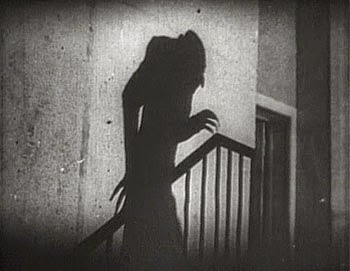
Our previous entry was a long time debt I had with one of the most, if not, the most iconic horror movie character of all times: The great count Dracula, Lugosi's Dracula to be precise. However, as connoisseurs we know there was an even darker take on Bram Stoker's best seller. One with illegal issues and a way more satanic look: Nosferatu! the original silent movie from 1922, cursed to oblivion due to copyright (hey, if Nosferatu was released today, no one would notice it! Today every film seems to be an opportunist counterfeit version of greater films from the past)
Nosferatu must be one of the most elusive films you can watch, elusive because since it was banned for being illegal, most of the original copies were burned down (like a fucking witch) and whatever version you could find, it was obviously not the complete film. Hell! there are editions with completely scene arrangements and even different soundtracks! Luckily, the Kino studio, perhaps one of the leading leaders in film restoration worldwide, did a wonderful research to recover as many film pieces they could find, thus delivering the most complete edition to date of this magnificent piece, that I gotta tell you, it can really scare the shit out of you, just by looking at Count Orlok's evil look.
 |
| The many faces of count Orlok. |
 |
| "I am...Orlok" |
'Nosferatu' opens with a man looking at his reflection in a mirror. Besides
its symbolic significance, this is a perfect distillation of his character,
that of a vain, narcissistic, absurdly self-confident to the point of
machismo, married man largely indifferent to a wife he abruptly leaves to
make the fortune worthy of a man of his merits. He ain't afraid of no
ghosts, nor robbers. So, the image he sees in that mirror is one of
wholeness, perfection - I am Hutter, I command all I see, my unity of
identity is linked to my power in body.
To the viewer, however, the effect is the precise opposite. The framing of the scene is fragmented, with the outer frame, the window and the mirror; Hutter himself is doubled - the 'real' Hutter and his reflection, or shadow. All the assumptions smilingly embodied in Hutter will thus be destroyed in conventional horror terms.
His whole identity will be destroyed - the Count will suck his blood and in effect become him, if we believe the man who claims 'blood is life'. Hutter's body will first become passive, feminised as he is violated by the Count; after, he will no longer be a body, but a shadow, bloodless - literally, he shadows the Count as the latter comes to England; and symbolically, in that two men now claim possession of Hutter's wife, and both have equal claim, both being Hutter.
To the viewer, however, the effect is the precise opposite. The framing of the scene is fragmented, with the outer frame, the window and the mirror; Hutter himself is doubled - the 'real' Hutter and his reflection, or shadow. All the assumptions smilingly embodied in Hutter will thus be destroyed in conventional horror terms.
His whole identity will be destroyed - the Count will suck his blood and in effect become him, if we believe the man who claims 'blood is life'. Hutter's body will first become passive, feminised as he is violated by the Count; after, he will no longer be a body, but a shadow, bloodless - literally, he shadows the Count as the latter comes to England; and symbolically, in that two men now claim possession of Hutter's wife, and both have equal claim, both being Hutter.
 |
| Heard something in the kitchen, better catch up. |
 |
| Bram Stoker is that you in the kitchen? |
Murnau is careful to give his horror story a genuine patina as an
'objective' story: no horror film has come as close to capturing the visual
essence of all those stories that have circulated in Europe for centuries,
the twisting medieval towns, the arcane religious symbolism, the plagues and
mass hysteria, the crumbling castles and storm-tossed ships, the creak of
wood - the look of the film feels like a crumpling manuscript setting out
the story.
But the film is also the portrait of a marriage. The opening sequence chillingly reveals the sterility of a marriage before anyone has even heard of the Count - Hutter wrapped up in himself; Ellen, hypersensitive, morbid, dressed as if in mourning; the union childless; the couple, above all, separate, each completely misunderstanding the other.
The image of the mirror is repeated throughout the film, connecting Hutter to the Count - the scene in Knock's office where Hutter looks at the map of Transylvania just as he did his mirror; the Count's house directly opposite Hutter's, a decaying edifice that looks like a melting, anguished face.
But the film is also the portrait of a marriage. The opening sequence chillingly reveals the sterility of a marriage before anyone has even heard of the Count - Hutter wrapped up in himself; Ellen, hypersensitive, morbid, dressed as if in mourning; the union childless; the couple, above all, separate, each completely misunderstanding the other.
The image of the mirror is repeated throughout the film, connecting Hutter to the Count - the scene in Knock's office where Hutter looks at the map of Transylvania just as he did his mirror; the Count's house directly opposite Hutter's, a decaying edifice that looks like a melting, anguished face.
 |
| Land Ho! |
 |
| Global warming is real! |
But Ellen is linked to the Count too, her somnolent rising mirroring his.
This isn't a conventional opposition between bourgeois and bestial urges,
even though the Count is given the most grotesque animal
features, and even though Murnau never lets us forget the Count as emanation
of the Hutters' dreams, desires and fears - Hutter reads that he will shadow
his dreams; Ellen spends most of the film sleepwalking.
All three elements of this triangle, which symbolizes the one relationship, is linked to death - the Count, the undead, living in coffins of dead earth; Hutter, narcissistic, onanistic, his lifeblood siphoned from him; Ellen, the Venus fly-trap, self-abnegating destroyer of the destroying force. Hutter ends the film as he began, alone, his lust for money and status destroying the union that crowned it. The contrivance of society and respectability is swept away by the malaise of nature, those gendered forests, tides and moons, as if the Count and Ellen are part of the one female nature Hutter cannot accommodate.
All three elements of this triangle, which symbolizes the one relationship, is linked to death - the Count, the undead, living in coffins of dead earth; Hutter, narcissistic, onanistic, his lifeblood siphoned from him; Ellen, the Venus fly-trap, self-abnegating destroyer of the destroying force. Hutter ends the film as he began, alone, his lust for money and status destroying the union that crowned it. The contrivance of society and respectability is swept away by the malaise of nature, those gendered forests, tides and moons, as if the Count and Ellen are part of the one female nature Hutter cannot accommodate.
 |
| Evil picnic. |
Such Freudiana is undermined in the film in two ways - in the disarming
comedy of the piece, the Count often seeming to have strayed from a silent
comedy, running around London with his coffin; and by a self-reflexive
examination of film, that sees the warning about vampires in the book Hutter
reads linked to bestiality and the eye that is so important in the film; the
turning of the film stock into negative as Hutter enters the Count's realm;
the trickery, such as time lapse and fast motion, that shows the Count's
mastery of time and space, but, more importantly, Murnau's mastery over the
storytelling, already indicated by an unseen, but constantly intruding
narrator; even Ellen's couch seems patterned
as strips of film. In a movie where human sexuality is impossible, the
characters seem content to be voyeurs, like the film audience, staving off
the death, the loss of identity, or at least its fragmentation, that contact
with another person entails.
here's the movie trailer:
And here's one of the many Nosferatu versions you can find (it's public domain, so do not worry)


