
 |
| And you thought Batman was campy. |
Now that the second season of Daredevil is out on Netflix (and everywhere thanks to the internet) I felt it was about time I talked about Shazam! yes! you read that right, Shazam! the live action series that run from 1974 to circa 1977 on your local TV station. No, I will also not talk about the Luke Cage teaser trailer from a few days ago, and that is only just because.
In the past, Captain Marvel had already been on screen in a 12 chapter serial produced by Republic in 1941. The series featured stunning special effects for the time, and like other superhero serials that would come later, it held little resemblance with the comic book source (see? this will happen forever, so the "it's not like in the comics" argument it's been fucking with comic book fans minds since the 1940's)
Before we get our hands in the series itself, let's take a look at the past of the Comic book industry, and how this affected Shazam!
 |
| Mentor & Billy driving across America. |
 |
| Billy & his alter ego. |
The fact the Golden Age of Comic Books started with the publication of the now legendary and expensive as fuck
ACTION COMICS No. 1, featuring that out of this world character known as Superman, is pure fact. Created by a pair of former High School
buddies from Cleveland, "The Man of Steel" would prove to be a
veritable overnight success; providing impetus for not only its
publisher, National Comics Publications (aka Detective Comics, Inc. and
ultimately, D.C. Comics), but also energizing the whole comics field
with the desire to bring the public more and more Super-hero characters.
National Comics was responsible for a great portion of the business driven proliferation of those altruistically driven, abnormally endowed with unusual powers and abilities "far beyond those of Mortal Men!" Within a year, DETECTIVE COMICS No. 27 premiered the non-super powered, but highly trained and prowess laden Batman Feature.
From then on, the D.C. dual headed editorial offices gave us The Flash, Green Lantern, The Spectre, Hawkman , The Sandman, Dr. Fate, Hourman, Starman and the inevitable female variation in Wonder Woman.
National Comics was responsible for a great portion of the business driven proliferation of those altruistically driven, abnormally endowed with unusual powers and abilities "far beyond those of Mortal Men!" Within a year, DETECTIVE COMICS No. 27 premiered the non-super powered, but highly trained and prowess laden Batman Feature.
From then on, the D.C. dual headed editorial offices gave us The Flash, Green Lantern, The Spectre, Hawkman , The Sandman, Dr. Fate, Hourman, Starman and the inevitable female variation in Wonder Woman.
Ironically, the biggest rivalry for Superman and Company came from a
character who is in many ways the one with the closest resemblance to
the Progenitor of all Super Heroes. Fawcett Publications "CAPTAIN
MARVEL" bowed in their WHIZ COMICS No. 2 (there was no # 1 published),
dated February, 1940. From the start, it was clearly evident that
perhaps Superman-D.C. had met its match, from another super-strong,
flying, totally noble hero. As further evidence of this, Fawcett's 2nd
comics title to feature Cap & his gang, CAPTAIN MARVEL ADVENTURES, went
to publishing every 2 weeks, the first comic book to do so.
 |
| Good fellas. |
 |
| One and the same. |
But all would not remain peaceful in the escapist 4 color mag world as
D.C. filed several suits, claiming copyright infringement against
Captain Marvel and Fawcett (something similar would happen to The Greatest American Hero TV series in the early 80's) The legal tug-of-war dragged on for several
years; until Fawcett threw in the towel with a figurative "No Mas"!
They agreed to never publish the adventures of Captain Marvel in
exchange for an armistice. The year was 1953 and comic book publisher
faced a lot of changes in the business; including a sharp drop-off in
popularity for the "Cape and Mask" set. It was a done deal; no Fawcett
Comics, no Legal Troubles.
NOW we must fast forward nearly two decades. A great Super Hero revival had been in progress for several years and once again, the business sense of the 'Suits' at D.C. reasoned that it would be foolishly wasteful to leave the old "Big Red Cheese" on the shelf during such an era of "super-powered" good will. A deal was struck and D.C. first paid royalties to publish Captain Marvel and later acquired the rights to him outright (well, I'll be damned!)
NOW we must fast forward nearly two decades. A great Super Hero revival had been in progress for several years and once again, the business sense of the 'Suits' at D.C. reasoned that it would be foolishly wasteful to leave the old "Big Red Cheese" on the shelf during such an era of "super-powered" good will. A deal was struck and D.C. first paid royalties to publish Captain Marvel and later acquired the rights to him outright (well, I'll be damned!)
 |
| Stop! you fucking punks! |
 |
| Shazam! and his amazing stunts. |
Soon, Television beckoned; as the Super-hero was a most desirable item
ever since the Pop Art-Camp Batman TV Series had made such an
impression on the Nation and indeed, the whole World in 1966.
Filmation, known for its TV animation projects, which included the New Adventures of Superman, Aquaman, Justice League of America and the
first Batman Cartoon Series, came up with a format for a sort of
juvenile coming of age/road trip scenario for the weekly episodes. In a
typical we would have young Billy Batson pondering some great mystery
of life and conferring with the old Wizard, Shazam (and oft with those
gods and heroes whose name spelled the acronym of Solomon, Hercules,
Atlas, Zeus, Achilles and Mercury). All this was rendered by
FIlmation's Animation Department.
Providing proper adult or even a sort of "parental guidance" was the character "Mentor"; played by long time distinguished actor of stage, screen, Radio and Television, Les Tremayne. The character is somewhat mysterious and he seems to be some sort of Wizard, himself; possibly even being Old "Shazam", himself.
Providing proper adult or even a sort of "parental guidance" was the character "Mentor"; played by long time distinguished actor of stage, screen, Radio and Television, Les Tremayne. The character is somewhat mysterious and he seems to be some sort of Wizard, himself; possibly even being Old "Shazam", himself.
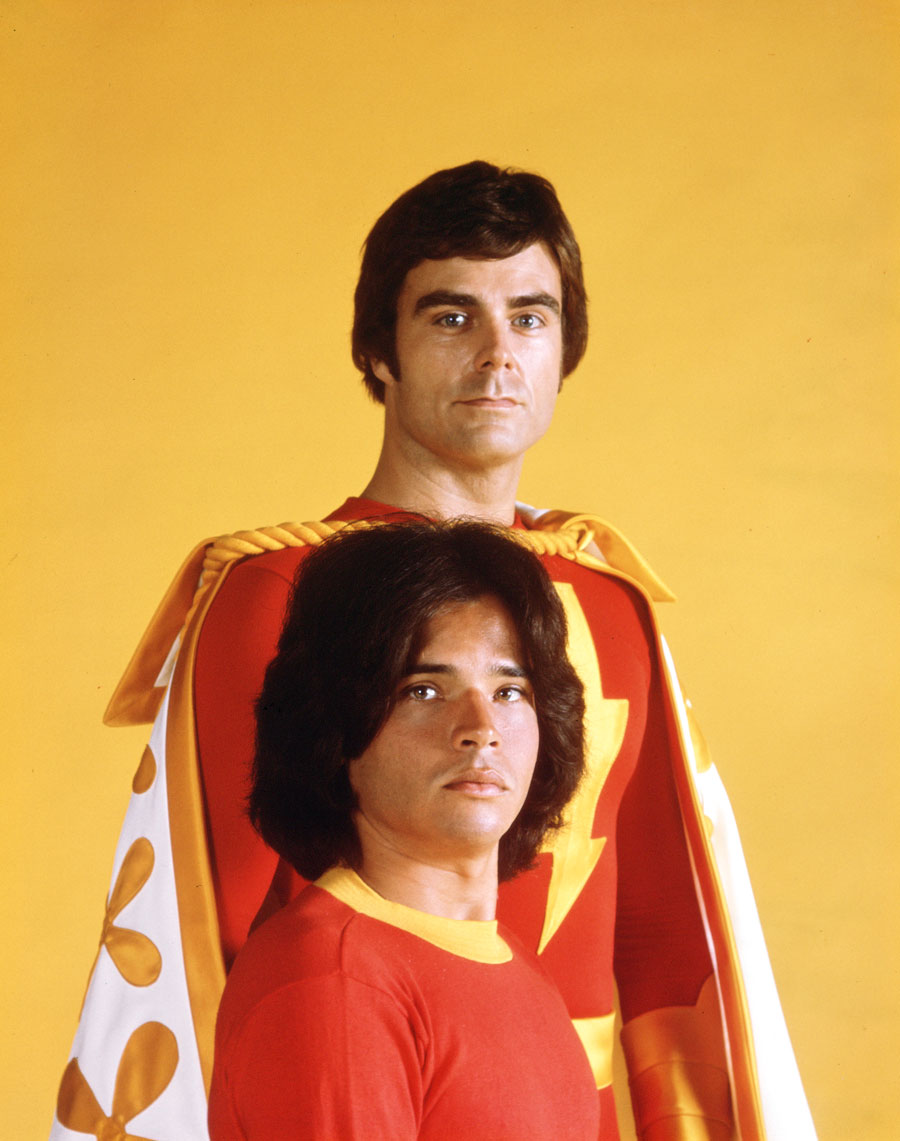
Only one problem remained as the name of Captain Marvel was tied up under Trademark Law in a more recent character, a member of Stan Lee's Marvel Comics Stable. The name was theirs to use, but not as a title. So, the title of "SHAZAM!" was settled on and Captain Marvel was known to whole new generations. The mixed Live Action & Animated "SHAZAM" had a successful 3 year run on CBS, with two guys in the lead. There was Jackson Bostwick (1974-75) and John Davey (1976-77). There was little noticeable difference in the two's performances.
 |
| Super promo art. |
 |
| Say the magic words Billy! |
Although Shazam! ran for three consecutive seasons, popularity of the show decreased quicker than a container box full of pot in Snoop Dog's hands. Season one ran for 14 episodes, while season two was 7 episodes and the final season was merely 6 episodes only. Since, the show was produced by Filmation, producers decided it would be a great idea to feature episodes with Isis & Shazam at the same time, thus making the earliest incarnation of a superhero crossover event.
Shazam! is definitely a product of its time. If people call the '66-'68 Batman series campy, I assure you, after watching one episode of Shazam! you'll think Frank Miller was the writer, producer and director of Batman. Production budget may be to blame because of this. In the series Shazam! didn't have a single challenge during the whole series! mostly because he had to school teens who were trying to do wrong, so he didn't really need to rely on his superpowers to make evil doers change their mind.
Another issue that made fans quit watching the series was the fact that Jackson Bostwick was fired from "Shazam!" two episodes into the second season, and replaced with John Davey.
Bostwick had sustained an injury during filming, went for medical
treatment, and was advised to stay home a few days to recuperate.
However, producers mistakenly accused him of holding out for a higher
salary. Nevertheless, Bostwick successfully sued Filmation, which was forced to pay
his full salary for the entire series, including all its reruns on CBS.
 |
| The crossover episodes. |
 |
| Did Shazam! & Isis had super sex? |
Another major let down issue the series had was, the even dated by 70's standards, the "moral ending" segment (Filmations is known for doing this in many of their cartoons too) where the viewer was
told the life lesson that was to be learned from watching it. For the
entire first season (15 episodes), Jackson Bostwick dressed as Captain Marvel delivered these messages. Michael Gray as Billy Batson gave them the second season (6 episodes) and in one episode of the third season along with baseball great Maury Wills. John Davey gave them in all other third season episodes.
Overall, a series that could have done a lot better had it had a bigger production budget and had it stuck a little closer the adventure/action felling other superhero shows had around the same time. Worth watching? hell, I don't know. Maybe if you're a superhero completist and still haven't watch it, it'd be worth a try. Also, if you're a hardcore Shazam! follower it will entertain you for a couple of minutes. Now, in my humble opinion this series lacked balls, big stinky hairy balls.
Here's the opening for season 1:
Here's the Shazam! & Isis hour TV promo:
Here's season 3 opening:
Stay tuned for more superhero stuff (of course we will check Daredevil season 2, Batman V Superman & Civil War!)


