The last time we saw MOTU in the big screen was 39 years ago. If you want to read about that film, you can click here.
Boy the world has changed since 1987! The lurking presence of official critics, plus an algorithm that thrives on negativity has certainly decided who's in and who's out. This modern world of zeroes and ones, has us seeing only content we like. The rest is deemed invisible, and when it occasionally shows up in our screens, we become Skeletor and can't stand living in a shared world with different cultures, political views, and favorite food. Masters of the Universe is a 44 year old property, AKA franchise, that has been here as long as I have. I'm 44 years old too, and I still feel I am entitled to say "I Have the power!".
Fisto & Teela.
Survival of the fittest.
In 44 years MOTU, has reinvented itself through comic books, animated sequels, never-ending action figure releases, pop culture, memes, and streaming services. The new film director Travis Knight knows this all too well. He was in charge of revitalizing the Transformers franchise with what I think is the best live action movie from the series: Bumblebee. So, as soon as I heard his name, I thought this could receive the same treatment. I was partially right. The new MOTU movie is spectacular. Every reference, story, scenery, battle moves, and original concepts are all here. Even the memes, that 4 Non Blondes one hit wonder, and more.
Amazon, love it or hate it, produced the film thinking ahead. A movie franchise, and all the byproducts that come with it. While the film preserves the original magic from the Saturday morning cartoon, it also embraces the pop culture that helped He-Man continue to live in the most unexpected places. Reddit, memes, Youtube songs became the familiar face to generations that were not born in the 1980s, and perhaps never cared for the 2000 reboot and the more recent Netflix series. Yet, they know He-Man is here. And so is Skeletor.
One of the early leaked film pictures.
Adam is ready to do what's right.
He-Man of the 21st Century
When a character story arc is solid, you can go back to telling the story over and over. The hero's journey, AKA, the Monomyth, one of the most frequent narrative styles used for superheroes, literary classics, and whatnot, is exactly what we need to return to that familiar place known as Eternia.
The monomyth is broken into 3 sections: Departure, Initiation and Return. The MOTU film is clearly about that.
Departure:
Adam Glenn has to escape to Earth in order to survive the Skeletor invasion of Eternia. As you and I know, Earth is the birthplace of Queen Marleena, so it's only fitting he may find solace and sanctuary there. The sword of power works as some kind of key/GPS that when the time is right will bring Adam back to his beloved family. Sadly, he loses the sword while traveling to Earth. So, obviously, he'll have to retrieve the sword if he's to ever see his homeworld again.
Initiation:
Once he finds the sword, the sword emits a traceable signal that brings Teela to Earth, and sadly Beastman. We know how obsessed Skeletor was with the sword of power, as he believed the weapon to be the ultimate key to access the secrets of Castle Grey Skull, and ultimately its massive god-like power. Adam is a Human Resources man, not a warrior by any means. Once he's taken home, he has to quickly adapt to his homeworld and with the little knowledge and training he had, he eventually is forced to wield the sword of power and yes, scream "By the power of Gray Skull! I have the power!"
Return:
The consequences of learning on the go, will push He-Man to the ultimate test, and the inevitable: He must defeat Skeletor in order to free his people, save his family, and become the man he thinks he's supposed to be. Queue Stone Temple Pilots' Creep "I'm half the man I used to be" verse. While seeing how powerful he can be, he needs to learn to control his powers, and boy does he feel miserable after he finds out first hand, there are casualties of war. Beaten he realizes the real reason why the Sorceress chose him as the champion of Eternia, and this truly feels like seeing a Filmation episode where at the end they tell you about what makes a hero.
Evil returns.
...and so does Good!
Add to that journey a proper sense of humor aimed at kids from the 1980s, not kids from today. The obvious jokes on characters' names like Fisto, & Ram-Man are there, but there are other jokes that assess the antiquated perception of what a villain is, and what he/she stands for. Yes, Skeletor's maniac laughter is there. Skeletor's evil conquest speech? check! Skeletor's purpose speech? Check!. There's even room for humor based on He-Man's physique, which reminded me of a friend whose wife was suspicious of him because he collected muscular men action figures.
In a nutshell, MOTU is the film we all dreamed of 39 years ago. The director, artists, producers, and actors aligned to deliver the best nerd-themed movie in recent years. Not even superhero films have been able of keeping the lore intact because the corporate industry is obsessed with reaching wider audiences. Niche films can also be lucrative, and this may be a good example of it.
Now that we've seen the Masters of the Universe revival in the form of not one, but two Netflix animated series (a live action film is in development as we speak), a She-Ra remake, plus the introduction of the Origins toy line in 2020, things couldn't look better for THE ultimate 1980s franchise. For those around when the original show premiered, it's no surprise most of the animation produced during the decade was because the toy industry wanted to get a slice of the most wanted toy for Christmas cake. Producers discovered how easy it was for kids to fall in love with characters they would see on the TV, hence the aggressive marketing model that built the decade, and had every boy and girl playing with at least one MOTU action figure, vehicle or playset.
Today's review is not about the deep psychological and philosophical morale of the story but about She-Ra, the Princess of Power!
As above mentioned, MOTU was a huge success amongst boys. The show had it all: Heroes, robots, futuristic vehicles, monsters,characters with a varied ethnicit,y morale lessons and all the human values parents would root for. These heroes wouldn't kill. These heroes would win the battle of good VS evil through friendship, team work, and a deep sense of truth, justice and...
...Toys!
Perhaps the one thing missing was a strong leading female. Although, Teela & The Sorceress were there most of the time, it was up to men to save the day. Girls also wanted a slice of the cake. They had seen Batgirl in the 60s Batman TV show, Wonder Woman & The Bionic Woman in the late 70s,so it was only a matter of time until they got a woman to be the animated hero to save the day.
The movie that introduced She-Ra to the world.
How to draw She-Ra.
I can't deny the influence these empowered women characters had not only in my childhood but also, throughout my entire life. One day I would fall in love with a woman with all these alpha features. I wasn't interested in the weak type, you know, the "princess in distress" stereotype that served the Film & TV industry for decades, I wanted a woman that could wield a sword, lift some rocks, go on an adventure with me, and probably save my life many times. I'm lucky to say I did marry one of those wonder women. Anyway, when Mattel & Filmation decided it was time to think of the female audience, they coined a lot of ideas, some saw the light, some remained unused. The first thing you need to know, is that the original title was "She-Ro" which was an odd version of the word "He-Ro"(one of the MOTU legendary characters), so they decided to call it "She-Ra" mistakenly assuming "Ra" meant God in Egyptian. The word actually means "Sun" so, it's safe to say Adora is "The sun of Etheria". Adora would also transform with the power of a magic sword. However, producers thought a girl couldn't fight or wield a sword, hence the abundant use of magic during the show. She-Ra wouldn't cut you in two with her sword. Instead, she would use the magical power of the sword to cleverly get rid of the bad guys. To make boys develop an interest in the new show, they made Adora the long lost twin sister of Prince Adam, and they made a movie about it: He-Man & She-Ra: The Secret Of The Sword. The movie was a smart marketing move to see if it made sense to make more toys and a brand new animated series. Of course, boys and girls alike, loved the movie, and were craving the toys before the film was split into the first 5 episodes of She-Ra: Princess Of Power.
While She-Ra took part in a number of adventures, the primary focus of the show was the conflict between the Great Rebellion and the Evil Horde, as the people of Etheria attempted to drive the Horde off their world. Unlike Skeletor's forces on Eternia,
the evil Horde was in a much greater position of power in Etheria, and
commonly took over entire regions and enslaved Etherians.
Most episodes consist of sci-fantasy adventures in the same mold as the
Masters of the Universe. Much like the He-Man series, some of the
initial details, backstories, and designs seen in the toy line differed
from the animated material.
She-Ra artwork from the 2019 DVD box.
Catra, the bad girl.
Like his twin brother, She-Ra also enjoyed of a toy line. Action figures, vehicles, comic books,a clothing line, and all kinds of accessories from lunch boxes to combs. The series ran for two seasons with 93 episodes and two animated movies.
The first three episodes begins with a basic introduction narrated by a deep-voiced male, designed to conceal the twist of She-Ra being Princess Adora as well as He-Man's lost long twin sister:
Where darkness rules fights the champion of light.
Where hope seems lost, there rides the Rebellion.
Together, they stand ready
against the dark evil warriors of the Horde
and their leader, the terrible Hordak.
The Rebellion, armed with hope and ancient powers
against the force and intergalactic army.
This is the story of one who will become leader of the great rebellion:
She-Ra: Princess of Power! (echoes)
Once She-Ra is introduced in episode three (She-Ra Unchained),
episode four and all further episodes begin with a basic introduction
to the premise and lead character narrated by Adora (which deliberately
parallels the intro of He-Man and the Masters of the Universe in both visuals and dialogue):
I am Adora, He-Man's twin sister, and defender of the Crystal Castle.
This is Spirit, my beloved steed.
Fabulous secrets were revealed to me the day I held aloft my sword and said,
"For the honor of Grayskull! I am She-Ra!"
Only a few others share this secret.
Among them are Light Hope, Madame Razz and Kowl.
Together, we and my friends of the Great Rebellion strive to free Etheria from the evil forces of Hordak!
Hordak, a real bad guy.
She-Ra won her battles by outsmarting their enemies.
Although She-Ra was cancelled before the originally planed finale for season 2, I can say her show was vastly superior than the original He-Man series. The animation had improved a lot since the early 80s, and the foreign inspiration brought by Animé, helped build more detailed characters with natural motion patterns, and detailed backgrounds and vehicles. Even the background music was more varied and complex. To make things more interesting, the show reveals that Hordak mentored He-Man's nemesis Skeletor, whom eventually betrayed
Hordak. According to Skeletor's origin story in the 2002 reboot of
"He-Man of the Masters of the Universe", Skeletor was an evil sorcerer
warlord named Keldor. When he tried to assassinate the Eternian Elders,
his face was burnt with acid. Future Eternian King Randor deflected the
acid with his shield. Hordak saved Keldor, replaced Keldor's head with a
skull, and renamed him Skeletor.
Now, let's bring back to life our long gone Trivia section:
-She-Ra's skirt never flies up despite her acrobatic tendencies. Lou Scheimer specifically asked animation coordinator Dori Littell-Herrick to make sure the lead characters private parts remained unseen.
-The series' writers found that creating action scenes for She-Ra even
more frustrating than with He-Man because not only did they have to
minimize the violence, but they also had to contend with what they
considered sexist pressure against the idea of a female hero being so
forceful against challenges.
-The "Star Wars" films, most notably "Star Wars: Episode VI- Return of
the Jedi" were strong influences behind the cartoon. The cartoon is
about the Great Rebellion fighting to free Etheria from Hordak. Princess
Adora/She-Ra is He-Man/Prince Adam's long-lost twin sister, separated
from Adam when she was kidnapped by Hordak as a baby and Adora/She-Ra
who serves Hordak as the Captain of the Evil Horde sides with the Great
Rebellion when she learns the truth of her past.
The Masterverse is real.
Colorful friends & foes.
-She-Ra was originally scripted to appear in Masters of the Universe (1987) but was dropped from the movie. If She-Ra had appeared in the movie she would had been played by either Brigitte Nielsen or Sybil Danning. Both actresses are natural blondes and have played warriors in other movies.
-The science fiction film Galaxis
(1995) starring Brigitte Nielsen was originally considered to be a
live-action film of "She-Ra", which would be a spin-off of "Masters of
the Universe" and the plot of the film would had been similar to
"Masters of the Universe". The film would had been about She-Ra, as
leaves Etheria and goes to Earth, as she sets out to Hordak, whom has
also gone to Earth find a mystical crystal, which is believed to destroy
all life on Eteria, Earth and the known universe.
-The character models for Adora and She-Ra were designed by artist Diane Keener,
based on various different concepts provided by the design departments
of both Filmation and Mattel. The design was approved by Lou Scheimer on September 19, 1984.
-Adora was originally named "Eve" in order to go with the "Adam & Eve" concept. However, since they were twins, they skipped the idea to avoid any incestuous misconceptions.
Horde Trooper & Grizzlor.
Hordak, dictator of Etheria.
Now, returning to our review, what 80s parents liked the most about She-Ra is that it was one of the few animated
kids' action series with a female at the center of the story. As such,
it can be seen today as an early example in media of the girls can do anything concept. Moreover, many of the female characters on She-Ra
are the wisest and most powerful, while males are often minor
characters or villains. Something that is definitely in line with today's social affairs. Each episode centered on a positive social lesson
such as the benefits of generosity.
The ACT & 22 Minute Commercials.
Ronald Reagan instituted the deregulation of advertising at the start of
the 1980s. This allowed companies to market as much as they wanted to
children, leading to an explosion of new toys, cartoons, junk food, fast
food, and breakfast cereals. Meals, movies, entertainment — they’re usually all determined by what the kids want. Children can influence 95% of selecting a restaurant, 89% in what beverages a family buys, and 80% of where a family vacation will be. This is all fine and good for daytime television, but targeting children
was seen as harmful. Action For Children’s Television (ACT) was formed
in 1968 in Massachusetts as a grassroots foundation to improve the
quality of children’s programming. However, as above mentioned, this ACT only had power until 1979, which is when Reagan opened the gates to every form of marketing possible. manufacturers
could now do whatever the hell they wanted. This is why you see an
explosion of toys, cartoons, candy, fast food items, and junk food in
the 1980s.
There
was a 300% increase in cartoons that had licensed characters. As much
as we loved these shows, let’s be realistic: They were nothing more than
22-minute commercials to sell toys and products. Shows based on any toy you could think of were put into production
(example: “Rubik, The Amazing Cube”). Not only that, but it also enticed
the broadcasters to schedule these shows in exchange for part of the
profit from the toy sales.
The
1980s were not just a time of crimped hair, spandex, and leg warmers,
but a time when some huge pop-cultural shifts happened. We look back on a
lot of the entertainment from the decade with nostalgia, but all of it
was completely commerce-driven.
We
can thank Ronald Reagan for pretty much creating the 80s as we know it.
If you were a kid growing up then, you loved it without knowing you
were a pawn of huge corporations.
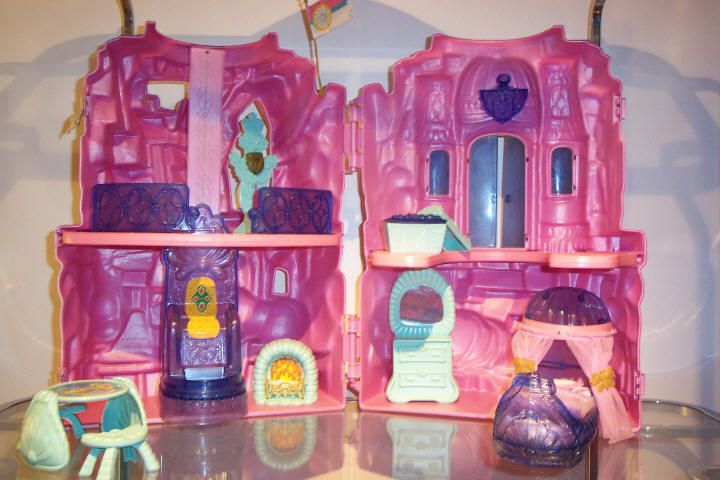
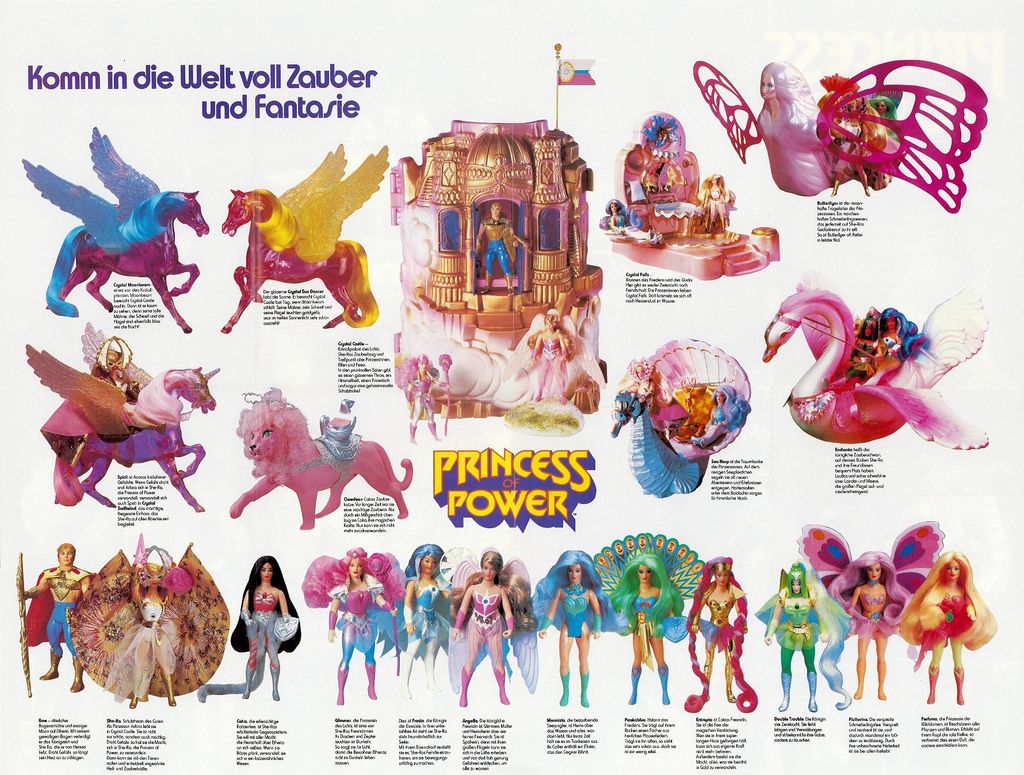
Crystal Castle playset.
Collect 'em all!
Now, why would I bring up the ACT and Reagan's deregulation of advertisement? Because that's what ultimately killed most of these wonderful shows. Especially, Masters Of The Universe & She-Ra, which I can unmistakably defend for they had heart, stories and values that went beyond other shows like, G.I. Joe where in each of its 95 episode run, you'll see at least 4 new characters and vehicles per episode. With She-Ra & He-Man there were also the mini comics which expanded on the origin of each character. Obviously, this was also a clever way to market their toys, nevertheless, you can still re-watch these shows because there are stories taking place, unlike Transformers which seeing them now as an adult, are as boring as a televised golf game.
MOTU fever has recently been revitalized, but now I'm sure the strategy will work for longer period of time, since most of its consumers are fully functioning adults with money to buy that toy they never had as a kid. They say life it's cyclical and this 80s toy revival more than proves it.


+-+32.jpeg)

+-+50.jpeg)

+-+17.jpeg)
+-+7.jpeg)
+-+25.jpeg)
+-+1.jpg)
+-+38.jpeg)