Writing reviews is taking longer these days. Not because I'm lazy or busy with my adult life or something. I always disliked people saying things "I don't have time for that anymore". That's not true. When you truly want to do something, you do it anyway.
Today's review, I hope is finished and posted by my Birthday next Wednesday, is about another giant robot Animé that almost made into the roaster of shows that made Voltron. Legend has it, some toys were licensed in hopes of a future release with the Voltron tag on them. Long story short, nothing happened and Lightspeed Electroid Albegas would eventually reach western audiences as its own thing. The show was produced by Toei Animation, and originally aired in Japan from 1983 to 1984. The series was also later moderately popular in Latin America, Spain and Italyduring the late eighties. 45 episodes were produced, clocking in at approximately 25 minutes each. The series is also known by other translations of its title, such as "Arbegas", "Arebegas", "Lightspeed ElectroGod Arbegas" and "Arbegas: El Rayo Custodio".
Hotaru's suit is a bit tight today.
State-of-the-art Mecha.
The plot is the classic, clichéd at this point, story of three teenagers, Daisaku Enjōji, Tetsuya Jin, and Hotaru Mizuki, who create award-winning robots as part of their school competition. At this time, the evil Derringer (デリンジャー, Derinjā), an invading alien race, plots to control the universe so its ambition is also to conquer Earth. To combat this threat, Hotaru's father, Professor Mizuki, takes the three robots and modifies them for battle. Hence, Albegas, thesuper robot, is born. The Japanese fascination for forcing teenagers into the most dangerous work is a trope of any Animé involving robots, transforming or not. Daisaku is the sometimes hot-headed leader, while Tetsuja compensates with more of a loner/mature approach . On the other hand, Hotaru is the beatiful woman everyone falls for, which leads to several episodes where she is faced with stereotypical situations that can only occur to a woman just because she is one. Other characters bring the comic relief to life, but it gets a bit tiresome by half. For example, professor Mizuki is an overweight single lady that is always looking for candidates for marriage. Moreover, she's too dumbed down to be a teacher of any kind. Then you have the most annoying of all: Goro Kumai who's nothing but a pale copy of Mazinger Z's Boss. His quest for earning Hotaru's love is dead lame. Now, don't get me wrong, not everything is bad in Albegas. The character and mecha designs are good. 80s good. Some episodes are excellent as well, but the episodic nature of the show makes it really difficult to get to the 45th episode.
School can wait.
Combiners!
Plot wise, it is not very clear at first why the Derinja have targeted Earth as their next expansion project. The episodic nature makes the bad guys seem very childish. They build one "mecha fighter" after another, then try to root for it until it's torn to pieces, and they're back on ground zero to survive another day. On the other hand, the good guys motivations are equally childish: "Bad monster comes to attack the city, heroes protect city, and blast monster into oblivion". One thing that always had my attention during the episodes is the fact you never see the police or military doing something to stop the alien attacks. Although they're seen defeated in the first episode, boom! next episodes we have no clue where the hell are they. Besides, Professor Mizuki is a man with a reputation for knowing what to do, so nobody ever questions his decision of sending underage kids to battle monsters while they should be in school doing chores instead. By the way, I know it's a fictional show aimed at kids before you tell me I'm being too harsh on it.
Each episode runs around 24 minutes counting the opening. The formula gets tiresome very quickly: Open episode, heroes either wait for something to happen, or one of the main characters has been tricked/manipulated by the Gerinja to deliver vital information to their operation, whatever the operation is. Then, one hero realizes something's out of place and tells the others, giant monster shows up, battle unravels, Albegas sword wins the day, everyday, always.
Hotaru is good at everything...
...Even providing light fanservice.
Out of all characters, Hotaru Mizuki remains the most interesting. Here's why: She's a good student, an excellent tennis player, the most responsible from the team, and quite a great pilot. Moreover, she gets more character development since she's the only female in the group. Men follow her, yet she chooses to ignore them. She's the school most beautiful student, and yet she doesn't give a rat's ass about it. She's a humble character with feelings. On the other hand Daisaku and Tetsuya are merely the male stereotypes of a heroic figure that doesn't seem to have anything else to do with their lives but to kill monsters, and occasionally try to see girls showering or in their underwear. A very common stereotype from the past. Kids would device plans to see their classmates undies during breaks, and there was nothing sexual about it, it was just a game of humiliation. Bad taste, I know.
Unfortunately, Hotaru also falls prey to stereotypical situations just because she's a female character. Kidnap, mind control, falling in love with the enemy without knowing it, not being strong enough as to escape by herself, and frequently having to deal with men chasing her just because. Her commitment to the cause is commendable, though.
You can still find the toys on E-Bay.
Too young to smoke, young enough to pilot a giant robot.
Plot holes are very frequent on the show. We never see why these kids were chosen to pilot state-of-the-art mecha probably the military would have handled better. The only explanation is on the first episode where these kids participate in a robot building contest in school, and win. Later these robots would be repurposed, very quickly to fit the episode, into Albegas by professor Mizuki, who with all his scientific knowledge and expertise, chooses his daughter and her two best friends to do what no adult is willing to do because they know better.
Morishita Kouzou directed the show, and to date he's the managing director of Toei animation. His resumé includes work ranging from earlier mecha animé like Kotetsu Jeeg, Magne Robot Ga-Keen to popular franchises like Dragon Ball Z & Saint Seiya. As above mentioned, the animation quality, including character, mecha & background designs are all superb according to the decade standards. The transformation sequence where the Alpha, Beta & Gamma robots combine into Albegas gets permanently attached to your brain, and although is reused in every episode, you never get tired of it. Neon retro grids in the background, pieces fitting together zooming in and out, and the final superhero pose with bursts of energy scream "Buy the toy while it's hot".
Still waiting for giant robots to lead the war on peace.
Retro grids hit different when you're 40 something.
Now, contrary to the belief an episodic show has no clear ending, Lightspeed Electroid Albegas does come to a satisfying conclusion in its final episode, or so it seems. Being a show aimed at children, killing all the bad guys while blowing their home planet to pieces, seems like a fitting end. Nevertheless, even an adolescent mind would question whether this is the right solution to the conflict, as our heroes basically do the same the Derinja are doing to planet Earth with far worse consequences. Anyway, it was the 80s and the producers weren't expecting the show to build a lasting legacy amongst Anime connoisseurs. These shows were made to test how well toys would sell provided the right animated story. Let's not forget the Dyaclone toyline had been out for 3 years in Japan, and the next year, 1984, Hasbro would license the Car-Robots toyline along with the Microman's Micro Change toyline from Takara to create the Transformers, igniting the worldwide robot craze of 1985.
Science with the cool schoolkids.
Beta as piloted by Tetsuja.
Gamma as piloted by Hotaru.
Voltron II
When World Events Productions began work on Voltron: Defender of the Universe, the intention was to adapt three anime into one shared universe. The series began with a run of episodes based on Beast King GoLion, followed by a run based on Armored Fleet DaiRugger XV. The intention was then to feature Albegas
as a third arc, with the mecha of the three shows being retconned into
having all been variations of Voltron. However, due to the
unenthusiastic response to "Vehicle Voltron" episodes, plans to adapt Albegas fell through.
In spite of this, Matchbox released a toy of Gladiator Voltron labeled Voltron II, in addition to Voltron I (Vehicle Voltron) and Voltron III (Lion Voltron).
Decades later, and to appease fans who wanted to see a spawned feature from the Voltron II
toy, Gladiator Voltron made a brief, one-panel appearance in Devil's
Due comics in 2004. Character dialog indicated that it was an earlier
failed attempt in the efforts to duplicate the Lion Force Voltron's technology (efforts which, in this continuity, resulted in the creation of the Vehicle Force).
All three Voltrons appeared together in the fifth issue of Robotech/Voltron, during a page which showed potential alternate dimensions.
Just so that we have a variety of OVAs in our humble blog, we'll move on from "so bad it's good" to "so good it should have had more episodes".
Hyper Combat Unit Dangaio (破邪大星ダンガイオーHaja Taisei Dangaiō) is an anime OVA series produced and animated by AIC and Artmic and released in Japan in 1987. The remaining episodes were released in 1988 & 1989 respectively. Dangaioh featured character designs by creator Toshiki Hirano, mechanical designs by Shoji Kawamori, and animation direction by Masami Ōbari. Moreover, much of the production crew from Fight! Iczer-1 worked on this series as well, on top of this, Mayumi Sho voices the protagonists of both series.
Disclaimer: Today's review is based upon the latest officially available edition from the OVA, that is, the Blu-Ray released in Japan in 2016, which contains the original three episodes in Japanese language only, without the wrong subtitles from the first VHS edition by U.S Renditions, released in 1990 with only the first episode. After the demise of U.S. Renditions in the mid-1990s, Manga Entertainment re-released Dangaioh in 1996 as Dangaioh: Hyper Combat Unit,
which was an English-dubbed compilation of episodes 2-3. For reasons
unknown, episode 1 was omitted from this release. This incomplete version was
re-released on DVD in 2003 and you can find it for around $60 dollars in used markets. However, my humble recommendation is that you look for the 2016 Blu Ray Japanese import edition, because it's simply the best in quality.
Beautiful heroic ladies.
Beautiful heroic mecha!
If you Google Dangaio, the first thing you'll notice is that is misspelled "Dangioh". The second thing you'll notice is that most of the available reviews are based on the 1990 VHS tape, with poor subtitles that clearly spoil the experience, for even the mos enthusiast fans. Third, most of the reviews state that the series lacks heavily in the plot department, which again, has to do with either early import versions, or poor fan subs. Now, if you're like me, watching the official Japanese edition, things change drastically in terms of experience, so don't be fooled into thinking this little 80's gem is nothing but a piece of shit, because it isn't.
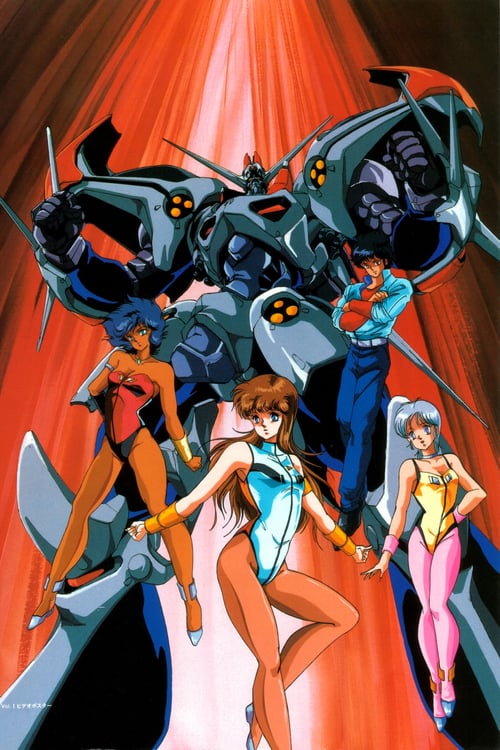
The story is pretty straight forward: 4 cybernetically enhanced random people with psychic powers wake up in the middle of a war, knowing nothing but the fact they want to get out of there as soon as they can. Little do they know, they were specially trained to pilot the Dangaio, the ultimate space robot.
Character wise, internet people have complained they're underdeveloped, and that we never learn anything from their lives. Wrong! fucking wrong! maybe paying attention and learning to read will improve the experience. Mia Alice, the leader of the team has psychic powers that could easily scare away the X-Men's Phoenix, yet she hates violence, and doesn't want to have anything to do with it. Pai Thunder, is her opposite, a very strong woman with fighting skills that would make a great match for She-Hulk. Lambda Nom, the youngest and weakest member of the team. She hardly remembers how to summon her kinetic energy powers. And last but not least, the only man in the gang, Rol Kuran, gifted with kinetic super speed. Altogether, they fly the coolest airplanes that can form the Dangaio super robot. As every episode goes by, they meet different people from their past, so they do have moments where they remember where they come from or what they used to do or work for in the past. Doctor Tarsan, is the scientist behind the group, and while he works for the bad guys, he always finds a way to let his children be free and use the Dangaio for dealing with evil doers (his own bosses).
Fuck you!
Teamwork.
Plot wise, our four heroes have to either escape or face the Bunkers led by Yoldo and his minions (they all seem to have been designed as homage to 70's/early 80's super robot villains). Out of all of them Gil Berg (who looks exactly like Roy Fokker) is the one that stands out, and has a hidden agenda towards Mia Alice. Unfortunately, with only three episodes, I really felt had they made more episodes, the overall rating of this greatly underrated OVA would have been very different. To put it in simpler terms, we all want to cum, so when we're about to, it's not nice to be left there hopeless.
A new 13-episode series named Great Dangaioh ran from April 5, 2001 through July 5, 2001 on TV Asahi in Japan. The series was created and directed by Hirano, and produced by AIC. Hirano's wife, Narumi Kakinouchi,
was the animation director. Originally perceived as a completely
different story, the series was revealed halfway as the sequel to the
OVA series.
The series was licensed in North America by Viz Media, featuring an English dub produced in the Philippines by Telesuccess Productions.
Music wise, I'd say the soundtrack is a clear "throwback" to the 1970's super robot Animé shows, therefore, it could be again misunderstood by younger audiences who'd prefer to stick to 80's synth wave, basically because this is an OVA from that decade. Homage is a good thing kids. "Cross Fight" by Mitsuko Horie & Ichiro Mizuki is the opening theme for the first two episodes, while "Cheap Thrills" by Hidemi Nakai, is the more updated rock theme opening the last episode."Kokoro no Honesty (Honesty of the Heart)" and "Who's Gonna Win" are the ending themes by Mitsuko Horie and Hidemi Nakai respectively. The official soundtrack was released on CD in 2007.
The original 1990 U.S. Renditions VHS tape.
The fantabulous Blu Ray set!
The animation style and mecha design is perhaps one of the best I've seen in my 36 years of life. You can tell the show has Shoji Kawamori all over! Even some of the designs are hints at what he'd do in future Macross sequels. The color palette is also brilliant! You can see the 80's vividly alive and well in this OVA. Moreover, the HD remaster is easily a top 5 of all the classic Animé that have received the same treatment in the last 10 years. Strangely enough, the third episode is not as pristine as the first two. Probably, producers lost the original reels, or they were damaged at some point so they had to work with what was left. Anyway, the art made for this OVA could easily be a 101 lesson on how to design classic Animé characters/Mecha, and no, I'm not biased, just honest.
Hyper Combat Unit Dangaio is an 80's homage/update of the original super robot Animé genre from the 60's & 70's where you used to have a team of young members that had unique skills that allowed them to control a fantastic giant robot. Usually, the bad guys had demonic looks and would be hidden far away in a super secret planet/fortress. On each episode the heroes would face a "villain of the week" type of enemy until the series would reach its climax and get into the real final battle. Since Dangaio is only three episodes, we don't really get the luxury of seeing our heroes face the big bad guy. Instead, we're given an unexpected revenge that leaves an open ending, suggesting there could be more episodes in the future. Obviously, none of this happened, and the 2001 remake series is only 50% a sequel that also failed to have an ending since it was cut short from 26 to only 12 episodes due to poor ratings.
The most powerful robot in the universe!
Mia Alice may look weak but...
Overall, don't let other people ruin the experience of witnessing forgotten history. Dangaio is the second OVA ever to be brought to the USA by the late U.S. Renditions (the other being Gunbuster). The artistic work by Shoji Kawamori is reason alone for you to get the fantastic Blu-Ray release of this underrated , and clearly not seen by many online reviewers, super robot homage adventure. Moreover, here you have a story with a lot of pros: Great voice acting (the original Japanese actors, that is), awesome movie-like quality character designs, great animation, giant robots, and the overall look of the whole story makes me think this is an A+ OVA series in my book. The cons? there are no cons! save for you not running to find a copy of it!
The opening for the first two OVAs, with the highly criticized by "overnight experts" dated theme: Same opening but in stunning HD as taken from the Blu-Ray release: "Kokoro No Heart" the song used in the opening for the third OVA (I didn't find the opening, sorry): The ending: A fan made AMV to push you into craving for some Dangaio: Manga Entertainment's Dangaio trailer: The Dangaio action figure set:
23 years ago (1993), a children's TV series premiered on the American tele. Such series integrated footage from a well-known Japanese "super
sentai" (Japanese superhero team) series called "Dinosaur Team Beast
Ranger"("Kyoryu Sentai Zyuranger") with newly shot scenes featuring an
English-speaking American cast of actors (later seasons would integrate
even more stock footage from other super sentai TV shows), that
drastically worked its way into American pop culture in such a fashion
that it rivaled yet another superhero craze at the time, that of the
Teenage Mutant Ninja Turtles.
The violently called white washing trick used thoroughly the 60's, 70's & early 80's was nothing but the reworking of the original material to make it western friendly. Asian products like movies, serials & anime were all affected by this practice. Anyways, this post is not about that, which I for one, think is a pointless dated trick in our current globalized world.
Five Teens with attitudes.
Karate, weapons and shit.
Like every other kid
growing up in the early to mid-1990s, I was twelve going thirteen when "Mighty Morphin
Power Rangers" debuted in August of 1993. I collected the toys, (mostly bootlegs, there were some pretty decent Power Rangers bootlegs back in the day for half the price of the licensed toys) too,
and thoroughly enjoyed "Mighty Morphin Power Rangers: The Movie" (1995)
when it came out. I shared this fandom with one of my best friends, so whenever I had to go to school, he would watch it and meet after school to tell me the details of the episodes I missed. I also remember, being a fan of MMPR wasn't much of a cool thing in my school. You see, the early 90's were all about becoming an adolescent full of teenage angst and either Grunge (which was huge) or Hip Hop (which was blooming) were almost the only possible thing a 13 year older would dig. So, I kinda kept my MMPR interest a secret, and only a few of my best friends who were into it, totally backed me up for.
The series initially centered around "five teenagers with attitudes" -
later to be supplemented by a sixth member - in the fictional city of
Angel Grove, California, who became a team of color-coded superheroes
to fight against the forces of the evil witch Rita Repulsa (initially
played by the late Japanese actress Machiko Soga, who only appeared in
stock footage from the original Japanese version and whose voice was
dubbed; Carla Perez played the character onward while voiced in both
instances by Barbara Goodson). (She would later be joined by the even
more-powerful Lord Zedd, her brother Rito Revolto, and finally her
father Master Vile in later seasons).
The original team, my personal favorite.
Remember Ultraman?
The five heroic teenagers chosen by the demi-god Zordon and his twitchy
robot servant Alpha 5 wereJason Lee Scott/The Red Ranger (Austin St.
John), Kimberly Hart/The Pink Ranger (Amy Jo Johnson), Zack Taylor/The
Black Ranger (Walter Jones), Billy Cranston/The
Blue Ranger (David Yost, the series' longest-serving member), and Trini
Kwan/The Yellow Ranger (the late Thuy Trang). In later seasons, their
numbers were supplemented by the likes of my personal favorite,Tommy Oliver/The Green
Ranger/The White Ranger (Jason David Frank), who eventually became the
sixth member and de-facto leader of the group, and was finally the most
powerful Ranger of them all; Adam Park/The Second Black Ranger (Johnny
Yong Bosch); Rocky DeSantos/The Second Red Ranger (Steve Cardenas); and
Aisha Campbell/The Second Yellow Ranger (Karan Ashley). This second
line-up was heavily criticized as "the new rangers, lack personality, they don't even have a clear onscreen character development like their predecessors" I'd say they were kinda right specially with Adam & Rocky but, Aisha, the new yellow ranger was an excellent cast choice.
In all of their battles with Rita Repulsa's minions (which included,
among other things, chaotically-edited Karate-based martial arts
fighting sequences), they were aided with the power of the Zords,
ancient giant robots based on prehistoric creatures (and later,
ninja-like and gong-fu-animal-themed warrior figures), like the
Tyrannosaurus Rex, Triceratops, Pteradactyl, etc., which could form
together to create a Mega-/Thunder-/Ninja-zord and would be used to
fight Rita's monsters when she used her powers to turn them into
towering monstrosities (giving rise to many daikaiju-styled monster
battles that utilized stock footage from the original Japanese version
of the show, which were produced by the Toei Company and Bandai).
Rita and her minions.
Lord Zedd, all Jewish, all evil.
And on the their down time, the kids had to find time to deal with
being common, everyday American teenagers, and having to deal with
numb-skull local bullies - and the show's comic relief - Bulk (Paul
Schrier) and Skull (Jason Narvy). (P.S.: For those that cared - and if
you were a worrisome enough parent during those days - you could find a
meaningful message about the power of teamwork, individual uniqueness,
courage, friendship, and working together for a common good.)
It's Might Morphin' Power Rangers trivia time! Morphinomenal!
Check all these awesome behind the scenes secrets that you probably didn't know. I must admit these were all found browsing several MMPR websites, so credits go to them.
Where's Your skirt?
In the original Japanese footage, the Yellow Ranger was male. This is why the Pink Ranger has a skirt, but Yellow doesn't.
Forever Blue
Billy Cranston, the Blue Power Ranger (David Yost),
is, to date, the only Power Ranger to hold the same position for the
longest time (3 years, 1993-1996) without ever switching colors.
Kimberly Ann Hart (Amy Jo Johnson)
is currently the longest-serving female Power Ranger and Pink Ranger of
all time. She appeared in 137 episodes of the TV series until her
departure from the series.
Tommy is here to stay
Jason David Frank
(Tommy) was never meant to stay on the series for as long as he did. He
was only supposed to be a regular until "The Green Candle Part 2" minus a
cameo in "Doomsday Part 2". but during his temporary time on the show
his popularity was higher than any other Ranger. Saban received large
amounts of letters daily after "The Green Candle" requesting Tommy to be
brought back into the series, Eventually the company gave in and
brought Frank back in the episode "Return of an Old Friend." and ended
up staying on the show lasting till Power Rangers Turbo (1997) and recently in returning for Power Rangers DinoThunder (2004). He has appeared in a total of 217 episodes in the entire Power Rangers series.
Enter the Green Ranger.
Tommy Oliver, Green & White, all ranger!
Lord Zedd, the Jewish
Lord Zedd is Jewish. During his wedding to Rita in Season 2's "The
Wedding: Part 3," he wore a yarmulke, he did the traditional breaking of
a glass to commemorate the destruction of the Temple, and the song
"Hava Nagila" was played.Jewish and evil? just saying...
Creepy Fandom
Actor Austin St. John
has admitted in interviews that, while he enjoyed working on "Mighty
Morphin Power Rangers", he had mixed feelings about the fame that the
show had given him. Mr. St. John admitted that, because he was
recognized as the Red Ranger by fans, he had to move into different
homes twice due to fans that would follow him to his home, he had to get
sensor lights on his home, and he once literally had the clothes ripped
off his back by Power Ranger fans when he tried to enter a local mall
to go shopping. As a result, Mr. St. John has said that he will take
photographs with his fans, sign autographs and talk with them, but he
remains very protective of his private life.
My name is
In 2007, Austin St. John,
who played Jason Lee Scott/the original Red Ranger, said at the Power
Morphicon that Austin is his stage name and his real first name is
Jason. This means that he is the only actor of the original Rangers to
have the same first name as his Power Rangers character.
Superstars in the set
During a video interview at the 2007 Power Morphicon, actor Steve Cardenas,
who played Rocky the second Red Ranger, said one of the best things
about working on "Mighty Morphin Power Rangers" were the celebrities who
would visit their sets. Gene Simmons from the rock band KISS, Mike Myers, and Jean-Claude Van Damme,
who had brought his children with him to the set, were among the many
celebrities who dropped by at one point to see the Rangers on the set.
Haters against the Blue Ranger.
David Yost would often get teased and mocked because of his homosexuality by the crew members and he ended up leaving after Power Rangers Zeo (1996).
The definitive MMPR team.
MMPR The Movie super suits!
How old are the Rangers?
Although they were portraying high school students, Austin St. John (Jason) was the only one still of high school age, 18, when the show debuted. Thuy Trang (Trini) and Jason Narvy (Skull) were 19. Jason David Frank (Tommy) was 20. Amy Jo Johnson (Kimberly), Walter Jones (Zack), and Paul Schrier (Bulk) were all 23. David Yost (Billy) was the oldest at 24.
Gymnasts, not Martial artists.
Amy Jo Johnson (Kimberly) and David Yost
(Billy) didn't do martial arts before the show, though Johnson and Yost
were gymnasts. So they took self defense classes and incorporated their
talents into the choreography for the fight scenes. Austin St. John (Jason), Walter Jones (Zack), Thuy Trang (Trini) and Jason David Frank (Tommy) were all martial artists long before the show.
Who leads? Red or White?
Although Tommy Oliver (Jason David Frank) was made the leader of the team once he became the White Ranger in season two, Jason Lee Scott (Austin St. John)
was actually supposed to remain the leader even after Tommy's return.
Some of this original idea is shown in the season 2 episode "Opposites
Attract" when Jason orders the team to return to the Command Center
during a disturbance, and he signals and leads the team, including Tommy
as the White Ranger, in the Power Rangers' morphing sequence. However,
those plans were scrapped due to the rumored pay dispute involving
Austin St. John that would lead to Jason being written off the series
and the line that Zordon (Robert L. Manahan)
says in the second part of the "White Light" storyline was changed and
re-recorded to make Tommy the leader instantly upon his return.
Power Rangers VS Batman
The series began airing weekday mornings at 7:30 AM. Despite being in the early time slot it managed to beat out Batman: The Animated Series (1992) in ratings which bumped Power Rangers to the afternoon time slot held by Batman.
Megazord!
Legendary pose.
Parting Ways
Part way through filming Season 2 Austin St. John (Jason) Thuy Trang (Trini) and Walter Jones
(Zack) left the show, it is rumored, over pay issues. Hence from "The
Ninja Encounter", Saban used recycled footage for their unmorphed scenes
(with any new dialog required for them, coming from other actors),
until "The Power Transfer" when their Rangers positions were replaced by
Steve Cardenas, Karan Ashley and Johnny Yong Bosch respectively. Although, Austin later returned to Power Rangers in a temporary spell as the Gold Ranger in Power Rangers Zeo (1996).
Pink's favorite
In an online interview, Amy Jo Johnson said that season two's "Bloom of Doom" was her favorite episode of "Mighty Morphin Power Rangers".
Lord Zedd, an American original.
Lord Zedd is the very first Power Rangers villain to be American made
instead of appearing originally in any Super Sentai production.
Forever Tommy
Along with having the most episode appearances, Tommy Oliver (Jason David Frank)
also holds the record for having the longest continuous stint as leader
of the team, being named leader in the early half of Season 2 when he
received the White Ranger powers, and not leaving until half-way through
Power Rangers Turbo, in the episode Passing the Torch. He also has the
record for most color-changes as he has been green, white, red and
black.
what time is it?
it's Morphin' time!
Racist Coincidence
The unfortunate implications and minor backlash that arose due to an African-American actor (Walter Jones) cast as Zack/The Black Ranger and a Vietnamese actress (Thuy Trang) cast as Trini/The Yellow Ranger were noticed too late in production to change and entirely unintentional. Audri Dubois, who is not Asian, was originally cast as Trini and Jones had originally been cast as Billy/The Blue Ranger. Incidentally, David Yost, who played Billy, was originally cast as Jason/The Red Ranger.
Seven days a week!
Filming for "Mighty Morphin Power Rangers" usually lasted seven days a week for sixteen weeks straight.
Kimberly, the coolest female Power Ranger.
The character Kimberly Ann Hart was originally meant to serve as a stereotypical "dumb blonde"-type character. When Amy Jo Johnson
was cast, the character was changed to a Valley girl-type and she
actually made several contributions of her own to her character as the
series progressed, including Amy Jo's real-life gymnastic skills and
being able to play the guitar.
The Elder Power Rangers
The original series has the distinction of being the longest-running incarnation lasting for three years (1993-1996).
Here's season 1 opening:
Here's the second opening for season 1:
Here's the first opening for the second season:
Here's the second opening for the second season:
And last but not least, the three openingclips for the infamous season 3: