
 |
| R.I.P. Dame Diana Rigg. |
I'm really sad to publish this review this late. I'd been planning it for months. Unfortunately, this week I was devastated by the terrible news: Dame Diana Rigg, dead at 82...
Emma Peel is one of the earliest memories I have of seeing an empowered woman do justice by herself with a tremendously avant-garde set of skills. Not that anyone cares but, Today, I'm a 38 years old man, I wasn't even born when the show originally aired, so thanks to the 80s frequent reruns of old TV shows,I got to meet one of the most important female characters of all time.
*Bare in mind, today's review is about The Avengers Seasons 4, 5, & 6. The seasons that had an official international release (over 90 countries) and coincidentally, the seasons that featured Dame Diana Rigg's character.
"But aren't The Avengers* the blockbuster superhero films?"
No. The Avengers we're talking about today, is a British espionage television programme created in 1961. It initially focused on Dr. David Keel (Ian Hendry), aided by John Steed (Patrick Macnee). Hendry left after the first series; Steed then became the main character, partnered with a succession of assistants. His most famous assistants were intelligent, stylish and assertive women: Cathy Gale (Honor Blackman), Emma Peel (Diana Rigg), and Tara King (Linda Thorson). The series ran from 1961 until 1969, screening as 46 minute episodes for its entire run. The pilot episode, "Hot Snow", aired on 7 January 1961. The final episode, "Bizarre", aired on 21 April 1969 in the United States, and on 21 May 1969 in the United Kingdom. The Avengers was produced by ABC Television, a contractor within the ITV network. After a merger with Rediffusion London in July 1968, ABC Television became Thames Television, which continued production of the series, though it was still broadcast under the ABC name. By 1969, The Avengers was shown in more than 90 countries. ITV produced a sequel series, The New Avengers (1976–1977), with Patrick Macnee returning as John Steed, and two new partners. In 2004 and 2007, The Avengers was ranked No. 17 and No. 20 on TV Guide's Top Cult Shows Ever.
 |
| Mrs. Peel & Mr. Steed. |
 |
| Spies with class. |
Background.
The show was sold to the American Broadcasting Company (ABC) in 1965, and The Avengers became one of the first British series to be aired on prime-time US television. The ABC network paid the then-unheard-of sum of $2 million for the first 26 episodes. The average budget for each episode was reportedly £56,000, which was high for the British industry. The fourth series aired in the US from March to the beginning of September 1966.
The US deal meant that the producers could afford to start shooting the series on 35mm film. The use of film, rather than the videotape of the earlier episodes, was essential, because British 405-line video was technically incompatible with the US NTSC videotape format. Filmed productions were standard on US prime-time television at the time. The Avengers continued to be produced in black and white.
The transfer to film meant that episodes would be shot using the single-camera setup, giving the production greater flexibility. The use of film production and the single-camera production style allowed more sophisticated visuals and camera angles, and more outdoor location shots, all of which greatly improved the look of the series. As was standard on British television filmed production through the 1960s, all location work on Series 4 was shot mute, with the soundtrack created in post-production. Dialogue scenes were filmed in the studio, leading to some jumps between location and studio footage.
 |
| Mrs. Peel Lotus. |
 |
| Mr. Steed mighty steed. |
New female partner Mrs. Emma Peel (Dame Diana Rigg) debuted in October 1965. The name of the character derived from a comment by writers, during development, that they wanted a character with "man appeal". In an early attempt to incorporate this concept into the character's name, she was called "Samantha Peel", shortened to the awkward "Mantha Peel". Eventually, the writers began referring to the idea by the verbal shorthand "M. Appeal", which gave rise to the character's ultimate name. Emma Peel, whose husband went missing while flying over the Amazon, retained the self-assuredness of Gale, combined with superior fighting skills, intelligence and a contemporary fashion sense.
After more than 60 actresses had been auditioned, the first choice to play the role was Elizabeth Shepherd. However, after filming one and a half episodes (the pilot, "The Town of No Return", and part of "The Murder Market"), Shepherd was released. Her on-screen personality was deemed less interesting than that of Blackman's Gale, and it was decided that she was not right for the role. Another 20 actresses were auditioned before the show's casting director, Dodo Watts, suggested that producers Brian Clemens and Albert Fennell check out a televised drama featuring the relatively unknown Rigg (she had earlier guested in an episode of The Sentimental Agent that Clemens had written). Rigg's screen test with Macnee showed that the two immediately worked well together.
A prologue was added to the beginning of all the fourth-series episodes for the American broadcasts. This was to clarify some initial confusion audiences had regarding the characters and their mission. In the opener, a waiter holding a champagne bottle falls dead onto a human-sized chessboard, a dagger protruding from a target on his back. Steed and Mrs. Peel (dressed in her trademark leather catsuit) walk up to the body as the voice-over explains: "Extraordinary crimes against the people, and the state, have to be avenged by agents extraordinary. Two such people are John Steed, top professional, and his partner Emma Peel, talented amateur. Otherwise known as The Avengers." During this voice-over, Steed pours two drinks from the wine bottle and Mrs. Peel replaces her gun in her boot. They clink glasses and depart together as the screen fades to black and the opening titles begin.
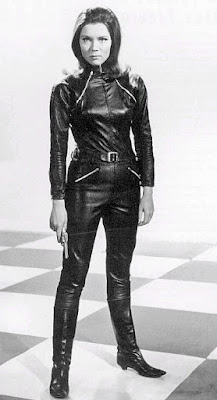 |
| Empowered woman. |
 |
| Yet very delicate. |
Review.
Dame Diana Rigg said in a 2015 interview "Emma Peel was avant-garde". However, she acknowledged, this was the result of mere causality since none of the producers, writers and people involved in the series production thought "ahead of their time". Implying the industry was at its most sexist (she was under payed. Camera men made more than She did!) back then, this product of causality empowered millions of women that saw themselves reflected in Emma Peel's impressive skills. As a matter of fact, I think that's what made the character remain in everyone's hearts for decades to come.
Although Patrick Mcnee was brilliant as John Steed, the masculine secret agent wasn't an original idea, even by the time the series originally aired. On the other hand, Emma Peel was nowhere near a damsel in distress. She knew Kung-fu, Judo, she was an expert in sciences, quick-witted and never, ever had to answer to a man. She drove her own sports car, had a wardrobe that established new standards in fashion, could easily use any weapon at hand, and didn't exploit her physique to get whatever she wanted. She was the archetype of feminine empowerment and, I, a stinky greasy unworthy male, could see that even when I was a small kid. The industry needs more Emma Peels and less [insert whatever name you can think of here].
Now, the combined talents of McNee & Rigg provided our screen with one of the finest couples ever seen on TV, and it shows. They were so good together, producers allowed to improvise their lines and even write their own dialogs whenever they came across a dead body, and boy did they come across dead bodies throughout the 51 episodes they partnered together.
 |
| World famous Emmapeelers. |
 |
| Ready for action! |
Setting aside the above mentioned talent of their protagonists, The Avengers was indeed a marvelous series where genre variety played a key role establishing the show as one of the greatest of all time. Besides the relatively obvious espionage episodes full of Soviet spies and her Majesty's traitors, there were cyborgs, mad scientists, horror stories, Aliens, secret societies, absurd yet terribly dangerous characters, corruption, frame-ups, blackmail, eccentric murderers, feminist killers, butlers, Arabian princes, state-of -the-art weapons, food poisoning, high tech murdering houses, and amongst all of that 19 gallons of Champagne!
After Rigg decided it was her time to move on from the series, "because She didn't want to play the part forever". She became the only Bond girl to actually marry the fictional character in "On Her Majesty's Secret Service". She also continued to work in plays (she acted in 38 plays from 1957 to 2018), 51 TV series (including The Avengers & Game Of Thrones), and 18 movies. The Black Narcisus series will be released posthumously this year, as well as the Last Night In Soho film set to release next year.
Patrick McNee died in 2015. Legend has it they remained friends long after the series was cancelled.
The Avengers Trivia
- Emma Peel's name was taken from the British movie industry expression "M-Appeal", or "man-appeal", which is what the show's producers were looking for in her character. Something that makes total sense considering Dame Diana Rigg said producers made her characer avant-garde by causality.
- During her first season, Dame Diana Rigg was dismayed to find out that the cameraman was being paid more than she was. She demanded a raise, to put her more on a par with her co-star, or she would leave the show. The producers gave in, thanks to the show's great popularity in the U.S.
- Series writer Brian Clemens noted in an interview the sexual chemistry that particularly existed between Steed and Emma Peel, and the common question of "Will they ever go to bed together?" Clemens' attitude toward the characters was that they already had done, and this was the next day. Patrick Macnee and Dame Diana Rigg confirmed later in interviews that they had decided their characters had a casual sexual relationship, "but just didn't dwell on it."
- The look and character of Steed is an amalgam of Patrick Macnee's father (a racehorse trainer and dandy), fictional character The Scarlet Pimpernel, and Macnee's commanding officer in the Navy.
- At least two principal actresses and one principal actor in this show appeared in James Bond movies: Honor Blackman as Pussy Galore in Goldfinger (1964), Dame Diana Rigg (Contessa Teresa "Tracy" Di Vicenzo Bond) in On Her Majesty's Secret Service (1969), and Patrick Macnee as Sir Godfrey Tibbett in A View to a Kill (1985).
- Dame Diana Rigg was the first person ever to do Kung Fu on-screen. In 1965, Ray Austin went to his producers and said, "Listen, I want to do this thing called Kung Fu." They said "Kung what?" and insisted that Emma, like her predecessor, stick to judo. Instead, Austin secretly taught Rigg Kung Fu.
- Mrs. Peel's maiden name is Knight. We learn more about her childhood and her relationship with her mother and father in an exhibition on the "late Emma Peel" in season four, episode twenty-three, "The House That Jack Built".
- According to Patrick Macnee in his book "The Avengers and Me", Dame Diana Rigg disliked wearing leather and insisted on a new line of fabric athletic wear for the fifth season. Alun Hughes, who had designed clothing for her personal wardrobe, was suggested by Dame Diana to design Emma Peel's "softer" new wardrobe. Pierre Cardin was brought in to design a new wardrobe for Macnee.
- Emma Peel's revolver is a gold-plated, pearl-handled pocket version of the Webley Mk IV chambered for .380/200 (a.k.a. .38 Smith & Wesson).
- Dame Diana Rigg auditioned for the role of Emma Peel on a whim, without ever having seen this show.
- This show was the first British television show sold to an American network.
- "The Avengers" became ground-breaking for introducing regular female characters who were portrayed as being just as tough, brave, and tenacious as men.

You don't mess with Mrs. Peel.
 |
| Style. |
Now the influence The Avengers had, and especially Emma Peel's influence inspired several artists to write songs about her. Sit back, and chillax to the following songs.
The Pretenders "Don't Get Me Wrong"
The Cretones "Hey Mrs. Peel"
The Allies "Emma Peel"
Dishwalla "Miss Emma Peel"
Matmatah "Emma".
Slot "Emma Peel"
Sadly, the songs by Pussy Galore, Shark Inferno and Babette Novak didn't have an available video at the time this post was made.
Overall, the three seasons featuring the great Emma Peel, are The Avengers at their best. If you still haven't given them a try, do so now. You won't regret it.
Last but not least, our classic opening and ending section:
Season 4 Opening & Ending.
Season 5 opening.
Season 6 opening.
Dame Diana Rigg, may you rest in peace...


