Showing posts with label U.S. Renditions. Show all posts

Nov 25, 2018

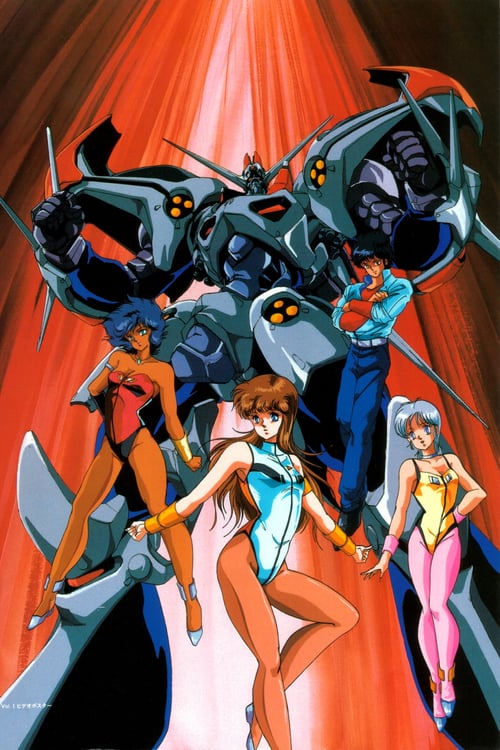
破邪大星弾劾凰 [ダンガイオー] / Great Planet Evil-Destroyer Dangaio / Hyper Combat Unit Dangaio

A 3 episode lesson on how to design Animé.
Just so that we have a variety of OVAs in our humble blog, we'll move on from "so bad it's good" to "so good it should have had more episodes".
Hyper Combat Unit Dangaio (破邪大星ダンガイオー Haja Taisei Dangaiō) is an anime OVA series produced and animated by AIC and Artmic and released in Japan in 1987. The remaining episodes were released in 1988 & 1989  respectively. Dangaioh featured character designs by creator Toshiki Hirano, mechanical designs by Shoji Kawamori, and animation direction by Masami Ōbari. Moreover, much of the production crew from Fight! Iczer-1 worked on this series as well, on top of this, Mayumi Sho voices the protagonists of both series.

Disclaimer: Today's review is based upon the latest officially available edition from the OVA, that is, the Blu-Ray released in Japan in 2016, which contains the original three episodes in Japanese language only, without the wrong subtitles from the first VHS edition by U.S Renditions, released in 1990 with only the first episode. After the demise of U.S. Renditions in the mid-1990s, Manga Entertainment re-released Dangaioh in 1996 as Dangaioh: Hyper Combat Unit, which was an English-dubbed compilation of episodes 2-3. For reasons unknown, episode 1 was omitted from this release. This incomplete version was re-released on DVD in 2003 and you can find it for around $60 dollars in used markets. However, my humble recommendation is that you look for the 2016 Blu Ray Japanese import edition, because it's simply the best in quality.

Beautiful heroic ladies.
Beautiful heroic mecha!
If you Google Dangaio, the first thing you'll notice is that is misspelled "Dangioh". The second thing you'll notice is that most of the available reviews are based on the 1990 VHS tape, with poor subtitles that clearly spoil the experience, for even the mos enthusiast fans. Third, most of the reviews state that the series lacks heavily in the plot department, which again, has to do with either early import versions, or poor fan subs. Now, if you're like me, watching the official Japanese edition, things change drastically in terms of experience, so don't be fooled into thinking this little 80's gem is nothing but a piece of shit, because it isn't.
The story is pretty straight forward: 4 cybernetically enhanced random people with psychic powers wake up in the middle of a war, knowing nothing but the fact they want to get out of there as soon as they can. Little do they know, they were specially trained to pilot the Dangaio, the ultimate space robot. 

Character wise, internet people have complained they're underdeveloped, and that we never learn anything from their lives. Wrong! fucking wrong! maybe paying attention and learning to read will improve the experience. Mia Alice, the leader of the team has psychic powers that could easily scare away the X-Men's Phoenix, yet she hates violence, and doesn't want to have anything to do with it. Pai Thunder, is her opposite, a very strong woman with fighting skills that would make a great match for She-Hulk. Lambda Nom, the youngest and weakest member of the team. She hardly remembers how to summon her kinetic energy powers. And last but not least, the only man in the gang, Rol Kuran, gifted with kinetic super speed. Altogether, they fly the coolest airplanes that can form the Dangaio super robot. As every episode goes by, they meet different people from their past, so they do have moments where they remember where they come from or what they used to do or work for in the past. Doctor Tarsan, is the scientist behind the group, and while he works for the bad guys, he always finds a way to let his children be free and use the Dangaio for dealing with evil doers (his own bosses). 

Fuck you!
Teamwork.
Plot wise, our four heroes have to either escape or face the Bunkers led by Yoldo and his minions (they all seem to have been designed as homage to 70's/early 80's super robot villains). Out of all of them Gil Berg (who looks exactly like Roy Fokker) is the one that stands out, and has a hidden agenda towards Mia Alice. Unfortunately, with only three episodes, I really felt had they made more episodes, the overall rating of this greatly underrated OVA would have been very different. To put it in simpler terms, we all want to cum, so when we're about to, it's not nice to be left there hopeless.  

A new 13-episode series named Great Dangaioh ran from April 5, 2001 through July 5, 2001 on TV Asahi in Japan. The series was created and directed by Hirano, and produced by AIC. Hirano's wife, Narumi Kakinouchi, was the animation director. Originally perceived as a completely different story, the series was revealed halfway as the sequel to the OVA series.

The series was licensed in North America by Viz Media, featuring an English dub produced in the Philippines by Telesuccess Productions.

Music wise, I'd say the soundtrack is a clear "throwback" to the 1970's super robot Animé shows, therefore, it could be again misunderstood by younger audiences who'd prefer to stick to 80's synth wave, basically because this is an OVA from that decade. Homage is a good thing kids. "Cross Fight" by Mitsuko Horie & Ichiro Mizuki is the opening theme for the first two episodes, while  "Cheap Thrills" by Hidemi Nakai, is the more updated rock theme opening the last episode. "Kokoro no Honesty (Honesty of the Heart)" and "Who's Gonna Win" are the ending themes by Mitsuko Horie and Hidemi Nakai respectively. The official soundtrack was released on CD in 2007.

The original 1990 U.S. Renditions VHS tape.
The fantabulous Blu Ray set!
The animation style and mecha design is perhaps one of the best I've seen in my 36 years of life. You can tell the show has Shoji Kawamori all over! Even some of the designs are hints at what he'd do in future Macross sequels. The color palette is also brilliant! You can see the 80's vividly alive and well in this OVA. Moreover, the HD remaster is easily a top 5 of all the classic Animé that have received the same treatment in the last 10 years. Strangely enough, the third episode is not as pristine as the first two. Probably, producers lost the original reels, or they were damaged at some point so they had to work with what was left. Anyway, the art made for this OVA could easily be a 101 lesson on how to design classic Animé characters/Mecha, and no, I'm not biased, just honest. 

Hyper Combat Unit Dangaio is an 80's homage/update of the original super robot Animé genre from the 60's & 70's where you used to have a team of young members that had unique skills that allowed them to control a fantastic giant robot. Usually, the bad guys had demonic looks and would be hidden far away in a super secret planet/fortress. On each episode the heroes would face a "villain of the week" type of enemy until the series would reach its climax and get into the real final battle. Since Dangaio is only three episodes, we don't really get the luxury of seeing our heroes face the big bad guy. Instead, we're given an unexpected revenge that leaves an open ending, suggesting there could be more episodes in the future. Obviously, none of this happened, and the 2001 remake series is only 50% a sequel that also failed to have an ending since it was cut short from 26 to only 12 episodes due to poor ratings.

The most powerful robot in the universe!
Mia Alice may look weak but...
Overall, don't let other people ruin the experience of witnessing forgotten history. Dangaio is the second OVA ever to be brought to the USA by the late U.S. Renditions (the other being Gunbuster). The artistic work by Shoji Kawamori is reason alone for you to get the fantastic Blu-Ray release of this underrated , and clearly not seen by many online reviewers, super robot homage adventure. Moreover, here you have a story with a lot of pros: Great voice acting (the original Japanese actors, that is), awesome movie-like quality character designs, great animation, giant robots, and the overall look of the whole story makes me think this is an A+ OVA series in my book. 

The cons? there are no cons! save for you not running to find a copy of it!

The opening for the first two OVAs, with the highly criticized by "overnight experts" dated theme:


Same opening but in stunning HD as taken from the Blu-Ray release:


"Kokoro No Heart" the song used in the opening for the third OVA (I didn't find the opening, sorry): 


The ending:


A fan made AMV to push you into craving for some Dangaio:


Manga Entertainment's Dangaio trailer:


The Dangaio action figure set:


Dec 10, 2010

超時空要塞マクロスII/ Super Dimension Fortress Macross II: Lovers Again


Lovers again!
Today I'm going to talk about an OVA I had the chance of watching around 1995 during my senior high school years. I remember there was this guy, kinda younger than me, who used to have a varied collection of VHS tapes with plenty of cool Animé OVAs which were not that easy to find. Obviously, I befriended him, and through that friendship, I had my first approach to an SDF Macross sequel, something I couldn't possibly miss, since Robotech had introduced me to the original series and fostered my love for Animé which lasts until this very day.

Back then I already knew Robotech was made of three very different Japanese Animé. The "SDF Macross: Do You Remember Love?" had been released on VHS by Manga Entertainment and everyday after school, I would go home making sure the shop that had it, still had it until I was able to save enough money to buy it and add it to my tiny collection. However, this film had that Robotech shadow that kinda kept on coming back to my head, so it is through Macross II that I actually felt I was witnessing a Macross series in its original format as it was meant to be.

The coolest Valkyrie not made by Kawamori.
So you think music can save you?
Background

Super Dimensional Fortress Macross II: Lovers Again  was the first installment in the Macross franchise to feature a new cast of characters. Macross II was produced by Big West, with no involvement from the original series creators from Studio Nue or the original series animators from Tatsunoko Production. 

After Flash Back 2012, Studio Nue no longer wanted to work on Macross as a series. Big West continued alone, building from Do You Remember Love? with Macross II and three video games: Macross 2036 and Macross: Eien no Love Song for the PC Engine CD and Macross: Scrambled Valkyrie for the Super Famicom. 

In light of this, Studio Nue decided to continue the story themselves, though they used the original television series as a base instead. This began with the 1994 Macross Plus and no further work is based on what is now considered a "Parallel World" timeline.
 
Hibiki and his camera.
Smile!
Macross II began production in 1991 and debuted simultaneously in the United States and Japan, during the second quarter of 1992, in order to commemorate the 10th anniversary of the original The Super Dimension Fortress Macross television series. Out of the original Macross staff, only three of them returned for Macross II: Haruhiko Mikimoto (character designer), Sukehiro Tomita (scripter) and Yasunori Honda (sound director). Shoji Kawamori, the creator of the original Macross series, did not participate in this project because, at the time, he had no interest in writing sequels. Since co-creator Studio Nue was also absent from this project, studios AIC and ONIRO handled the production. 

Macross II was framed as six episodes because, at the time, it was felt that short OVA series were the current trend in anime. Initially conceived as taking place 300 years in the future, that number was pared down to 80 years during production. Macross II also takes place in the same universe as the PC Engine Super CD-ROM games Macross 2036 and Macross: Eternal Love Song. The staff was not allowed to use any of the original Macross characters in this project. Furthermore, the staff decided to avoid the "idol" singer concept that was propounded in the original series. Their rationale was that Japan was experiencing an "idol boom" during the 1980s and Macross mirrored that. Haruhiko Mikimoto explained that he and director Kenichi Yatagai differed on what they envisioned Macross II to be; compromises had to be made on both sides. The mechanical designs for Macross II were created by Junichi Akutsu, Jun Okuda and Koichi Ohata (who previously worked on Gunbuster). 

I had this poster when I was in my teens.
The animation style is pretty 90's.
International Release

U.S. Renditions released Macross II in 1992 and 1993, dubbed into English, on three VHS cassettes each containing two episodes. L.A. Hero released the series in 1993 as a movie in a limited number of theaters across the U.S.A. as a 150-minute film on 35 mm film.
 
Manga Entertainment consolidated the six episodes in 1995 into a single VHS cassette called Macross II: The Movie. This compilation removed the opening and ending credits for episodes 2 through 5, as well as the episode previews. It was released as two VHS cassette variations: the first contained the English dub and the second contained the original Japanese dialogue with English subtitles.
In 2000, Macross II: The Movie was released on DVD by Manga Entertainment. 
This DVD included both the English dub and the original Japanese dialogue with English subtitles. Bonus materials included a music video (actually a creditless closing theme), four character profiles and an image and mechanical designs gallery. 

Macross II: The Movie was released as a downloadable video rental on the Xbox Live Marketplace for the Xbox 360 by Starz. This release only included the English dub and it was in standard definition. Manga Entertainment released Macross II in 2008 as a downloadable video purchase on the iTunes Store in its original six-episode format with each episode available individually. The episodes only include the English dub and they are in standard definition.
On May 2, 2011 a new version of the English dub movie was uploaded by Manga Entertainment to their YouTube channel. This version only contains episodes 1 through 4
the Zentraedi are back!
the Lady is a hero.

The review

The story takes place 80 years after the end of the original Macross story where the Zentraedi decided to make peace with humans after a war that lasted a whole year. The UN forces are so used to minor attacks by rebel Zentraedi that they have developed the "Minmei Attack Technique" which is basically, singing songs, while fighting, in order to cause confusion among the Zentraedi  thus making them an easy target. However, once a new enemy shows up using singers to enhance their desire for destruction, things change drastically for the UN forces. These beings are known as the "Marduk" a variant of the Zentraedi mixed with Meltrandi (female zentraedi) In between this battle a young journalist named Hibiki Kanzaki is sent to the space to transmit live for his news channel SNN. While up in the skies Hibiki records the total failure of the UN forces and intends to show the news on a full coverage to let people from Macross know that they're no longer safe. Hibiki's attempt is blocked both from the UN forces and the management of his news channel.

After the first encounter, Ishtar a young Marduk gets lost down on earth in the city of Macross. Hibiki takes her to his apartment and makes important discoveries about her race and notices that they're not so different and that peace can be achieved. From here on, another important character is introduced:  Silvie Genna, a hotshot pilot from the UN forces who also happens to have a relationship with Hibiki. Here is where the story goes "classic Macross" introducing a classic love triangle among the main characters.

Later, the Marduk forces send a special mission to retrieve Ishtar and there is where the greater battle begins. Ishtar believes the SDF-1 is the Allus, a sacred ship that would bring peace among the Marduk, so Hibiki and Silvie decide to take Ishtar to the space fortress and reactivate it for one more time to defend earth from the evil Marduk...

The new VF.
Battroid mode.
The story is very similar to the original Macross series plot, you get to see the SDF-1 plenty of times, and even in action!! the Valkyries are also similar to the original models and amongst Ishtar, Hibiki and Silvie there's this sort of lite version of a love triangle. Culture, specifically our human culture is also shown as a forbidden topic for the Marduk as it was for the Zentraedi. There's also a singer named Wendy Ryder, who would be the new Lynn Minmey.

I rate this one pretty high even though it's not official Macross Canon. It was made without Shoji Kawamori for Macross's 10th anniversary. When they finally were able to get Kawamori back to work on Macross Plus and Macross 7, He was kind enough not to dismiss this thing's Canon and instead place the Canon in that of an alternate universe that takes place after the events in Macross: Do You Remember Love? Now quite literally this OVA is an almost carbon copy of "Macross: Do you Remember Love?" with the way it's story goes. Just without any of the characters we known and love (other than the Macross Ship.) Instead it gives us 3 new characters and a new Love Triangle to deal with ,and a new Race of Zentraedi controlled by Aliens known as the Marduk.

Animation wise though it is quite nice and the animation style is that of early Nineties OVA's which have well detailed characters, backgrounds and sharp lines. And the Mecha's used in it are rather nice Though the UN Spacy mecha's are not a Kawamori design so design wise it's different and has a few flaws in it. But you get over it after you continue watching the OVA.

Sexy Ishtar.
Music wise , while the music is a good complement to the OVA, it's nothing really that memorable like Macross Plus.

The voice acting in Japanese is quite good like most Japanese audio tracks are. Where as the English Track coming from the movie version... It's more meh than anything else.

Overall? Macross II Lovers again (OVA and film) is a fun anime. It is a carbon copy and not official Macross Canon. However If you look away from these and more consider it a parody of Macross, it's pretty fun and enjoyable.

Not everyone will like it, not even die hard Macross enthusiasts are happy about it. (because in the states, it gives the very bad impression that it look like the end of the Macross Franchise which isn't true at all since it continued on with Macross 7)

Here's the opening:


Here's the L.A. Heat & U.S. Renditions opening:


Here's the 1st ending:


Here's the 2nd ending:


Here's Manga Entertainment original trailer:


The Blu Ray box Macross II trailer:


The classic Arcade videogame made by Banpresto in 1993: