Showing posts with label Shoji Kawamori. Show all posts

Jun 19, 2021

クラッシャージョウ/ Crusher Joe (The Movie)

This poster has all the feels.

Hello there fellow readers! We're not dead! (at least not yet) After some months of adulting and of course, watching vintage Anime and movies we return to celebrate the big news: Macross will be legally available outside Japan! And in order to celebrate we'll review one of Shoji Kawamori's coolest 80s works because, we've already reviewed every Macross available to date, so second to none!

クラッシャージョウ(Crusher Joe) is a series of science fiction novels written by Haruka Takachiho and published by Asahi Sonorama from 1977 to 2005 (an additional trilogy was published between 2013 and 2016). During the late 1970s one of the founding fathers of Studio Nue, Takachiho decided that besides being a designer he would try his hand at penning novels. The result was Crusher Joe, a group of anti-heroes who were not the typical self-sacrificing types but noble in their own right nonetheless. Obviously, these characters casually became the archetype of what a group of anime heroes would be during the 80s.

Crusher Joe was made into an animated film in 1983, and a pair of OVAs in 1989. The film version won the Animage Anime Grand Prix prize in 1983.

The movie and the OVA series are currently licensed for English language release by Discotek Media. Go get them while they're hot!
 
The original VHS some of us got to rent long ago.

The definitive 80s hero team.

The movie adaptation was produced by studio Sunrise and directed by Yoshikazu Yasuhiko who's not really done much in terms of directing, but more in terms of animation direction and character designs on series such as Mobile Suit Gundam.

In this movie we follow a team of Crushers comprised of Joe (voiced by Takemura Hiroshi), Alfin (voiced by Sasaki Run), Ricky (voiced by Ohara Noriko) and Talos (voiced by Kobayashi Kiyoshi). Crushers are intergalactic jacks-of-all-trades who will take on any task for the right price. Joe and his team are tasked with helping escort a cryogenically frozen heiress to a medical facility. However, something happens during warp and they end up nowhere near where they were supposed to go, and the heiress and the people who hired them are nowhere to be found. The pirates have been playing them for fools in order to escape, but Joe doesn't like being fooled and goes to track the pirates down to get his revenge and to rescue the human cargo.

Crusher Joe isn’t a deep or mind expanding film, instead it’s a fun action packed, often funny and beautifully animated sci-fi adventure with great characters. However the world of the crushers is incredibly well realised with insane attention to detail like many anime features of the 1980’s. No doubt the novels helped fill in a lot of background detail to give it that Star Wars-like “lived in universe” feel.

Incredible mecha designs by Shoji Kawamori.

This machinery looks important.
 

The film’s plot is cleverly linked to set pieces and characters, so you never feel like "hey, whatever happened to watchamacallit?, or "Why did they show that if it didn't add up to the story?".
Everything you could want from an action adventure is in this movie somewhere. Beautiful women (more nudity would have been nicer), archetypal heroes, bad guys that are both scary evil and comedic enough, awesome mechanical design (what else can you expect with Shoji Kawamori, Sunrise and Studio Nue all involved) and an incredibly fun scene where during some downtime our heroes inadvertently end up wrecking an entire disco after a fight breaks out that culminates in riot police being dispatched.

Our heroes are such interesting protagonists that it's impossible not to root for them in every challenge they face. Mainstream movies need more slightly gray anti-heroes these days which is probably one of the reasons why the big screen adaptations of Marvel’s Guardians Of The Galaxy have proven so popular despite being based upon rusty stereotypes from the past decades.
 
80s Hero hair.

A toast to heroes!

If you like the look of old school Animé the likes of Space Battleship Yamato, Super Dimension Fortress Macross, and especially Mobile Suit Gundam you’ll love the movie’s character design and furthermore if you like the work of Sunrise and Studio Nue you’ll really dig the general world and technology aesthetic present in Crusher Joe. A lot of Sunrise staff who worked on the original Gundam shared duties on this film including the director/character designer Yoshikazu Yasuhiko. Also in a little nod to Gundam there are several blink and you’ll miss em cameos of the character that would become Sunrise’s mascot, Haro the little tennis ball-like bouncing robot from Sunrise’s original Mobile Suit Gundam and later seen in Gundam Zeta. If you're familiar with it, you may find it three or four times during in the movie. There is also a scene featuring a drive-in movie that features Kei and Yuri the two protagonists of Crusher Joe creator Haruka Takachiho’s other most famous work The Dirty Pair.
 
Looking back across 20 years of anime history, the Crusher Joe movie had a lot going for it. The 1983 feature was the first theatrical production of Sunrise, the studio that was poised to dominate much of the anime scene for the next two decades. Shoji Kawamori, gave an early demonstration of his amazing talent for Mecha Designs. It featured the first-ever animated appearance of the Dirty Pair. Star Wars was taking the world by storm, and Crusher Joe was a galactic space opera in the best George Lucas tradition.
 
Cool mecha.

Beautiful aircrafts.

Plot wise things are unpretentious and straight forward. One is able to glean from the dialogue that Alfin used to be a princess of some sort before joining the Crushers, and that Talos was a former associate of Joe's father, but that's all the history given on these characters. Reading other reviews, I noticed some people saying the main characters lack personal identities beyond cliched archetypes. Things like Joe's the badass leader, Talos is the heavy, Alfin's just "the girl" and Ricky's just "the kid", and that's probably an opinion from younger Anime enthusiasts. At the time this movie was made not a lot of characters had these features in common, and while it's true these personality traits became overused during the decade,  I wouldn't see this as negative aspect of the movie and subsequent OVAs.

Roughly five years went by before Joe and his team returned to anime, this time in the form of two 1-hour OVA episodes. Once again we find intelligent stories with a down to earth perspective.  Nothing's pretentious. Just the right amount of character development to remind the viewer he's here for the adventure. The shorter running time and more polished look of these installments make them more watchable for newer connoisseurs that dislike handmade animation and praise boring CGI as an actual artistic feature. 
 

Disco music made a comeback in the future.

Psychedelic future.
 
Crusher Joe's one definite strength is its musical score. To their credit both the movie and the OVAs feature full orchestral arrangements at a time when synthesizers were the preferred scoring method. Crusher Joe sounds every bit as grand as Star Wars, Buck Rogers and the other outer space epics it tries to imitate. Obviously, this is my opinion. Like I've said above, to enjoy this anime at its fullest, you may need to be older in order to understand the technical limitations of the time. A lot of reviews criticize the soundtrack as a no standout generic soundtrack you could be playing in the background while reading, cleaning or doing whatever you do, save for paying attention to the music. To each his own but bare in mind, this soundtrack was actually written and played by real musicians. It wasn't made in a computer app.
 
Overall I have to say that I really enjoyed this movie. I had been told before hand that I was probably gonna to like it, but I did not think I was going to like it as much as I did. The action in this movie was really good. They did a nice job making it so that our main characters felt strong and good at what they are doing, but at the same time they managed to keep them from being so overly strong and cool that no one would ever be a threat to them. This was shown especially during a fight at the disco where they would both beat people and get swarmed and overpowered. Other things I thought the movie did really well was the animation. The way they portrayed expression in the characters using more cartoonish animation techniques really did wonders for this movie. I also really liked that instead of having what the characters were thinking and feeling show through inner monologue, they used the animation and expressions of the characters to get that through to the viewers.
 
Blink and you'll miss all the action.

Wear a mask and keep the distance.

Now I have a lot of praise for the show, but I also have a minor thing to say. I think they could have explored a bit more, such as the whole Crushers organization and some more villain motivations and how they were connected to the events that took place, but I think they did an OK job at that anyway. I would really recommend people give this movie a watch. I don't understand why it's got such a low rating on sites like MyAnimeList , let's not forget this movie won

the Animage Anime Grand Prix prize in 1983. 
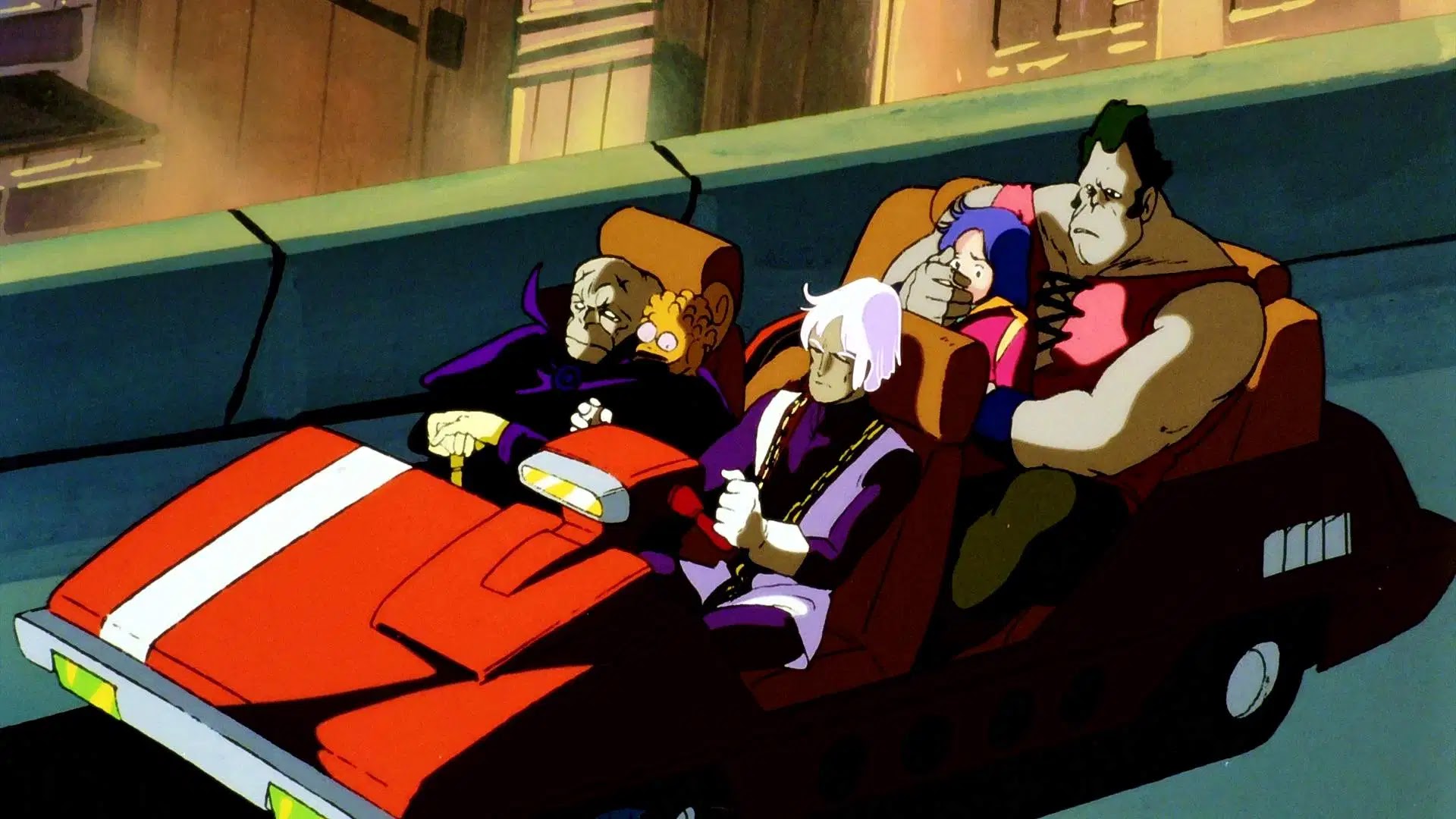
 
Haruka Takahisho said "...While observing this developing trend, thanks to "Star Wars" and all, I began to think that maybe my own stories could finally get published! So I pulled all my scrapbooks from my high-school days out of the storage, and began "novelizing." It took me two whole weeks to complete, and the end result was basically the first printing of "Crusher Joe." Now, this sold rather well, made many people happy, and I was requested to write sequels to it. And thus, it began its life as a series!"
 
Bad guys and fast cars.

Somebody's gotta clean this mess!

About the making of the Crusher Joe movie he recalls "...When I finished writing the first "Crusher Joe", the editors were asking me who I wanted as illustrators for my novel. Without hesitation, I recommended Yasuhiko Yoshikazu, who worked as the character designer for "Raideen."

But Mr.Yasuhiko insisted, "Look, I'm an animator, not an illustrator," so he steadfastly refused to do any illustrations for me. But, after three days and nights of constant begging, he finally said, "Oh, what the hell!" You see, one of the troubles was that Mr.Yasuhiko had this belief: "Real animators draw using pencils only, because real animators don't use ink!" But I told him, "It's no problem - You just go ahead and draw with pencil, then I'll Xerox them and send the copies to the publisher." He was, at last, convinced. Since that day, Mr.Yasuhiko worked prolifically not only as an animator, but also as an illustrator, and even as a manga author.

Because this combination --- Takachiho & Yasuhiko --- had produced a hit, Sunrise wanted to release "Crusher Joe" as their first original theatrical anime production. This led to the theatrical version of "Crusher Joe."
 
You can read the full interview at Animeigo.
 
Here's the original Animeigo movie/OVAs trailer:
 

Here's the Blu-ray box Japanese trailer:


Here's every Japanese TV ad for the Blu-ray box set release:


Jul 11, 2019

マクロスΔ(デルタ) / Macross Delta

Macross Δ.
It's hard to start another Macross review without mentioning how much this franchise has grown despite the Harmony Gold (Tatsunoko & Big West?) blockade that has stopped Japan from exporting its wonderful series, movies and music. Anyway, fans don't give up so easily and thanks to the internet, there's a huge community built around Shoji Kawamori's gargantuan creation. It's not secret a few days ago Harmony Gold renewed or extended (it's not clear at this point) its license contract to profit from SDF Macross, SDC Southern Cross & Genesis Climber MOSPEADA, meaning things don't change for the avid fans. Expensive import box sets, bootlegs, fan subs, and E-Bay have been playing a crucial role in the expansion of the franchise outside Japan. 
Background
Today's entry is to celebrate the legacy of Macross with their latest series: 
マクロスΔ, AKA  Macross Delta, a space opera anime television series that aired on Tokyo MX in Japan from April 3, 2016 to September 25, 2016. The fourth television series set in the Macross universe, it is directed by Kenji Yasuda (Arata: The Legend, Noein) and written by Toshizo Nemoto (Log Horizon, Tokyo Majin) with Shōji Kawamori being the chief director and mechanical designer, while Chisato Mita handling the original character design. Kawamori is also credited as the original creator along Studio Nue.

A new (almost) love triangle.
Not one, but five idols!
Synopsis.

Macross Delta is about the Var Syndrome, a mysterious disease that drives people crazy to the point of losing their will and becoming extremely violent towards everyone around them. The consequences of the spread of the disease are well known across star systems and the only possible way of fighting back at it, is music. Yes, music, like in every other Macross series, only this time, there's a specialized team known as Walküre (Valkyrie in some Nordic language according to the series) This all female singing team seems pretty much like the animated version of a K-pop/J-pop band of teenagers, so if you're not into that kind of music be warned, the entire series features not one, but many songs in that style throughout its 26 episode run. Obviously, these girls are not alone in the battlefield. A full team of ace pilots is ready to aid the ladies while dogfighting the enemy's valks. Moreover, there's a bigger battle linked to the origin of protoculture and who's worthy of it in order to conquer the universe as the ultimate sentient being.

The main characters are Freiyja Wion & Hayate Immelman but, a Macross series isn't a Macross series without a love triangle, so the third main character is Mirage Farina Jenius. 

A news squadron of heroic micronians.
Massive transforming battle fortresses!
Review.

One thing that makes Macross, THE Macross, is that after 35 years of history, the “love conquers all” motto remains as relevant as ever. While there are obvious space wars taking place, the winning stroke of luck has always been brought by love, through music.


From SDF Macross to Macross Plus to Macross Frontier, Macross has always upped their game when it comes to aerial and mecha combat. The accompanying soundtrack has also been Macross' zeitgeist. Hence, some of the bad reviews that claim Macross Delta lacks depth, and that it was only made to cash in a piece of the J-Pop/K-Pop idol craze. Sadly, for old fans, the music industry is constantly changing. You can't expect the producers to bring the old 70's/early 80's hits back to life to a brand new population of Otakus. However, and as it's always been the Macross tradition, Delta features a lot of interesting connections to previous series, even in musical form. 

Fan service!
This is not what you think it is.

If some people didn't like Macross 7  for constantly  relying on music to defeat the space vampires, then Delta may not be your cup of tea. Walküre is not merely singing from afar; they are engaged in battle, often themselves at the epicenter of dogfights. And from start to finish, it is never any less ridiculous to watch the team assess combat, dodge bullets, and talk to each other all the while maintaining their harmonies!. OBVIOUSLY, this is science fiction, and liberties are taken for artistical purposes. As with Frontier before it, the premise of Delta gives the opportunity for an anime veteran to work along side a newcomer with Koshimizu Ami and Suzuki Minori fronting Walküre. The backing members are nothing to shake a stick at either with Yasuno Kiyono’s solo piece “Axia” being the most moving in the entire series. The incredible vocals extends equally impressive voice acting.Some people say, "if there's one good thing about the Macross franchise, it's the seiyuus (voice actors)".

Plotwise, the good guys v/s bad guys standard storytelling features a mild twist that will have the main characters question their views on the rising conflict between the U.N. forces and the Windermere. Interestingly, the series also spends time explaining the origins of protoculture, and how this ancient power is linked to music as the ultimate weapon. Unfortunately, other stories weren't fully explored: Walküre's group dynamics, the Windermere short lifespan, Mirage trying to live up to the legacy of her family, character development/growth, etc. Yet the series never takes advantage of them, preferring to remind the audience of plot and lore. Where previous incarnations were oddly unconcerned with mythology beyond pineapple related fanservice, Delta is smothered in it, leaving nary a moment to properly develop its characters. Walküre itself is a stock sentai even by stock sentai standards. Even at the forefront, Freyja experiences little drama outside small bouts of anxiety. Likewise, her relationship with Hayate is treated less as a budding romance and more of a foregone conclusion. Despite Macross’ reputation for love triangles, there is barely a token one, as Freyja’s supposed rival Mirage gives up on Hayate in the early episodes.

Idols are for kids!
I mean, Idols are for everyone!

It causes no shortage of frustration to think that in 26 episodes, Macross Delta invokes not an iota of pathos. Tantamount to the kind of pop songs presented here, beyond the high production value, the series isn’t really about anything new. Longtime Macross fans already know about the origin of protoculture (Macross Zero), the power of music (every Macross series, OVA and movie) and love triangles (same). The fact that now we have five singers instead of one, or two, doesn't really add to the overall plot of "let's defeat the bad guys through music and some dogfighting". 

I know a lot of people bashed this new series, but don't get me wrong, Macross Delta is good for what it is. I don't think the producers were desperately looking for adding new elements to the well established franchise mythology. Besides, we all love to see a good story retold many, many times. Take a look at movie reboots, or the MCU, where, honestly, a lot of stories have been retold, yet people frigging loved them. However, if you're looking for something fresh, please feel free to answer who is Lady M?

A familiar face.
Could Lynn Minmay be "Lady M"?
Apparently this is the greatest mystery Macross Delta has to offer us. As for the choices above:

Mikumo - It would be too obvious. besides she's got a mystery to solve on her own. The dreams?

Mirage - She's only a pilot, related to some great pilots, but only a pilot. I can't see how she can have some authority in the Government.

Makina - No need to say anything.

Minmay & Misa & Milia - They would be like sixty, respectively seventy and hardly can I image getting involved. Besides, I'm not sure of how much Kawamori and the other creators would like to bring past characters. Maybe from the more recent series yes, but the SDF series is far too old to stand a chance.

Myung - Don't think so. Macross Plus isn't one of the most popular and most beloved series in the franchise, besides being just a four-episode OVA, and bringing Myung would shock the fanbase, but not necessarily in a good way.


Mylene - She's a singer. Despite being related to the army (pilots), I'm not sure how much interest she could have gotten over time in politics, so that she would end up as some really important person in the Government. Not probable... at all.

Miranda - She would bring from the previous appearances little to nothing. It would be easier to bring her back than Mylene, Minmay, Misa, Myung, from the other series. And also all these characters had already had their stories. Miranda stands a chance of being brought back just because she wasn't part of the story before appearing just in 2 or 3 episodes, and can finally get some action for herself. She may be just an idol as well, but somehow she stands this chance.

Mao Nome - because M; Because of that weird thing Gramia and Heinz say: Rudanjal Rom Mayan, and Sara Nome was a Mayan priestess - which kind of connects things;
- Because The Song of the Wind - thing appears in MZero as well, and is connected to Mao herself;
- Because it wouldn't anyway be the first time Macross Zero proved to actually be important to more recent events.

However, Berger Stone (the Arabian businessman in the series) said
there is a rumor that connects Lynn Minmay to a backer of Xaos known as "Lady M".

The Windermere shall rise and conquer!
Now, we're in trouble!
The finale has the… unenviable position of having to tie up so many loose ends at once, making it clear the production crew was on a deadline. Delta, especially in its second half, suffered from weak pacing, underdeveloped characters and excessive subplots and the finale has to ignore for the sake of the main plot. Still, Delta Squadron has saved Ragna and Hayate and Freyja get their happy ending, but the Windemereans make it clear the war is not over and the death toll numbers in the millions. Also, poor Mirage got her Love Confession rejected.

For the Windemerians’ case, their future doesn’t look bright for them. Though Heinz is willing to establish peace talks and at the same time, wants the UN Government to pay for their sins, it might not go very well and his kingdom will suffer a lot of backlash from the intergalactic community for their actions. Likewise, Heinz is slowly dying after his singing affected his health and his brother who is the strongest pilot in the air force died which not only left the Aerial Knights in a vulnerable position but also leave no successors to take the Windemerian leadership once Heinz kicks the bucket.

The power of music will be back!
Certain songs get you naked in space.

Anyway, the show did spawn the now, usual movie (and there's another on the way, suggesting a new Walküre member), an excellent soundtrack and even with all the divisive fans, I still recommend watching it for both Macross and casual fans of good quality Animé. The only thing I didn't like it was how the love triangle was handled so weakly, and according to some websites Shoji Kawamori didn't want the story to feature a love triangle but pressure from producers pushed him to do so ultimately. The movie version is focused mainly on Walküre instead of the love triangle and the raging war. Maybe that's an indication of what went on behind the scenes. 

Overall, while not as appealing as Macross Frontier, Macross Delta is another interesting installment in the hopefully, ever-going franchise. Maybe it's about time Mr. Kawamori & Co, take Macross to new frontiers (no pun intended) where the formulaic scheme is no longer needed by viewers to realize they're watching a new Macross product. After 37 years of songs and transforming Mecha, we could use some fresh air. Macross Delta tried, but according to some, (not me) it didn't try hard enough.

Here's the 1st opening:


Here's the 2nd opening:


Here's the 1st ending:


Here's the 2nd ending:


Walküre live 2018:


Mikumo & Freiyja in the studio:


Japan Expo 2017 featuring Macross music from different decades as "performed" by cosplayers:


 Walküre backstage:


May 15, 2019

マクロスF(フロンティア)/ Macross Frontier

Idols & space robots return!
A few days ago in the magical world of Japan, NHK (Japan's national public broadcasting organization) celebrated the "Ultimate Macross Poll", a feast like no other for Macross fans. The celebration included the participation of Macross celebrities, creators (Shoji Kawamori, the God himself) and if you want to know more about it, you can totally open this link were educated people compiled every bit of information and translated it to English right here. Now, what does this have to do with today's entry? EVERYTHING!! マクロスF (フロンティア) was voted as the number 1 all time Macross Animé!

Taking place 47 years (story-wise) after the original series, Super Dimension Fortress Macross, Macross Frontier is everything old & new fans can expect from a franchise that has proven time after time, to be larger than life!


New Valkyries!
New idols!
Background

Macross Frontier is the twelfth installment (yes, twelfth!)* in the space opera franchise, with Macross Zero being the previous OVA series and Macross Delta being the latest entry in the saga to date.

The macross chronology (not including Manga, novels, video-games and musicals) is as follows:


  1. Super Dimension Fortress Macross (1982)
  2. Macross: Do You Remember Love? (1984)
  3. Macross: Flashback 2012 (1987)
  4. Macross II: Lovers Again (1992)
  5. Macross Plus (1994)
  6. Macross 7 (1994)
  7. Macross Plus Movie Edition (1995)
  8. Macross 7 The Movie: The Galaxy Is Calling Me! (1995)
  9. Macross 7: Encore (1995)
  10. Macross Dynamite 7 (1997)
  11. Macross Zero (2002)
  12. Macross Frontier (2007)
  13. Macross Frontier The Movie: The False Songstress (2009)
  14. Macross Frontier: The Wings Of Good-Bye (2011)
  15. Macross FB 7: Ore No Uta O Kike! (2012)
  16. Macross Delta (2016)

*While Macross F is the 12th official release in the franchise, it's the actual third Macross series, so in terms of story continuity it'd be the direct sequel of the Macross 7 series made in 1994.

Written and directed by Shoji Kawamori & Yasuhito Kikushi, the third full series entry in the popular Macross franchise, which aired in Japan from April 3, 2008 to September 24, 2008. The series began airing during Macross' 25th anniversary and has proven immensely popular (its Blu-ray release was the single best selling HD release in the entire Japanese marketplace in 2008, and one of its soundtracks sold as many in its first week as a Neon Genesis Evangelion soundtrack - a decade-old record). It even spawned two movies.
 
Zentradi boobs.
Very large micronian boobs.
The story is set in 2059 aboard (and in the space surrounding) the titular Macross Frontier, one of the many colonization fleets heading from Earth towards the centre of the galaxy in search of a new home to settle. However, Frontier's mission is suddenly disrupted when it comes under attack from a bug-like alien race known as the "Vajra".
 
There are three main characters: Alto Saotome, an ex-kabuki actor turned pilot who feels oppressed by the domed skies of Macross Frontier but also an obligation to protect them; Ranka Lee, a spunky young girl with a severe case of post-traumatic stress disorder and a dream of becoming an Idol Singer; and Sheryl Nome, a popular and headstrong Idol Singer from the neighbouring Macross Galaxy fleet who is known as "The Galactic Fairy".

Friends will be friends.
Brunch, Macross style!
The stories of these three intertwine amidst the Vajra attacks on the Macross Frontier, slowly revealing dark conspiracies that seem destined to determine which direction mankind will move forward into the stars.

A movie version was announced at the airing of the last episode of the series. It was initially expected that it would largely be a clip show of the series with some new scenes, similar to Macross Plus, but as the project developed it eventually became more of an Alternate Continuity retelling that was split into two movies. The first, The False Songstress, was released in November 2009 and covers the range of episodes 1-7 in the series, including numerous new and altered scenes as well as several new songs. Some scenes were altered quite drastically. For instance, Sheryl Nome's fall during her first concert in episode one was caused by Alto accidentally knocking her off during a stunt, while in The Movie she jumps off the stage by her own free will. The second movie, The Wings of Goodbye, was released on February 26, 2011 which resolves the Love Triangle that has hounded the show since the first episode.

With the release of the TV series, several PSP and PS3 games were released consisting of Ace, Ultimate and Triangle Frontier. Trial and Last Frontier were bundled with the two movies when they released to the public, and a PS3 crossover game (done in the style of the PSP games), Macross 30: The Voice that Connects the Galaxy was released in February 2013. A few mangas/light novels/drama CDs were also released, contributing to the storyline of the show.
The Macross 7 crossover movie, Macross FB7: Listen to My Song!, premiered October 20, 2012 and is set in the middle of the TV series.

Sheryl Nome and her hope & dreams.
You must feel the music flow.
Due to a current legal dispute over the distribution rights of the Macross franchise, involving Studio Nue and Big West against Harmony Gold, much of the Macross merchandise post 1999, including Macross Frontier, has not received an international release. However, there are still ways to get your hands on official DVD/Blu-ray sets from the Macross franchise. The only problem, is shipping is a bitch, and you need to know Japanese in order to understand what's going on because there are neither English dubs nor subtitles available in the Japanese official editions. 

Unfortunately, for the Harmony Gold corporate greedy pigs, Macross is really big outside Japan, and fans around the globe, have always found ways to watch every new entry in the saga, and hopefully by 2021 Harmony Gold finally loses the outside-Japan-merchandising-rights to Macross, and finally, fans will move on from black market fan-subbed copies, to official merchandise from once and for all.

Review

Macross F isn’t merely another sci-fi space opera. Despite incorporating just about every anime cliché in the book (some of them established by the original series) Macross Frontier manages to create something that is simultaneously the maximum fulfillment of its genre’s capacity and also the complete and utter subversion of its viewer’s expectations. It’s been hailed as 'the SDF-Macross of the 21st Century', and there’s no doubt about that; even for viewers unfamiliar with the original Macross series, Macross F plays as a standalone series of its own. Moreover, it manages to explain the origin of its world in a single episode by re-telling the Macross Zero story. Years earlier, Macross 7 did the same thing while explaining the events that took place in the Macross: Do You Remember Love? movie. A clever move that was masterfully reprised on Macross F as to allow new fans to understand what makes music & technology so relevant to warfare matters.

The directing is a combination of what made SDF Macross a classic and updated techniques that take advantage of the new animation technologies available. The signature tracking shots of dog-fighters have been given extraordinary retrofits with wonderful CGI integration, and immediately call to any Macross fan’s mind the meticulously drawn epic battles of the original series and its companion film, yet they still manage to remain largely unique. This lies in the masterful art direction and consistently top-notch quality found throughout the whole series, giving the impression of absolute relevancy yet remaining “Macross” enough to justify just enough nostalgia to appeal to any fan.


Ranka Lee, the new rising star.
Oops! no undies!
Macross has always being popular for featuring some of the coolest songs in Animé history, and while old school fans like you and I, may find it a bit hard to get used to the 'new sounds of Japanese animation' Macross F's soundtrack is easily one of the series’ highlights. The ballads from the original series, and the alternative rock from Macross 7 have been somehow merged and updated into a more J-Pop/K-Pop feel that may not be every old school fan's cup of tea, but believe you me, there is a high quality product here. Yoko Kanno provides the perfect musical accompaniment to the lovely vocals of Megumi Nakajima and May Nakabayashi. The climax of the whole show provides one of the most interesting medley collages of music I’ve ever encountered, and pretty much reestablishes (or at least adds credence to) Yoko Kanno’s position as one of the greatest soundtrack composers of all time.

"1st Anime Album in 11 Years to Rank in Japan's Top 3"

"Two Macross Frontier Singles in Japan's Weekly Top 10"

"All four of the Macross Frontier singles that have been released have debuted at #5 or higher."

How does that sound for starter? The Macross series were largely famous for its music as they all played an integral part in every single Macross title. However, one can say Macross Frontier have taken the anime song industry to a whole new golden era! Both the singer and seiyu responsible for singing the second OP won awards for their fabulous works.


Pick your favorite idol.
Music & space fights: Classic Macross!
And then there’s the story. Classic Macross! We have a group of daring Valkyrie pilots, transforming space fortresses, not one, but two singers that have the ability to disturb the enemy while the fight is taking place. We also have the classic love triangle figure, an mysterious alien race that wants mankind dead, and a lot of interesting characters that play key roles as the series reaches its climax. Oh! boobs! we have boobs! Moderate fanservice, but yes, there is a little here and there.

Its seemingly simplistic plot allows for character development (at least the main characters) in leaps and bounds, to the point that just about every character in the series is fleshed out enough to be a well-rounded and three-dimensional device. Despite this, Macross Frontier remains a heavily plot-driven show, as much of the conflict created between the characters—masterfully handled as it is—remains largely unresolved through interactions and relies on plot-driven consequences in order to keep the whole narrative flowing. At times this peeks through as a detriment, but for the most part the show manages to balance itself out. To its credit, it never fully lapses into ungrounded melodrama and angst in order to illustrate character interaction, and seems to be acutely aware of the fine line between well-executed drama and baseless moaning. In compensation for its shortcomings with overall character drive, the plot takes advantage of allegory and an abundant use of vague foreshadowing to create an ever-shifting storyline that never really has a chance to congeal into a set routine. 


a familiar view.
Alto Saotome,  our hero.
Now, let's take a look at the main characters:

Alto Saotome

Alto's a high school student in the Mihoshi Academy, studying its "Pilot Training" course. As a result of his fine, feminine features and long, blue hair, he's often mistaken for a girl at first glance, even receiving the In-Series Nickname "Hime" (Princess). Otherwise, Alto's your Ordinary High-School Student, though somewhat aloof and standoff-ish. Born into a well-known Kabuki family, his persistent yearning for the skies has made a thorny relationship with his father Ranzou Saotome. He constantly frets having to live aboard the Macross Frontier fleet, due to the lack of a "true sky". After getting the chance to pilot a VF-25 Messiah variable fighter (due to its original pilot, Henry Gilliam, being killed by a Vajra space mecha-drone) and seeing the destruction brought upon by the Vajra, he makes it a point to serve the S.M.S., a private military corporation, to protect those around him and fulfill his dreams of taking to the skies. Under the designation "Skull-4", Alto serves under Major Ozma Lee of the S.M.S. Skull Squadron.

Throughout the series, Alto balances both school and military life, being called into service when the Vajra attack. He also develops emotional bonds with Ranka Lee, a young girl who aspires to be a singer and shares Alto's similar drive to achieve his dreams, and Sheryl Nome, the Idol Singer from the Macross Galaxy fleet.

Ranka Lee

One of two female protagonists, Ranka's a petite, lively and cheerful (although naive) teenage girl with green hair and one-quarter Zentradi, which gives her a unique ability to have her hair move on its own according to her feelings, including an above-average resistance to the vacuum of space. Ranka suffers a mild form of amnesia due to having witnessed the destruction of the 117th Long Distance Research Fleet where her biological family perished. As the adopted younger sister of Ozma Lee, she initially attends an all-girl's high school at the urging of her brother while working part-time at the Chinese restaurant "Nyan-Nyan", but later transfers to Mihoshi Academy to facilitate her singing career after being discovered at the Miss Macross Contest and an ensuing movie. Ranka started off as a huge fan of Sheryl Nome as she loved singing since her childhood and had dreamt of becoming a singer. She develops a crush on Alto, especially after being rescued by him when the Vajra first attacked the Macross Frontier fleet.

Idol panties are a galactic collectible.
"Is it true you saw Sheryl naked?".
Sheryl Nome

The second of two female protagonists, Sheryl's known as the "Galactic Fairy", a pop idol from the Macross Galaxy fleet who constantly topped the music charts, leading people to say it was impossible not to hear her songs if you lived in the Milky Way. Her popularity was soaring just as high in the Galaxy's sister fleet, Macross Frontier. Due to her beauty and singing talent, she's a very proud and self-assured person. Sheryl recognizes the singing talent of Ranka and often offers to help her "behind the scenes" to realize her dream. Sheryl's first encounter with Alto was when he served as a backup stunt performer at her first concert in the Frontier, leading her into the series' archtypical Love Triangle.


Now, the secondary characters, are what some reviewers have called as the major weakness Macross F has. Mostly due to a lack of development in their personalities. Allegedly, these characters "don't grow" enough by the end of the series. Moreover, some people have called Alto Saotome, the weakest main character of the series, as he seems to behave the same throughout the whole series, while Ranka & Sheryl clearly change their personalities, due to the issues they face. Fair?, Unfair? You decide. I for one, think the series features a fair amount of secondary characters serving a purpose, while avoiding to stay one-dimensional. You can't deny how relevant Ozma Lee is to the series! Moreover, Mikhail Blanc & Klan Klein's love story is hilarious!. Catherine Glass is the updated version of Claudia La Salle & Misa Hayase! How can't you not find that good enough! (psst, there's a love triangle going on there too), and let's not forget about Grace O'Connor and the mysterious Brera Stern, both characters very relevant to the story so I'll leave their story for you to find out.

But what about that lame ending? 

To a lot of Animé fans, the ending of the series felt incomplete as Alto never made a choice between Ranka & Sheryl. Fan theories, fake interviews, and fake info all over the web may or may have not influenced producers to offer a clear ending in the Macross F: The Wings of Good-Bye movie. If you ask me, and considering I'm an old fart, since I became a "fully functional adult" years ago, I sorta stopped enjoying the romantic stories offered in most Animé because they simply felt 'too childish' for me to actually relate to them. Honestly, I feel there are a lot of interesting things happening on this Animé besides who's Alto going to put a ring on it. However, if you're interested, I'd say he clearly chose to keep on flying, and to my limited understanding, he chose that over the two girls. Obviously, the second movie settles it very clearly. If I was Alto, I'd choose Sheryl simply because she's an adult woman!.

Are you talking to me?
Massive space battles!

Overall, Macross Frontier is a series that will have both new & old fans of the franchise craving for more as soon as the 25 episodes are over. 25 episodes because the series was made for the 25th Anniversary of Macross! Be sure to watch the series and find a lot of extra number 25 related themes, like Ranka being a quarter Zentradi and more! What are you waiting for? go watch it now!


Here's opening 1:


Here's opening 2:


Episode 17's special opening:


Here's Ending 1:


The ending featuring the "Aimo" song:


 Ending 3:


The Blu-Ray reissue ad:


The PS3 Blu-Ray box trailer:


Macross Frontier Galaxy Tour: