Showing posts with label Vampire. Show all posts

Mar 4, 2015

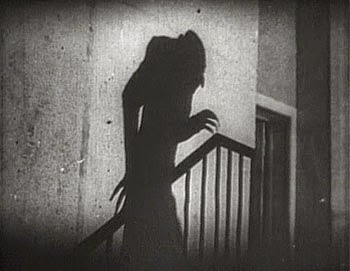
Nosferatu, a Symphony of Terror

Can fake be better than real?
Our previous entry was a long time debt I had with one of the most, if not, the most iconic horror movie character of all times: The great count Dracula, Lugosi's Dracula to be precise. However, as connoisseurs we know there was an even darker take on Bram Stoker's best seller. One with illegal issues and a way more satanic look: Nosferatu! the original silent movie from 1922, cursed to oblivion due to copyright (hey, if Nosferatu was released today, no one would notice it! Today every film seems to be an opportunist counterfeit version of greater films from the past) 

Nosferatu must be one of the most elusive films you can watch, elusive because since it was banned for being illegal, most of the original copies were burned down (like a fucking witch) and whatever version you could find, it was obviously not the complete film. Hell! there are editions with completely scene arrangements and even different soundtracks! Luckily, the Kino studio, perhaps one of the leading leaders in film restoration worldwide, did a wonderful research to recover as many film pieces they could find, thus delivering the most complete edition to date of this magnificent piece, that I gotta tell you, it can really scare the shit out of you, just by looking at Count Orlok's evil look.

The many faces of count Orlok.
"I am...Orlok"
'Nosferatu' opens with a man looking at his reflection in a mirror. Besides its symbolic significance, this is a perfect distillation of his character, that of a vain, narcissistic, absurdly self-confident to the point of machismo, married man largely indifferent to a wife he abruptly leaves to make the fortune worthy of a man of his merits. He ain't afraid of no ghosts, nor robbers. So, the image he sees in that mirror is one of wholeness, perfection - I am Hutter, I command all I see, my unity of identity is linked to my power in body.

To the viewer, however, the effect is the precise opposite. The framing of the scene is fragmented, with the outer frame, the window and the mirror; Hutter himself is doubled - the 'real' Hutter and his reflection, or shadow. All the assumptions smilingly embodied in Hutter will thus be destroyed in conventional horror terms.

His whole identity will be destroyed - the Count will suck his blood and in effect become him, if we believe the man who claims 'blood is life'. Hutter's body will first become passive, feminised as he is violated by the Count; after, he will no longer be a body, but a shadow, bloodless - literally, he shadows the Count as the latter comes to England; and symbolically, in that two men now claim possession of Hutter's wife, and both have equal claim, both being Hutter. 

Heard something in the kitchen, better catch up.
Bram Stoker is that you in the kitchen?
Murnau is careful to give his horror story a genuine patina as an 'objective' story: no horror film has come as close to capturing the visual essence of all those stories that have circulated in Europe for centuries, the twisting medieval towns, the arcane religious symbolism, the plagues and mass hysteria, the crumbling castles and storm-tossed ships, the creak of wood - the look of the film feels like a crumpling manuscript setting out the story.

But the film is also the portrait of a marriage. The opening sequence chillingly reveals the sterility of a marriage before anyone has even heard of the Count - Hutter wrapped up in himself; Ellen, hypersensitive, morbid, dressed as if in mourning; the union childless; the couple, above all, separate, each completely misunderstanding the other.

The image of the mirror is repeated throughout the film, connecting Hutter to the Count - the scene in Knock's office where Hutter looks at the map of Transylvania just as he did his mirror; the Count's house directly opposite Hutter's, a decaying edifice that looks like a melting, anguished face. 

Land Ho!
Global warming is real!
But Ellen is linked to the Count too, her somnolent rising mirroring his. This isn't a conventional opposition between bourgeois and bestial urges, even though the Count is given the most grotesque animal features, and even though Murnau never lets us forget the Count as emanation of the Hutters' dreams, desires and fears - Hutter reads that he will shadow his dreams; Ellen spends most of the film sleepwalking.

All three elements of this triangle, which symbolizes the one relationship, is linked to death - the Count, the undead, living in coffins of dead earth; Hutter, narcissistic, onanistic, his lifeblood siphoned from him; Ellen, the Venus fly-trap, self-abnegating destroyer of the destroying force. Hutter ends the film as he began, alone, his lust for money and status destroying the union that crowned it. The contrivance of society and respectability is swept away by the malaise of nature, those gendered forests, tides and moons, as if the Count and Ellen are part of the one female nature Hutter cannot accommodate.

Evil picnic.
Such Freudiana is undermined in the film in two ways - in the disarming comedy of the piece, the Count often seeming to have strayed from a silent comedy, running around London with his coffin; and by a self-reflexive examination of film, that sees the warning about vampires in the book Hutter reads linked to bestiality and the eye that is so important in the film; the turning of the film stock into negative as Hutter enters the Count's realm; the trickery, such as time lapse and fast motion, that shows the Count's mastery of time and space, but, more importantly, Murnau's mastery over the storytelling, already indicated by an unseen, but constantly intruding narrator; even Ellen's couch seems patterned as strips of film. In a movie where human sexuality is impossible, the characters seem content to be voyeurs, like the film audience, staving off the death, the loss of identity, or at least its fragmentation, that contact with another person entails. 

here's the movie trailer:


And here's one of the many Nosferatu versions you can find (it's public domain, so do not worry)


Mar 3, 2015

Dracula

Gentlemen horror.
"Listen to them. Children of the night. What music they make!" so said Bela Lugosi in what was to be the role that cemented him as a pop culture icon of American film. To see director Todd Browning's original 1931 adaptation of Dracula is to see the American horror film at its finest. Dracula is the vampire formula at its purest before it could be diluted by the telling and the retelling. Dracula is a surreal experience as Browning takes us with him on a journey into our fear of death, but also our fear of the filthiness of sex. It is a film that has aged like a good wine which Bela Lugosi's Count Dracula swore to never drink.

If one were to try and dissect Todd Browning's Dracula to find a sole element of success the search would lead us time and time again to Bela Lugosi. Dracula simply is not Dracula without Lugosi's portrayal of the Count. So much credit has to be given to Lugosi and his portrayal of the titular character. It is doubtful this film would have the staying power, or the atmosphere that it has if another actor was portraying Count Dracula. Lugosi's performance and how it succeeds is the marriage of so many factors, but arguably Lugosi's greatest asset to his performance would have to be his rich Hungarian accent. Lugosi surprisingly doesn't get much dialog in the film as much of the exposition comes from the protagonist Professor Van Helsing played by Edward Van Sloan, and Dracula's slave Renfield played by Dwight Frye. The lines Lugosi does deliver are often extremely concise. It is not the lines themselves, but rather the way Lugosi delivers them that creates this character. How Lugosi delivers the lines offers more insight into this character than any detailed dissection of the character could. Lugosi's lines are read almost phonetically, each word one by one, each little nuance of the language stressed in Lugosi's thick Hungarian dialect. The resulting effect is hypnotic, poetic, frightening, and in many ways very sad. Lugosi's introduction is in my humble opinion one of the strongest scenes in motion picture history almost solely based on the delivery of the line "I am... Dracula". The scene follows Renfield, a solicitor whom Dracula will drive mad, as he ventures through Dracula's dilapidated castle searching for the Count. Dracula appears out of the shadows sucking in whatever air Renfield could muster in these catacombs of death by merely saying "I am…Dracula." Lugosi's delivery is as much a part of the aging castle trapped in time as the cobwebs are. Lugosi was so suave and mysterious as Dracula that the audience became attracted to the vampire. 

"I am...Dracula"
Look into my eyes mortal.
Dracula is not merely Lugosi's picture though. The film has a strong supporting cast highlighted by actor Edward Van Sloan, and Dwight Frye. One thing that can be said of Dracula's entire cast is that despite the extreme material no one even comes close to going over the top with their role. The amount of sincerity and the absence of any tongue in cheek aspect of performance are to be admired. Sloan and Frye's characters both had the potential to skate towards over the top territory, but both performances are firmly grounded in reality and are very effective in complimenting Lugosi's Dracula.

Dwight Frye is very strong as Renfield. The role is as complex as that of the Count. Renfield is a bipolar madman enslaved to do Dracula's bidding. Frye is asked to exhibit behaviors on all forms of the spectrum. This character and the characterization are unpredictable to the extreme. One constant about Renfield is that he is the predator, and he represents the fear of sexuality within the vampire mythos. Frye's facial expressions are other worldly especially when we see the extent of Renfield's madness. There is a scene where Renfield crawls with vulture eyes towards a housemaid who has fainted by the sight of his very appearance. Frye too is asked to deliver insight into a character despite the fact that the lines don't explicitly offer character exposition or development. Renfield's dialog mainly consists of nonsensical lunatic ravings. The way Frye delivers the lines and how he builds the intensity is really powerful though. It is these build up of the madness that keeps this character effective.

Dracula's Dead Wives.
Now that's a tasty neck.
Technically Dracula isn't all that impressive a picture from a cinematographer's standpoint, but does it really need to be? Browning is very cautious about what he wants to do with his camera. Much of the film is very static and offers little to no movement of the camera. What Browning captures in his shots though are really powerful images. The amount of attention given to the detail of each shot truly is amazing. The fact is there is not one shot of Bela Lugosi blinking in the entire film; that shows an incredible commitment. Browning is more of a still photographer than he is a cinematographer, but the power of the images is unmistakably there. This static dream-like world is perfect for the subject material.It may hurt the pacing a tad, but an argument can be made that the audience are much better able to appreciate Bela Lugosi, and even Dwight Frye's performance due to the way Browning stages his picture. Browning's appreciation for the hypnotic quality of images is one of the strengths of the film, not one of the weaknesses.

Dracula is a masterpiece of film making. The film still offers a hypnotic experience almost 80 years after Bela Lugosi first uttered "I am…Dracula". It is a film that has only gotten better with age. Todd Browning and Bela Lugosi succeeded in creating a surreal picture where vampires do exist. 

Van Helsing VS Dracula!
Talk to the hand!
Overall, a film that is absolutely obligatory in any connoisseur's personal collection.  However, if you're not too experienced in watching these kind of films you may feel a bit bored due to the lack of graphic action scenes or because of the slow pace the film has in order to make room to believable character portrayal. 

Now, what would the SPAM Alternative recommend? Watch it, but watch it thinking it's a 1930's film where things were so different than they're today. Back in the day censorship had Nazi-like features, no blood, no bitting, no sexual innuendo, no language, no nothing you can find everywhere today. Still, the lack of blood or graphic violence serves this film well, as you get the impression of watching a delicate classy horror film, not a cheap gory flick in the lacks of most of what a horror film is according to today's standards (well, since 70's standards) The way Lugosi stares at the camera really makes you feel he's a force of evil. Dracula, the original 1931 movie is a pleasure of film scholars, but you can become your own scholar appreciating classics like today's film in review. 

A gentleman Vampire.
Luckily, for us human beings of the 21st century  Dracula is now public domain, so you can have it legally for free (unless of course, you buy a physical copy) anyways, there are some excellent quality DVD/Blu-Ray editions around the globe, if you want to watch it in pristine quality.

Here's the movie trailer:


Here's the entire film for your scholarly pleasure:


Jan 13, 2015

Reipu Zonbi, Lust For The Dead

Zombies are sick o' brains.
Think of three words: Nudity, Gore & Violence. Do they get along? sure they do! Do people get sick and tired of films based on those three words? Nope, Not yet, never! Japanese film maker Naoyuki Tomomatsu is a well known character who has spent most of his career directing films under the "Pink movie" category. A Pink film, for the Japanese is the equivalent for us non Asians, of the exploitation, sexploitation & softcore films. Tomomatsu's career goes back a long way (the early 90's) but his most important films were made in the 21st century (Chikan Densha, Female Prisoner Ayaka and Maid-Droid) Nevertheless his name became important once he filmed Stacy: Attack of the Schoolgirl Zombies in 2001. The film was considered as a comeback to the classic gory zombie  genre.

Reipu Zonbi, AKA Rape Zombie is a 2012 film that depicts the aftermath of a nuclear explosion that contaminated Tokyo. The film had its name changed for international releases as Lust Of The Dead(maybe due to "rape" being a highly censorable word)

Due to some weird phenomenon, males everywhere are turning "toxic". They start bleeding from their eyes and start raping every female they see. The females have to band together to fight off ravenous hordes of "rape zombies", who have highly poisonous semen to boot, and can only be killed by castration or a gun blast to the genitals. The funniest scenes involve female soldiers forming firing squads to execute "toxic males", who are bound and dressed in bulls-eye underwear so they know exactly where to shoot. The castration and genital blasting jokes wouldn't offend anyone in America, but many people would take the rape scenes way too seriously. Hordes of male "rape zombies" penetrate females who all conveniently have their silicone-enhanced breasts exposed and bouncing around, and of course they eventually end up enjoying the experience, at least before the poison semen does them in. But if you don't let your PC panties get in a bunch, you'll realize these "rape scenes" are every bit as ridiculous and funny as the firing-squad scenes.

The news are spreading and girls are too!
Schoolgirls and machine guns.
The main characters meanwhile are four female "survivors" who are holed up in a shrine. The main character, the badass, is played by Asami(Rina Aikawa), who is often called a "porn star", but seems to mostly appear in low-budget sexploitation fare like this as opposed to out-and-out "AV" (adult videos). There are also a pair of lesbians, who have a long scene together--it's NOT true all the nudity in this involves rape. Then there's a very sexy and mature-looking "schoolgirl" (who's even less believable as a genuine schoolgirl then is anything else in this movie). She's so horny for a (non-toxic) man she decides to seduce the young priest of the Shinto shrine, who is seemingly immune to the virus since he has taken a vow chastity. The result of this schoolgirl seduction is pretty predictable, but also very sexy.

Rape Zombie: Lust of the Dead is more or less a Japanese remake of the Troma film 'The Taint' but with more rape and guns and Japanese girls. I think it is needless to say but this film is not for everyone its an erotic exploitation horror film about rapist zombies full of sexual violence and nudity, only for those who can handle seeing a lot of messed up stuff. The girls in this film are very attractive sadly the only time you see them nude is when they are being raped which isn't the best way to see them. The acting is decent along with the writing and effects some of the effects are pretty good then at other times there is super fake CGI blood and visual effects. The effects are still pretty good its kinda like the effects in 'Ichi the Killer' good and bad but still cool. The camera-work and lighting are kinda OK you know shaky cam at times and a bit of lens flair here and there. The film has a very Vampire girl vs Frankenstein girl look and vibe to it, violence, gore, nudity, sex, schoolgirls. And apparently this film was so popular in japan that it had a sequel and another sequel that came out last year another that came out this year and another that is planed to come out this year. so yea watching at least one sequel.

I'm gonna cut your dick you zombie perv!
Double decapitation IYKWIM.
On the gore meter from one to ten one being something like 'The Corpse Grinders' and ten being something like 'Braindead' this film is a 5/10 lots of gun violence, sexual violence, a beheading, zombie violence and blood. Compared to his previous films (specially with Stacy) the amount of graphic violence has been heavily toned down perhaps to appeal to wider audiences (as a matter of act this film is very popular outside of Japan)  

Rape Zombie did so well that the next year (2013) Tomomatsu not only released the sequel but also the sequel of the sequel (!) and guess what? last year there were two more sequels! So we're talking about five movies about zombies who rape! boy that escalated quickly. However, the original 2012 film being reviewed today is by far the best out of the franchise. Despite not being a very original idea, the plot delivers and people like it the way it is. Maybe you wouldn't watch it with the wrong people though (but you're connoisseurs so you already know that) Those who have a sense of appeal for the nude japanese woman body may be interested too. 

These make a pink movie.
Japanese Nudity.
Generally though, this movie goes for entertainment value first with the masturbation appeal only secondary. I wouldn't call it a "pink" film exactly , but it's much closer to that than it is to actual porn (It's what in other countries used to be known as "sexploitation"--films that definitely USE sex, but aren't NOTHING BUT sex). I don't know if I'll watch the rest of the franchise, but this one was pretty fun. 

Here's the movie trailer:

Aug 19, 2014

Leonor, Mistress Of The Devil

Till Death do us part?
Leonor is a 1975 art romance horror film directed by Juan Luis Buñuel. The film premiered two years later outside of Europe and was also known as Mistress Of The Devil. This medieval tale revolving around a Satanic pact that results in resurrection and a spate of vampire killings was considered too atypical for either sensibility and consequently fell through the cracks over the years; then again, such disparaging remarks by popular critics as Leonard Maltin – who labeled it "idiotic", even awarding the film his dreaded (but undeserved) BOMB rating – has not helped the chances for a proper reappraisal much! Indeed, most seemed to be of the same opinion as it prematurely terminated the director's career in mainstream cinema – he would go on to make just one more feature-length film in 1986, an obscure Western entitled THE REBELLION OF THE HANGED – and was restricted to work exclusively in TV thereafter!

Now, reviews from this movie are only based on prejudice and preconceived cliches of what a horror film should look like. Believe you me, this movie has horror within but,  explained in a non-graphic scheme that requires bone heads to pay close attention.

Though the film is a Spanish/Italian/French co-production, the copy I watched featured audio in English, Spanish & Italian.The only problem being, that in both English and Spanish there were several missing portions of dubbing that forced you to listen to the original Italian track missing some important dialogue. Of course, if you speak Italian that won't be an issue for you. 

Leonor has a thing for kids.
Catherine.
The presence of Michel Piccoli(Richard, the main character) and Liv Ullman(Leonor) drew obvious parallels with the works of Bunuel's own more renowned father and Ingmar Bergman respectively; the obsessive love lasting beyond the grave shared by the protagonists and the general sense of godlessness on display was clearly up the Spanish Surrealist's alley, while the character-driven downbeat nature of the whole is akin to the austere Swede's chamber dramas.

Ornella Muti co-stars as Piccoli's young and lovely second wife Catherine who, failing to replace his affection for the late Leonor, will take the worst part in the film. 

Leonor, despite the movie title, is more about Lord Richard, a powerful hero who lives in a big castle and owns wide lands while holding big reputation amongst those around him. Unfortunately, no hero could fight the black death during the middle ages so, his lovely wife Leonor succumbs to it very quickly. On the same day his wife is buried, he immediately goes after Catherine (Muti) for a marriage proposal, and since he's respected in town, She & her family instantly agree. Ten years go by, and they have two young kids and a peaceful and happy life. 

Things change when Richard starts seeing her late wife everywhere he goes. The visions become clearer than daydreaming so he decides to search for a sorcerer that would allow him to revive his late wife.   

So, you're tell me I Shouldn't fuck a death woman?
"I just love your cum dear Richard"
The vampirism angle is not rendered explicit and even abruptly handled: no sooner has Leonor re-awakened – the ten-year period is itself seen passing at the bat of an eyelid – that there are a dozen or so kids missing from the village (the inference being that she drains them of blood); in fact, she at first rejects Piccoli's advances but, once she has been nourished, feels quite ready to express passion – this recalls the Sadean credo perhaps best exemplified by the horror classic THE MOST DANGEROUS GAME (1932), when Count Zaroff states something to the effect of "Kill, then love – only then will you have known true ecstasy!". The Inquisition/plague elements which come into play during the latter stages also tie LEONOR to THE MONK (1972), adapted by the elder Bunuel and Jean-Claude Carriere (who also co-wrote this) from Matthew Gregory Lewis's classic novel; incidentally, the protagonists' children here are named after that particular author! 

Why is Leonor a horror film?

Now, to make things even, I will explain you why this is actually an art-horror flick. 
  1. Richard sells his soul to Satan in order to bring her beloved back from the death.
  2. Richard murders Catherine despite having two kids with her!
  3. Leonor can only enjoy life after feeding off of children blood.
  4. Richard protects Leonor compulsively. The whole town is aware she's a vampire and he just doesn't give a flying fuck about it.  
  5. Many kids are murdered during Leonor's return to life.
  6. Leonor kills Richard's sons and he still doesn't give a fuck!
  7. Richard represents horror in the film, seriously! I mean, he has his whole family killed just for a couple of good fucks with her old lady.
Penetrate me with your dick, not your sword.
I swallow and you still wanna kill me?
Apart from the afore-mentioned Muti, there are three other notable Italian credits – screenwriter Bernardino Zapponi (who was just coming off Dario Argento's DEEP RED [1975]), as well as cinematographer Luciano Tovoli and composer Ennio Morricone, both of whose contribution is essential to the film's stunning recreation of a distant and harsh past. Still, if the film does not emerge a complete success, it is because of the rather unsympathetic characterization of the central figures (the boorish Piccoli in particular), a general lack of incident (as already mentioned, the introspection and feeling of dread would have doubtless gained from a better exposition detailing Piccoli's solitude and Ullman's depredations) and the fact that, frankly, it seems not to have much idea how to end (after being lured into a trap by the locals, the female bloodsucker escapes and makes it back home, where she kills one of her former husband's children and even seems to attack Piccoli but, now presumably afflicted himself, the two of them take off on horseback, one suspects, to spread the vampire plague even further: as with the two versions of NOSFERATU (1922 and 1979), this much-abused horror device is equated with an all-pervasive - and very real - disease). 

Here's a movie excerpt, where the church blames the wrong woman for the killings:

Oct 22, 2013

Sexcula

She'll suck more than your blood!
The 1970s and early ’80s brought us some wonderfully weird adult cinema. Back then—when you could still call them “films” without it being colloquial—porn filmmakers went balls-to-the-wall with storylines and a lot of the time the sex took a backseat to the nuttiness. That could definitely be said for the long-thought lost Canadian porn parody Sexcula which was shot in Vancouver, British Columbia (GO CANUCKS!). Bizarre doesn’t begin to describe Bob Hollowich’s (aka John Holbrook who went on to work as camera operator and director of photography on mainstream films) sex-filled gothic nod to the Universal Monsters, starring Marilyn Chambers lookalike Debbie Collins who only did this one movie but hey! she's made it to the official archives of sexploitation flicks from the 70's and with the recent Impulse Pictures release of the film on DVD now everyone can enjoy her timeless performance forever!
The story begins with a good-looking young couple (the girl is Collins who also plays Countess Sexcula in dual roles) who visit a rundown house once owned by her grandmother. They find a diary and begin reading it while on a naked picnic. The film shifts to telling the story of Dr. Fallatingstein (we can assume she is the girl’s grandmother) who is busy creating a sex robot to pleasure herself. The problem is “Frank” can’t exactly step up to the plate, if you know what I mean. So the perverted doctor creates a female pleasure-bot to try to get his motor running, but to no avail. The next step is to call in her friend Countess Sexcula, who is a hooker with supernatural powers. Yes,  you actually read that, a hooker with supernatural powers.
the opening titles.
Two girls one guy how does that sound?
Sexcula swoops in and tries everything from hypnotism to a sexy striptease featuring a poor gorilla prop suite that culminates into a mutual raping (!) to get Frank to sport some wood. Still the poor fuck droid just can’t get the blood flowing downstairs. It isn’t until the Countess of Cooter (that’s my name for her) uses her vampire-like power of stealing the virility (nay “sex cells”) from random people including XXX actors on the set of a wedding porn! That’s right, Sexcula smashes the “fourth wall” and takes us to a scene where nuptials turn into an orgy where even the old minister eventually gets dragged into the action (YUCK!). Spoiler alert: the supernatural vampirism works and the last stanza is a montage of everyone getting their collective groove on.
70's outdoors picnic.
3 girls and a guy.
This obscure Canuck production is as entertaining as they come. Of course you have the requisite sex scenes which take up about half of the runtime but the other half is filled with craziness that only ’70s adult cinema could bring us. There is a running gag throughout where Orgie, Dr. Fallatingstein’s disgusting assistant, can’t get laid aside from the gorilla who just wants to bang him in the booty. It’s hilarious to watch the two wrestle around; a horrid looking hunchback-type and a dude in an obvious ape suit. The “actors”—and I use that term very loosely—deliver their lines like maybe someone is standing off camera with a cue card because they couldn’t be bothered to learn their lines. The whole production is a mess but it’s a lot of fun to watch.
With a film like this, one that is so incredibly unnoted, it’s a wonder that I now have it on my hands. Impulse Pictures somehow have worked to make this a viable and watchable piece of adult history. The only problem I could see is that there are some scenes that are so darkly lit that it’s hard to tell what’s going on, especially scenes in the lab and with the gorilla. But I think that is more a testament to the production values of the filming and not the resurrection transfer to digital that was taken from a theatrical print found in the basement of the Library and Archives of Canada. There are no extras other than a trailer, but great liner notes from porn guru Dimitrios Otis and on the flip side a fantastic cartoon synopsis of the movie by Rick Trembles.
Let me give you a hand honey.
This is how you said "I do" in the 70's.
Tits & special effects.
Sexcula, will get a screening in an uncharacteristically high-brow venue next week:the Vancity Theatre.
Sexcula is scheduled for a one time only screening on Oct. 25. at 10:30PM Tickets can be bought at www.viff.org and prices are $11/$9. Remember that you have to be a member of the Vancity Theatre to watch the film. In case you're not a year membership is only $12 and includes a free ticket for the movie of your choice.  
Here a movie excerpt:

Sep 30, 2013

Nadja

Hurry! the dead travel fast!
Hello fellow readers, since Halloween is around the corner what about a vampire movie made in the alternative rock peak years? yes, I'm talking the early 90's! 1994 to be exact. Enter, Nadja a unique take on the vampire myth.  Like any "good" horror story it works on different levels. Like the Zombie films of George Romero there's an underlying message to this film that has nothing to do with it's horror exterior. But you have to think about what Michael Almereyda is trying to say with this story. This isn't just true of this film, but of all good horror. Dr. Jeckyle and Mr.Hyde-Addiction to substances, Frankenstein-Man playing at being God, Dracula-Hate poisoning the mind and soul. The main theme of this film is wanting to change your life but not being able to escape your old habits and break loose. It's even mentioned outright several times during the film by different characters. There's a lot of philosophical discussions by different characters on this through the film.


This film has black humor, meaning of life philosophy, camera work that serves a purpose to enhance the story and heart felt dramatic performances by all of the actors and actresses. 

One of the things that I really like about this film, (and one of the things that many people didn't understand or like) was the use of the toy camera pixel-vision effect. I found it to be a perfect way of economically expressing the intoxicating effect of being under the influence of a vampire.

If you watch the film and think about the scenes where it's employed it will be obvious. It isn't just a random attempt to be arty as many of the reviewers seem to think. It's a visual depiction of the impaired state of mind that you might experience if a vampire was psychically manipulating a mortal. And it enhances the film it doesn't detract from it. Whether you like it or not, film-making is an art. Just like painting, drawing, writing or any other form of expression. Some filmmakers just don't have any sense of art, they only wish to mindlessly entertain. That's why people say things like TV rots your mind. Well, I guess that if you watch anything in a mindless manor that could be true. But film that has something to say, something to think about is a worthwhile use of time and intellect.

Pixel Vampire Death!
it's OK for vampires to smoke.
I have a fairly large collection of "horror" films and "Art House" and I can tell you that Nadja is one of my all time favorites. Every time I watch it I see something new, get a different little joke or notice different connections that I didn't get before. I also enjoy many of the "Mindless entertainment" variety of Vampire films,and so a quote from the writer David Goyer who wrote the screenplays for Blade, "Sometimes you just want to see somebody kick some ass!".

Most people don't realize how huge the genre of Vampire Cinema really is. Dracula is the definitely the most filmed character in film history, and the greater tree of Vampire films in world cinema is so big that it almost impossible to accurately list. Of the Art House and Vintage, comedy and Vampire Hunter categories I would recommend checking out some of my favorites. Many Vampire films are a hybrid of two or more of these categories,but they all have different points that I find attractive,humorous, exciting, entertaining and thought provoking. Again, I haven't seen but a small selection of the huge list of Vampire cinema, so it's likely that I'll be leaving out many excellent selections and maybe some of your favorites in this list. I'm giving this list because the film Nadja could very well be enjoyed if you like some of the films that I like and have been entertained by.

Daughter of Dracula.
Art House and Vintage: Nosferatu 1922 (The original granddaddy Vampire film from the silent era. The Kino Version is worth paying for with an excellent soundtrack option featuring musicians from Art Zoid), Nosferatu the Vampyre (Werner Herzog), Shadow of the Vampire (a fun comedy-fictional story based around the making of F.W. Murnau's Nosferatu-1922), Vampyr (Carl Theodor Dreyer's atmospheric masterpiece, even though part's of the film were created by accident!),Dracula (1931), The Hammer Dracula series (featuring the great Christopher Lee), Dracula-Pages from a Virgin's diary (a modern silent film of a Canadian Ballet company filmed by Guy Madden), Blood for Dracula (also known as Andy Worhol's Dracula), Immortality, Ganja and Hess, Habit, Near Dark, Salem's Lot (Based on the novel by Stephan King-the original mini-series, I haven't seen the newer remake) Bram Stoker's Dracula (The love it or hate it classic by F. Coppola). 

Some of my favorites from the Vampire Hunter sub-genre: The Blade Series (Again one of those "Love it or hate it" series for some.), John Carpenter's Vampires (This one is hard to classify, lots of comedy too.), The Captain Kronos-Vampire Hunter films by Hammer studios, The Forsaken, and the British TV series "Ultraviolet" (an X-Files type mini-series). Also worth mention is the Japanese-Anime films Vampire Hunter D-Bloodlust (You'll forget that you're watching a cartoon, the story's that good!), and Blood-The last Vampire (A short but well done film that eventually became an animé of its own).

Count what?!
Nadja is one of the jewels of my collection because it is truly a multi-faceted piece of film-making that defies categorization.

Here's the movie trailer:


Bonus tracks for the excellent soundtrack provided by My Bloody Valentine! What a great record did they make with "Loveless" 

"Lose My Breath"


"Soon"


Nov 9, 2012

Doriana Grey/Die Marquise Von Sade

The greatest spanish import of them all.
If someone wanted to define Jess Franco merely as an erotic/porn filmmaker he would be just miserably missing the point.  Jess Franco was much more than an erotic/porn director. In fact, I'd like to state, Mr. Franco's signature talent was that he developed erotic/porn horror like no other in the industry. He didn’t invent the erotic horror movie, but he took it further than anyone else had taken it up to that point, and further than anyone has taken it since. And in Doriana Grey, AKA Die Marquise von Sade, made in 1976, he took the form to its logical conclusion. 

Given that the movie contains real sex (fellatio, cunnilinguns, penetration, facials and masturbation to be exact), it raises the obvious questions. Is this pornography or art? Is this pornography or a horror movie? The answer is that it’s pornography, and it’s art, and it’s a horror movie, and there in lies Jess Franco's undisputable talent.

Poor girl can't stop masturbating.
See? masturbating is her thing.
It deals with the same themes Franco had already explored in my personal favorite Female Vampire, AKA Erotikill in 1973, and to a certain extent in Vampyros Lesbos in 1970. Vampirism is no longer a metaphor for sex. Vampirism is sex. Superficially these movies seem to equate sex with death, but given that the theme is obviously important and personal for Franco I find it difficult to believe that he’s actually intending such a puritanical message. I’m more inclined to think that he’s equating sex with life, sex as the life force, sex as the alpha and the omega of life. It’s not a case of the blood is the life; it’s sex that is the life.

Doriana Grey is a fabulously wealthy, exquisitely beautiful and eternal youthful woman. She is also a vampire. Like the Countess Irina in Female Vampire she has an insatiable hunger for sex, and like the Countess Irina she drains the life from her victims through sex. But she can never satisfy her hunger; she is incapable of experiencing the physical fulfillment of sex. She has a twin sister, from whom she was surgically separated birth. She was left without the ability to experience sexual ecstacy no matter how much she craves it; her sister was left with little except that ability. They are both incomplete. Doriana has sex obsessively, but it’s her twin who experiences the pleasure.

Yes kids, real actors portray real sex.
Doriana can go from one boy to one girl at ease.
The link to Oscar Wilde’s The Picture of Dorian Gray may seem somewhat tenuous, and it certainly doesn’t qualify as an adaptation of the novel, but Wilde’s tale was undoubtedly one of the inspirations for the movie. In this case the twin sister takes the place of the painting.

Lina Romay plays both sisters. She looks ravishing, and I doubt that any other actress could have combined the necessary feel for the character with the necessary very high degree of uninhibitedness that the role demands. I personally think she’s a very underrated actress, and this is one of her best performances.

Those who dislike Franco’s movies in general will hate this one. Apart from an enormous amount of sex it features the stylistic touches that annoy his critics so much. There’s an obsessive use of the zoom lens, and there’s an equally obsessive and at times bewildering tendency to move in and out of focus, with the focus frequently dissolving altogether. There’s no question it’s a deliberate technique, and it works, conveying very effectively Doriana’s disconnection and alienation from herself (in fact the disconnection and alienation from self of both halves of her personality housed in separate bodies).

Skiddle addict.
Doriana likes to drink cum at tea time.
I think it’s vitally important not to see this movie until you’ve seen Vampyros Lesbos and Female Vampire - they form a sort of vampire trilogy, with each film pushing the theme a little bit further. It’s not a movie for everyone, but then no Jess Franco movie could be described as a movie for everyone. And be warned, I’m not kidding about the sex. It really is explicit and it really is non-simulated. Personally I think it’s a bold and brilliant film. 

Here you can see Doriana Grey getting busy: