Showing posts with label Made for TV. Show all posts

Oct 25, 2017

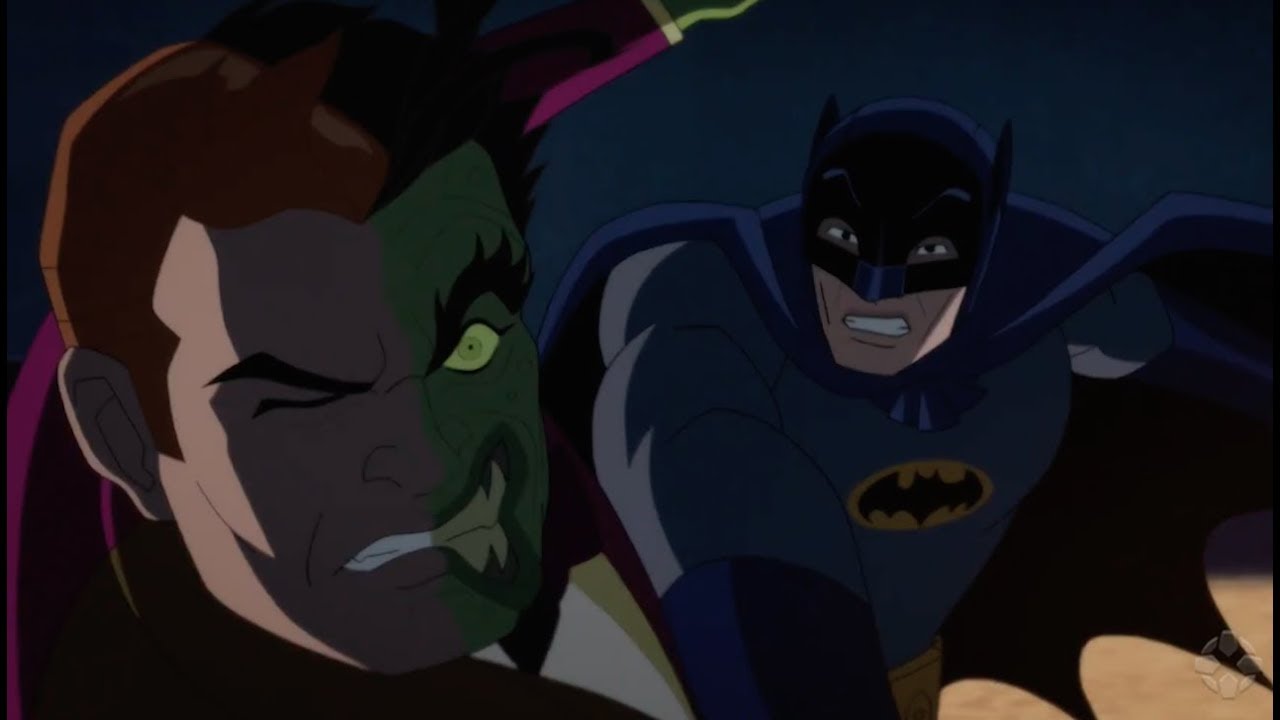
Batman VS Two Face

Holy alter ego!
Batman VS Two Face comes as an unexpected heartwarming homage film that digs deep not only into the hearts of the original TV show but, also into the hearts of many Batman fans. Adam West will always remain as one of the most important actors to bring to life the caped crusader. I vividly remember turning on the Tele to watch the many reruns of a series that started 15 years before I was even born (I'll save you the math, I was born in 1981). I for one, will always agree/defend that Adam West will always be the best Batman. Despite the campy humor the show had, West's deadpan delivery was so perfect that he could convey his love for justice with a ridiculous "Let that be a lesson. In future, be more careful from who you accept free lemonade." as much as Christian Bale could with an entire "It's not who I am underneath, but what I do that defines me" monologue. 

Last year marked the 50th anniversary of the Batman TV show, and to celebrate a legacy larger than life, DC Comics & Warner Bros. decided to bring the series back to life in the form of Batman: Return of the Caped Crusaders an animated movie that became an instant hit, thus pushing producers to make a sequel. 

William Shatner as himself!
What do you mean with "beam us up"?
The prequel breathed new life into the concept by bringing in the voice talents of most of the original cast with Adam West, Burt Ward, and Julie Newmar, reprising their roles. The film not only was a pitch-perfect extension of the '66 series, but brilliantly satirized just how much darker the portrayal of the "Dark Knight" has become ever since. Earlier this year, we lost our contrasting "Bright Knight" when Adam West passed away, but not before lending his voice to a sequel that will mark his last time donning the bat cowl to save the day once more.

"Batman Vs. Two-Face" doesn't satirize like its predecessor, but fully embraces the original series' campiness, with one concession: the inclusion of a villain considered too dark and gritty for the series at the time. According to legend, Clint Eastwood was all set to take on the role of Two-Face before studio execs thought he'd scare off young viewers and put the kibosh on it. In "Batman Vs. Two-Face", Professor Hugo Strange, another villain who never appeared on the TV series, is working on an "evil extractor" to rehabilitate Gotham's greatest criminals. He's aided by another now- popular villain, one not created until the early 90's, in a cameo role. Strange, naturally, is portrayed with an impersonation of the German mad scientist voice Peter Sellers perfected for Stanley Kubrick's "Dr. Strangelove, Or: How I Learned to Stop Worrying and Love the Bomb." Unfortunately for Strange, his assistant, and Gotham City District Attorney Harvey Dent, Batman's greatest enemies have the ability to raise their evilness on command and, through their combined malevolent cackling, cause the devise to overload, splashing the D.A.'s face with the liquid manifestation of evil and transforming him physically and mentally into Two-Face.

Professor Hugo Strange.
Gallery of rogues.
The opening credits montage shows Batman and Robin waging war on Two-Face as if he were just another villain on the bi-weekly roster of the series. When we return to the film proper, Bruce Wayne has found a way to restore Dent's face as well as his law career. But when King Tut and Book Worm, two villains who existed solely in the universe of the TV series, pull off heists with all of the trademarks of Two-Face's plots, Batman and Robin have to try to figure out how Two-Face can co-exist with the seemingly cured Harvey. It's a mystery with a simple solution, but the movie's not about detective work: it's about revisiting a Gotham where the swinging 60's never ended, and where the police force exists only to toggle the Bat Signal on and off, because they wouldn't know how to bring a jaywalker to justice without the intervention of the Dynamic Duo.

Sorry, Clint, but William Shatner should have always been the first choice for Two-Face. Not only was he a familiar face on TV screens of that era, but no one else shared Adam West's love for the dramatic pause the way he does. He makes the menacing villain gel well with the campy universe, his distinctive cadence fits the squeaky-clean prosecutor, while he adds just a little bit of a growl to portray the darker aspects of the character. And there will never, ever be another Adam West. Only he could make a visit to the window of Catwoman's prison cell to share a kiss, read some poetry, and remind her how many months are left until her debt to society is paid seem so endearing.

Good VS Evil.
Alex Ross art.
Youthful ward Dick Grayson's maternal aunt gets giddy at how intimate Bruce and Dick seem, winking and nudging at rumors about the relationship that have persisted since the 60's, but she also gets giddy seeing Bruce and Harvey together, at one point all but pressing their faces together and telling them to start making out. Taking from other popular adaptations of the Two-Face character, Bruce and Harvey are portrayed as being old friends, in spite of the fact that the D.A. never even got a namedrop in the original series. It makes for a sort of love triangle between Bruce Wayne, Harvey Dent, and Dick Grayson, and pays off with a sweet little moment of Batman declaring just how rock solid his relationship with the Boy Wonder is.

Writer Harlan Ellison wrote a treatment for an unproduced episode of Batman (1966). The treatment was adapted as a comic book in 2015, "Batman '66--The Lost Episode", by writer Len Wein, pencils by José Luis García-Lopez, inks by Joe Prado, colors by Alex Sinclair and lettered by Wes Abbott. The story title was "The Two-Way Crimes of Two-Face". Although there was early speculation that this film would be based on the above mentioned unproduced treatment, that is not the case. The animated movie tells its own original story.

To the bat-poles!
Caped Crusaders about to go kick some ass.
While there was a significant number of acting crossover between the Star Trek (1966) and Batman (1966) series, William Shatner is the first regular "Star Trek" cast member to perform on the original "Batman" series. The role of Harvey Dent/Two-Face was previously played by Billy Dee Williams in Batman (1989) and The LEGO Batman Movie (2017). Williams also appeared in Star Wars: Episode V - The Empire Strikes Back (1980) and Star Wars: Episode VI - Return of the Jedi (1983). This makes Two-Face the third Batman villain to be played by both a Star Trek and a Star Wars cast member. The role of the Joker has been played by Mark Hamill and Brent Spiner; and Ra's Al Ghul has been played by David Warner (himself a veteran of both franchises) and Liam Neeson. However, Harvey Dent's transformation into Two-Face took place in Batman Forever (1995) where he was played by Tommy Lee Jones.  

Batman VS Two Face world premiere was held on October 8, 2017, at the New York Comic Con. The screening was part of a panel that included William Shatner; Burt Ward; supervising producer/co-screenwriter James Tucker; producer/co-screenwriter Michael Jelenic; and director Rick Morales. The film is already available on digital, DVD & Blu Ray format everywhere.

An early draft of the film screenplay included the character Poison Ivy, who never appeared in the original Batman (1966) series. In addition, Early in the production there were plans to include an end-credits sequence that would have included a cameo by Wonder Woman, based on the television series Wonder Woman (1975) that starred Lynda Carter. The segment was dropped and was never animated.

Batman & Robin protecting the bookworm?
Catwoman teaming up with Two Face?
Anyway, anyone old enough to remember the original 60's Batman TV series will love this. It's great that this movie mirrors the 60's show i.e. it has the old batmobile & the original voices from Batman, Robin & Catwoman. Another former Catwoman Lee Meriwether also has a small part. William Shatner does an excellent job as Dent/Two face and the whole movie embraces the tongue in cheek wackiness of the original series. This must've been one of the last projects Adam West was involved in prior to his death. All I can say is that he went out on a high. 

A number of Batman animated films have been released in recent years, featuring different iterations of the character as presented in comics and movies - from the Dark Detective approach to much lighter interpretations. This is the second film to use the characters and tones of the 1960s television series and was fortunate to get Adam West and Burt Ward to recreate their roles.

The writers and animators have carefully considered the construction of their animated world with many nods to the TV series, including the presentation of some of the villains from that show (King Tut and the Bookworm among them)as well as the arch, perhaps slightly camp approach of the original. This is built upon somewhat for a modern audience with a number of double entendres and self-aware moments. Dialogue is also reflective of its inspiration with Robin's frequent declarations beginning with the word Holy and Batman's reference to his younger colleague as Old Chum.

The wonderful opening sequence.
The hammer of justice!
West sounds much older and a little frail but is able to be commanding when required and gets the tone of his delivery consistent with his original interpretation. Ward's voice has not aged a day. The perhaps surprising casting of William Shatner as Two Face / Harvey Dent works wonders as, despite being many years older than the character he is playing, he manages to sound appropriate for the role and conveys both the camaraderie of his character with Bruce Wayne and a capacity for evil.

The plot is really little more than a string of set pieces to present these fondly remembered characters but functions well despite this. Animation is of a high standard with diverse backgrounds and detailed character stylings.

Ending with a tribute to the "Brightest Knight" Adam West this is an effective exercise in nostalgia for those who remember the first television incarnation of Batman with warmth and fondness. 

Here's the movie trailer: 


A sneak peek:


Adam West, thank you for bringing Batman to life. May you rest in peace bright knight...

Apr 4, 2017

Jem

This poster came with the dolls.
If you're wondering if our newly re-designed color scheme has to do with today's entry, you're a tad right, and a tad wrong, you see, the v a p o r w a v e trend relies on 90's graphics and colors that were surely borrowed from the 80's. A e s t h e t i c s aside, today's review is dedicated to my wife, a true fan of Jem!

Like any other kid from the 80's on planet earth, I used to wake up early on Saturdays just to enjoy a full morning of the coolest cartoons TV had to offer. Girls cartoons would always go first, so us, boys would have to wait a bit longer for our dose of violence and transforming toys. 

Jem AKA Jem & The Holograms is a Sunbow/Hasbro/Marvel cartoon from 1985 that ran for three seasons until 1988 completing a total of 65 episodes. Like many other cartoons from the decade most of the animation work was done overseas because it was cheaper. Shockingly enough, the animation was provided by the renowned Toei Studio. Predictably enough, as it was during the decade, the Japanese animators were given no credit for Jem whatsoever.


Jem & Jerrica.
The Misfits in action!

The series is about Jerrica Benton, the owner of Starlight Music and the Starlight Foundation, which is a foster home for young girls. But by using her earrings to project a holographic image over herself, she is transformed into her alter ego Jem, the lead singer for the successful music group, Jem and the Holograms. Other members of the group are Jerrica's sensitive little sister Kimber, the strong-willed Aja, and the creative Shana. The group's rivals are The Misfits, made up of the cold-hearted Pizzazz, the tough-acting Roxy, and the humble Stormer. Jem and her friends are always involved in glamorous and exciting adventures around the world, while touching people's hearts with their hit songs. Obviously, the subject of music & the music industry was the core of the animation hence, the 80's pop culture aesthetics of the entire series. Although other cartoons & animé had already explored the music industry in their content, no other American cartoon merged the music stardom  lifestyle with the down to earth side fo things (Jem keeps Jerrica as her secret identity. While one is super popular & outgoing, the other worries about the foster home) In addition, the series featured a set of songs, each properly about something relevant to the plot of each episode. Cassettes were recorded and sold for a limited time, and even some dolls came with the cassette and a tape recorder system. 

Loads of make up.
Loads of cheesy love.

The story is the kind of format you'd see in any sports or music film where it's some up and coming underdog team that is struggling to survive and get to the top. And there are tons of melodrama, which makes the cartoon an animated soap opera. 

The characters are actually pretty good, they're not entirely three dimensional but, it's an 80's cartoon! what do you expect?. However, there is a certain amount of depth given to them. Enough to make us actually care about what they're going though. Jerrica/Jem is solid, she's the typical struggling sweet heroine, selfless, independent, persona wise she's a bit bland but in a good way. Her niche is her hologram ability where some supercomputer gives her the power to change her hairstyle and look so she wouldn't be recognized. Why the hell Rio can't put two and two together that both Jerica and Jem are the same person is anyone's guess. There is a slight romance dynamic with both Rio and Jerrica/Jem, which was rare in a cartoon. I mean, how many animated girls and boys would genuinely interact and even kiss in the 80's?

Hey you! Buy our cassette!

♪♫ 666, the number of the beast ♪♫

The Misfits are fun rivals, personally I found them to be the most interesting and fun. My favorite one was always Stormer, whom to me is interesting and I'll admit as a kid had a bit of a crush on her (I said I was a kid). Because she never really seemed like a bad guy she actually was kinda sweet, just a person that I felt was playing for the wrong team or influenced by the wrong people. But also there was this mystery to her, in episodes she kinda can surprise you because she does something that is contrary to the Misfits sometimes.


However it's really not the story that drive the show so much it's really more by it's nature style over toping substance, and this show has lots of style. It really is a product of it's time as it really tackles the 80's customs of music, fashion, and "MTV" when it was still actually good.

Jem dolls.

My wife's Jem doll.

Animation wise, Jem it's the same compared to other Hasbro properties like Transformers and G.I. Joe meaning the attention to detail in character design is rich and varied enough to allow each character to be identified by its physical features. After all, being animated by japanese artists can do you no wrong!

The series highlight without a doubt is music!, most of the songs are memorable in reprising what was going on music wise in the 80's pop scene. Each episode featured three one minute songs. Two by Jem & by the Misfits. During season 2 & specially 3 a few songs were reused in more than one episode. The songs were presented as videoclips to make the viewer feel he was actually watching MTV.

Choose your side wisely.

80's pop art!
Overall, a great piece of 80's nostalgia and maybe the one animated show that was most influenced by 80's youth pop culture. Clothing, hair style, music, colors, locations and even plotwise, no other cartoon can relate to the 80's as Jem does. I only wish there were more cartoons like this for the girls of today's world. After all, this series did have a heart and deeper meaning beneath each character's struggles (including the bad guys).

With love to my awesome wife!

Here's season 1 opening:


Here's season 2 opening:


Here's season 3 opening:


And a complete playlist featuring every song played on all 3 seasons!

Nov 28, 2016

The Star Wars Holiday Special

a long time ago, in a holiday far away...

Now that  Rogue One: a Star Wars story is just around the corner, we decided it's time to revisit our Star Wars fandom with a very special review. In the past, we covered every Star Wars episode to date. We even included reviews for the made for TV Ewok films and it was about time we paid our debt with the infamous Star Wars Holiday Special. Made directly for TV and directed by Steve Binder this may be the worst official Star Wars film ever made.

Honestly, what Star Wars fan wouldn't want to watch this? (and how many have already watched it many times?) Well, maybe a few. Made after the massive success Episode IV: A New Hope had in 1977, this 1978 TV special featured every major Star Wars star, and even introduced the world to new characters that would be part of the following sequels, while other new characters where blasted into oblivion just like the idea of an official release of the film.

The original cast returns...
...plus a few new additions.
First off, yes, I and no one else who is a Star Wars fan, who has seen this, will ever disagree it is complete and total crap. But you know the old saying about train wrecks, you just have to watch them, this is that. Because as unbelievably horrible as it is, and as totally unfathomably bad every scene is, as a Star Wars fan you want to see these characters in new scenes (specially those who were there in 1978, where no SW sequels would happen until 1980)

It IS cool seeing "new" footage of Han and Chewie in the Falcon's cockpit. It's cool seeing Luke do his thing(despite his surgery that makes his face look odd), Leia, the droids, everyone, although this is nothing but a huge mess, you gotta like seeing these characters again somewhere. Of course, as you watch you may say to yourself that you wish you had NEVER seen this, because it taints the memory of these great Star Wars characters. So was actually seeing this special worth it? If you can keep your feelings about Star Wars in check and dismiss this easily, sure it is.

Wanna sing a holiday song Leia?
I really rather you didn't Luke.
The Boba Fett debut appearance (that's it you newbies! before the special editions, Boba Fett wouldn't show up until Episode V) in the animated sequence is very cool, best thing about the show probably. It's too short though, especially in such a long show.

But you know, this is one part of the Star Wars universe where I would love some additional information. The special itself we have - but this is the only piece of the Star Wars universe we know almost nothing of the background about. How was this show proposed? What were the creative meetings for this abomination like? Who felt this should be 2 hours long in broadcast time? What did the actors say and feel when they read what they were supposed to do? How did the recording of Carrie Fisher's "Star Wars song" go? Did everyone on screen just think this was a big joke before it was through?

And most importantly...did absolutely no one whatsoever in power have any ability at all to see this final product and realize what a complete piece of garbage this was, and what a blight on the Star Wars universe this would surely become? Were there stipulations that said this HAD to air, and they couldn't even trim it down?

I'm Boba Fett.
I take it you have no love of the empire.
I can't believe after creating such a masterpiece like "Star Wars" that George Lucas didn't have the eyes to see what a total hack job this Star Wars Holiday TV Special was. 

The special has never been released on video, but bootleg videos have been circulating for years, and are now all over the internet. George Lucas remarked at an Australian convention that "if I had the time and a sledgehammer, I would track down every bootlegged copy of that program and smash it." 

According to Carrie Fisher, Lucas gave her a copy of the special as a gift for recording the DVD commentary for Star Wars: Episode IV - A New Hope (1977). She claims that she plays it at parties when she wants her guests to leave.  

mm, nice to meet you.
Laugh it up fuzz ball!
Plotwise the holiday special  follows Chewbacca and Han Solo who pay a visit to Kashyyyk, Chewbacca's home world, to celebrate Life Day. They are pursued by agents of the Galactic Empire, who are searching for members of the Rebel Alliance on the planet. The special introduces three members of Chewbacca's family: his father Itchy, his wife Malla, and his son Lumpy, though these names were later explained to have been nicknames, their full names being Attichitcuk, Mallatobuck, and Lumpawarrump, respectively. 

The program also features many other Star Wars characters, including Luke Skywalker, C-3PO, R2-D2, Darth Vader and Princess Leia (who sings the film's "theme song", set to the music of John Williams' Star Wars theme, near the end). The program includes stock footage from Star Wars, and also features a cartoon produced by Toronto-based Nelvana that officially introduces the bounty hunter Boba Fett. Scenes also take place in outer space and in spacecraft including the Millennium Falcon and an Imperial Star Destroyer. The variety-show segments and cartoon introduce a few other locales, such as a cantina on the desert planet of Tatooine and a red ocean planet known as Panna.

Let's all sing the song of joy.
Funky music was also a big thing in Kashyyyk.
According to Charles Lippincott, who was head of marketing of what was termed "The Star Wars Corporation", CBS brought the idea of doing a TV special to Lucas, although there is some debate within Lucas's inner circle about this claim. Lucas was not heavily involved with the special, and his name does not appear in its credits. Still it was Lucas's idea to build the narrative around a family of speechless Wookiees and their celebration of Life Day. Bruce Vilanch, who was hired as a writer, was concerned about the challenges this decision would pose to writing and feared that the special would turn into "one long episode of Lassie". Regardless Lucas would not budge on the story.

The special went through two directors. The first, David Acomba, was brought in in an attempt to "make us different in variety shows", according to Lippencott. Acomba, a classmate of George Lucas at USC film school, was unfamiliar with a multi camera setup, which caused some problems. Acomba also felt that there was a divide between him and the producers and quit after finishing only a few scenes. He was replaced by Steve Binder. Binder never got to meet Lucas before the show but instead got a "Wookiee Bible" detailing how Wookiees were supposed to look and behave. Acomba chose to leave the project, a decision supported by Lucas.

Prototype toys of Chewie's family.
The special was broadcast in its entirety only once, in the United States, on Friday, November 17, 1978 (the week before Thanksgiving), on the U.S. television network CBS from 8:00 pm to 10:00 pm, Eastern Standard Time (EST), pre-empting Wonder Woman and The Incredible Hulk; and on the Canadian television network CTV from 7:00 pm to 9:00 pm, Eastern Standard Time. It was also broadcast in New Zealand on TVNZ and in Australia on the Seven Network.


Here's the infamous holiday special for your viewing pleasure (?)


Also, Diahann Carroll "This Minute Now"


The Jefferson Starship "Light the Sky on Fire" song:


And last but not least, Princess Leia sings "A Day to Celebrate":


Let’s start with the most obvious snag. About six minutes into the movie, right after Darth Vader (Lexington Steele) and a bunch of scantily clad Stormtroopers bust in on Princess Leia (Allie Haze)’s spaceship, we get our first sex scene. Those of you who were paying attention to the number of proper nouns in that last sentence may have already figured out where this is going.
See, in the original films at least, Darth Vader is actually Princess Leia’s father, which makes it pretty darned uncomfortable when the first ten minutes of this movie find him going right at her for a pretty vigorous interrogation about the whereabouts of the Rebel Alliance. With his penis.


Read More: ‘Star Wars XXX': The Porn Parody Is Still Better Than The Prequels [Review] | http://comicsalliance.com/star-wars-xxx-porn-movie-review/?trackback=tsmclip

Mar 21, 2016

Dr. Strange, the 1978 TV Movie

70's Magic!
Superheroes never cease to amaze the world with their incredible stories. They're always recruiting new minions into their 70 something going 80 years old of ruling the comic book world. Big proof of this is the ton of remakes, sequels, crossovers, films, TV series and of course, and most importantly, the constant upgrade of each superhero universe every few years. As a matter of fact, the superhero pop culture is so big, that everyone in the world knows origin stories of many of the most popular characters having not read a single page of a comic book magazine. 

The superhero "revival" that started somewhere around 2005 with the Christopher Nolan's Batman movies, was fostered by 2008's Iron Man. Well, let's be fair, in the late 80's Tim Burton also had a say, and so did many others in the likes of Joel Schumacher & Bryan Singer. Nevertheless, if you know your math, you know for sure that the superhero hype began long before all of the above mentioned moments in time. 

There was a decade that was a magical free wheeling momentum for the TV & film industry. Yes, my fellow connoisseurs, I mean the 1970's, a decade like no other.

Morgan LeFey, a MILF witch!
Pure non CGI Evil.
With the late 40's TV serials (Captain Marvel, Batman &  Captain America), 50's Superman and 1966's Batman being the only exceptions, the 70's screamed sexploitation and superhero at the same time, and with the same force. 

In the 1970's, DC comics, through the ABC television network, produced the highly successful Wonder Woman (1975 -1979) series, with the Amazonian beauty of Linda Carter. With the prospects of DC's most famous character's big screen incarnation, in Richard Donner's Superman: The Movie (1978), Marvel, with their groundbreaking silver-age characters, needed a platform for their characters. Whilst they had success with their animated Saturday morning shows, live-action and the TV series was the place to promote them.

From 1977 to 1982, Universal television broadcast The AmazingSpider-man (1977 - 1979), The Incredible Hulk (1978 - 1982), and two TV movies, Captain America (1979) and Captain America II: Death Too Soon(also 1979). The quality was of course varied, and the Hulk was its most credible triumph. Then in 1978, writer/producer, Philip DeGuere, produced a feature length television movie of one of Marvels most "psychedelic", cerebral characters, Doctor Strange. Created by comic legend Steve Ditko, it seems like quite a huge leap of faith to create a plausible adaptation within the restrictions of television production. This leads to some of the more fantastical elements of the comic books to be altered, or left out entirely - but this is of course an understandable exclusion.

it's time to pass the torch.
it's magic time!
Doctor Stephen Strange (Peter Hooten), a Psychiatrist working in a New York hospital who has been chosen by Thomas Lindmer (John Mills) to take his place as the new Sorcerer Supreme of Earth. However, an evil Sorceress, Morgan LeFay (Jessica Walter), has plans to kill the Earth- bound magicians. After throwing Thomas off a bridge, Clea Lake (Eddie Benton), has been telepathically controlled by the evil witch, Morgan, and it is down to Dr. Strange to save her from the astral plain, then conquer the cosmic universe to become the sorcerer. 

The movie plays in a very 70s style: background music is a character in itself. The dramatic melodies aid the viewer to understand something either evil or magical is about to unravel. Dr. Stephen Strange, a resident doctor spends the first half hour of the film aiding his patients unaware of his future until he meets the elder Earth Magician who is more than willing to prepare him for the fight of his life: Saving earth from a horde of demon minions waiting to make humanity suffer forever. it is the strange (no pun intended) connection our doctor develops with Clea, his mysterious patient that allows our hero to finally let go and accept the truth to face his destiny as the most powerful sorcerer on Earth.

I have the power!
Dr. Fate?
Once Strange begins his transition from doctor to sorcerer the 70's psychedelic special effects show up and deliver something that could well be described as an acid trip or LSD trip. However, Dr. Strange does have the limitations of a 1970's television production, and falls flat very often with the dialogue - including excruciatingly annoying laughter from Strange and Clea, as they laugh at their unfunny exchanges. However, it is an admirable effort to bring a more obscure Marvel character to a live-action context. With Stan Lee as a consultant (as with all the other aforementioned shows), Lee states that this was his most enjoyable experience out of all of them. It was intended as a pilot for a series, but this was never produced - a television interview with actress Morgan LeFay towards the end, actually gives clues as to the way the show could have gone, and to be honest, it seems like an incredibly good concept.

Now, the time has come for some Dr. Strange trivia:

Dr. Stranger's suit.

The star-burst on Dr. Strange's costume is not on his comic book outfit. While it is indeed similar to one that ordains the costume of another Marvel Comics hero; Captain Mar-Vell, this particular TV movie costume star-burst design is a tell-tale "signature" of this production's costume-design consultant (and former Dr. Strange comic book artist); Frank Brunner. Brunner uses that star-burst on many different design projects and incorporated it, as a more TV-friendly replacement to the "demon" symbol usually worn by the comic-book Dr. Strange. Although not named, the creature that Morgan serves is visually inspired by Dr. Strange's comic book arch-nemesis, Dormammu, while Morgan herself could be seen as being inspired by Dormammu's sister (and Strange's foe), Umar. 

Morgan Le Fay, has been foreseen.

Morgan Le Fay appears as Doctor Strange's foe in this TV movie. Oddly enough, Morgan Le Fay was introduced to the modern era of MVL comics in Spider-Woman#2 (after an appearance in a dream in Son of Satan#8), just a few months before the air date of this TV movie, and did not encounter Doctor Strange until Avengers#240-241, published in 1984, six years after this TV movie came out.  

Morgan Le Fay is the first live action Villain.

Morgan Le Fay was the first Marvel foe to be adapted to live action. She was later joined by the Kingpin in The Trial of the Incredible Hulk (1989) and the Red Skull in Captain America (1990). 

She's a beauty.
Happily ever after.
Overall, a TV movie that settles more for the side of drama and a one step at a time developing story in order to provide a more realistic tone, rather than providing full frontal science fiction from start to finish. Dr. Strange is a rarity even by today's standards, just think that his first movie won't come out until next year, after years of a growing cinematic universe.

Here's the movie trailer:


And last but not least, here's a CBS promo: