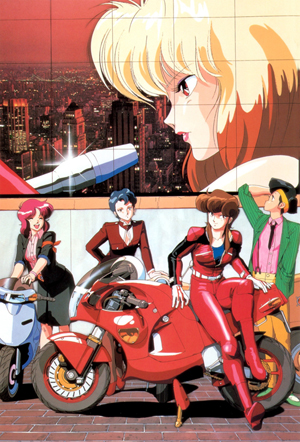
Gunsmith Cats (ガンスミス キャッツ) is a Japanese manga series written and illustrated by Kenichi Sonoda. It was published in Kodansha's seinen manga magazine Monthly Afternoon from 1991 to 1997 and was followed between 2004 and 2008 by a sequel series Gunsmith Cats Burst which included the same characters and situations. The series describes the adventures of young women fighting crime in Chicago.
Nineteen-year-old Irene "Rally" Vincent operates the titular "Gunsmith Cats" gun shop but also works as a bounty hunter,
which is the impetus behind many of the stories. She is assisted in
both activities by her housemate, former prostitute "Minnie" May
Hopkins. Rally is an expert combat shooter and marksman with just about
every firearm in existence, as well as a brilliant driver. May is an
explosives expert, knowing the inner workings of and many uses of all
manner of explosive devices. Teenage ex-burglar and lock-picker Misty
Brown later joins the team and there is also Becky Farrah, a top, if
expensive, source of information on underworld activity.
Bounty hunting has of course led Rally to make many enemies, most
notably Gray, the leader of gangsters whose use of armaments, including
bombs, have likened them to terrorists; and Goldie Musou, a leading
figure in the Mafia who uses drugs to manipulate people to the point that they can be brainwashed into killing their nearest and dearest. Bean Bandit,
a man who specializes in delivering illegal goods, often features as an
alternate ally or enemy—depending on the behavior of his clients, most
of whom are being hunted by Rally.
Attention to detail.
Shelby Mustang GT500 just because.
OVAs.
A three-part anime adaptation was created. This adaptation is an
original story for the characters but includes several references to the
manga storyline. The character of Becky is given an increased role
compared to the manga.
Produced by OLM and directed by Takeshi Mori and Kazuya Murata in 1995.
The anime was based on the homonym manga series written and illustrated
by the above mentioned Kenichi Sonoda. After leaving anime production company Artmic to work
as a comic artist, Sonoda presented some of his story concepts and
illustrations to Kodansha. These did not impress the editors but an
illustration of two girls caught the attention of one of them, who
suggested Sonoda develop a concept for it. Sonoda stated in an interview
that the drawing was the genesis for the series. At the time Sonoda did
not have any plans for the illustration but decided to expand his
Riding Bean concept into a developed story. Due to licensing issues,
Sonoda was originally unable to use the Riding Bean concept or character
around the time he was creating Gunsmith Cats. However, during the run
of the series the rights were returned to him and he added Bean Bandit
into the series.
Although Sonoda was a fan of the Japanese police drama
series Taiyo ni Hoero!, he decided the show did not fit his preferred
Western style. The story is influenced by American gun-action movies
such as The French Connection and The Blues Brothers. Sonoda chose the
Shelby Cobra GT500 as Rally's car after realizing that the cars in
driving movies from the 70s were often Ford Mustangs. He researched the
various models and selected the GT500 because it was the most powerful
rather than any attraction to the car itself. When drawing guns, Sonoda
would use a combination of magazines and his own replicas. Character
names were taken from American TV shows such as Bewitched and The
Fugitive. The character of Minnie-May was the result of a compromise
between Sonoda and the publisher.
Ladies with guns.
Product placement.
Review.
Gunsmith Cats almost entirely revolves around 3 very American clichés: the fascination for guns, Muscle cars (1967 Mustang GT), and big breasted women. While it's true the Japanese have been somehow infatuated with American pop culture, this OVAs serve as the ultimate example of that. They really tried as hard as they could to pay homage to all these things they love from the USA.Now, whether that is a good or a bad thing, I'll leave it up to you.
Our heroes are 2 chicks that illegally
sell guns in "gun free" Chicago in order to combat oppressive gun
control laws. They are also bounty hunters, because hired guns are
better than a police force. The depiction of Chicago is as accurate and realistic as it gets. However, you can't skip the fact everyone now speaks perfect Japanese. Maybe this story takes place in a different timeline where either Americans speak Japanese as their native language, or they finally started learning different languages to get a wider view of the world's rich cultures. Selecting the English audio track in your DVD/Blu-Ray will obviously render this comment worthless.
GTFO Mustang!
Driving skills.
Pursuing that "we love America in Japan" the OVAs put our ladies against stereotypical enemies America would have. For instance, Natasha Radinov, a Russian spy that seems modeled after a Soviet Union communist extremist. Moreover "her" surname should be "Radinova" suggesting she's a Lesbian stereotype that may seem of poor taste today. What happens next are plenty of ridiculous car chases and
shootouts. Continuing with the Japanese fascination with American pop culture,these OVAs may or may not remind you of The Dukes of Hazzard, car chase wise only because, there are no Daisy Dukes or Dodge Chargers. Neither will you find any of the nudity, and sexual innuendo from the original Manga. Another weak point in my book.
Music wise it comes as no surprise the soundtrack is made to emulate all those 70s action TV shows and films with cars, detectives and spies. Jazz, funk, disco, R&B are all there to get Cowboy Bebop as jealous as fuck.
This as far as Fanservice will get here.
Pages from the limited edition book included in the blu ray set.
Overall, Gunsmith Cats could have been a much more faithful to the source adaptation but instead producers chose to make it a standard made for TV show.Not having every original character, and all the spice they added to the Manga, makes this 3 part OVA a forgettable experience. Even though, the show does have its fans (the Blu Ray box set in different editions proves it) I think Aika, and Shin Cutie Honey, are more faithful to the source material and not afraid of showing a little T&A and sexual innuendo here and there.
And there you have it fellow connoisseurs, Gunsmith Cats! Make sure you read the Manga to get the missing potential the OVA didn't have.
Here's the original 1995 trailer:
Here's the opening in full HD as taken from the Blu Ray:
Following our latest self-inflicted trend, we continue to look back at some of the most memorable Anime ever created. No matter whether they had a long or short run, if they're archetypal, they're here. That simple.
Today's entry involves one of those unique cases where conveying ideas that were already established, become greater than the original places where they took place. The 80's were a neon-fueled decade accompanied by the rise and fall of some of the greatest pop music acts worldwide. I was born in 1981, I spent nine years there. Nine years where I was lucky enough to find my way into the world of Anime. Today, 36 years later I can state, Bubblegum Crisis: Tokyo 2032 is the most 80's Anime you will ever see.
Bubblegum Crisis (Japanese: バブルガムクライシス Hepburn: Baburugamu Kuraishisu) is a 1987 to 1991 cyberpunk original video animation (OVA) series produced by Youmex and animated by AIC and Artmic. The series was planned to run for 13 episodes, but was cut short to just 8. The series premiered on February the 25th, 1987 and ended on January the 30th, 1991. Six months later (August the 30th, 1991) the series would have its first official US release. So it took nearly four years for it to be enjoyed by a growing wave of Western Anime fans like yours truly.
In North America, AnimEigo first released Bubblegum Crisis
to VHS and Laserdisc in 1991 in Japanese with English subtitles. The
series is notable in that it was one of the few early anime series that
were brought over from Japan
unedited and subtitled in English. While anime has become much more
popular in the years since, in 1991, it was still mostly unknown as a
storytelling medium in North America. Bubblegum Crisis was aired in the US when it first aired on PBS affiliate Superstation KTEH in the 1990s, and STARZ!'s Action Channel in 2000.
Girl power.
Girl armored power!
The series started with Toshimichi Suzuki (writer of the series) intention to remake the 1982 film Techno Police 21C. However, he met Junji Fujita (one of the series producer) and the two discussed ideas, and decided to collaborate on what later became Bubblegum Crisis. Kenichi Sonoda acted as character designer, and designed the four female leads. Masami Ōbari created the mechanical designs. Obari would also go on to direct episode 5 and 6.
The OVA series is eight episodes long but was originally slated to run for 13 episodes.
Due to legal problems between Artmic and Youmex, who jointly held the rights to the series, the series was discontinued prematurely.
Another unique features BGC has, is the fact it has a different soundtrack for every OVA, meaning there are 8 albums full of music from the series. The majority of songs were sung by Kinuko Oomori, Yuiko Tsubokura, Maiko Hashimoto, and The Knight Sabers.
Here is every opening theme song:
#1: "Konya wa Hurricane (今夜はハリケーン)" by Kinuko Oomori (ep 1)
#2: "Mad Machine" by Kinuko Oomori (ep 2)
#4: "CRISIS ~ Ikari wo Komete Hashire" by Yuiko Tsubokura (ep 4)
#5: "Mysterious Night (ミステリアスナイト)" by the Knight Sabers (ep 5)
#7: "Say Yes!" by Maiko Hashimoto (ep 7)
#8: "Bye Bye My Crisis" by the Knight Sabers (ep 8)
And the respective ending theme songs:
#1: "Mr. Dandy" by Bluew (ep 1)
#2: "Kizudarake no Wild (傷だらけのWild)" by Kinuko Oomori (ep 2)
#3: "Wasurenaide (忘れないで)" by Oomori Kinuko (ep 03)
#4: "Twilight " by Tsubokura Yuiko (ep 4)
#5: "Omoide ni Dakarete (思い出に抱かれて)" by Tsubokura Yuiko (ep 5)
#6: "Rock Me" by Yuiko Tsubokura (ep 6)
#7: "Never the End" by Maiko Hashimoto (ep 7)
#8: "Chase the Dream" by Kinuko Oomori (ep 8)
Neon colors, pop idols and fast bikes.
And graphic violence!
BGC opens with what might be one of the best opening 7 minutes of an anime
ever, this OVA opens with a montage of the future, a dark sprawling
Mega-Tokyo. (Many have noted the similarity between the opening of the first episode and the start of the 1984 film Streets of Fire)
Immediately Ghost in the Shell comes to mind, some scenes look almost
identical, the Oshii vibe so thick, the possible influence on the man
(and even Masamune Shirow himself) is made more and more questionable throughout
the OVA with many stylistic choices bringing the GitS franchise to mind. Moreover, some people consider BGC the archetype used for Akira.
After the introduction of the various comings and goings of the city, a
concert suddenly begins, introducing a blonde wigged character Priss,
and is intercut with the appearance of a boomer wrecking
havoc. The direction and editing, and hell even the music are
all excellent and ensure the OVA gets off to a cracking start. 80's
cyberpunk at its best!
The story follows four plucky young women with nothing better to do in
their spare time than to don cyber-outfits and blow crap up, preferably
those pesky rogue boomers who keep appearing all over the city. The
combined IQ of these four women finally figures out that Genom
corporation, which apparently holds accounts for 68% of the world's
cars & robots, might have something to do with these incidents and so
Bubblegum Crisis delivers 8 episodes of pure unadulterated fun in a way
only 80's anime can.
Priss, you're a pop star!
While some are dancing, some are hunting.
Mega-Tokyo, 2032. This is the future, but seen from the eyes of the
80's. Each decade's vision of the future is idiosyncratic, and so each
decade produces strange and brilliant works of genius or garbage, with
Bubblegum Crisis firmly in the strange and brilliant camp, albeit
lacking both genius and garbage, though still retaining quality
production and vision. Plenty of great directorial choices, POV shots,
pans, zooms, it's all dynamic and makes up for the dated, yet still
decent, animation.
No matter the humor or clunky dialogue or 80's sprinkled aesthetics in
hair styles and clothing, this is cyberpunk at its peak. Everything
associated with the genre is present, the connective nature of society,
the paranoia of having satellites hovering above your head with the
capability of blowing you up, biotech suits, corporate power run amok.
In a sense Bubblegum Crisis is more cyberpunk than a lot of cyberpunk
anime out there which sometimes jettison a lot of the genre's traits and
settle for dystopic hijinks with the occasional robot AI thrown in.
Bubblegum Crisis revels in the genre and doesn't leave
anything out.
Front and center.
The looks of stardom.
The anime came out at what might be seen as cyberpunk's peak of
influence and exposure in the mainstream, and as such is worth a watch
for its historical significance, in terms of impacting the genre of
cyberpunk in anime and also being a window to the time. It's so classy
it even has time to throw a shout out to The Third Man!
It's flawed, but packed with so much creative ideas and flair,
you can't help but bop along to the 80's tunes. Each episode
starts with a cinematic musical montage of 80's soft rock/pop and
narrative-advancing imagery. This isn't on-par with cyberpunk
like GitS, you have to accept the humor and gaping plot-holes as part
of the charm, or you'll just not be involved and will tune out. The AD
Police are written as what a 12 year old imagines the NYPD are like,
complete with the gruff black police captain arguing with the rookie
cop.
There's lots of subtle visual flair in this OVA, the directors knew what
they were doing. (Except for episode 5 and 6. That director probably
went to the school of Koichi Mashimo, though he wasn't helped
by the screenwriter for those episodes either) Too often in
post-millennium anime there are tons of 'arty' shots that are
meaningless and the camera either flies around the place like a Steadicam-operator on crack, or pans laboriously across the screen as if
directed by an old age pensioner, but back in the 80's/90's they knew
how to pace episodes just fine while choosing narrative-coherent
viewpoints to the action. I guess I'm harping that old
cliche; of modern day anime being too shallow with emphasis on
looks rather than content, but considering that this anime is packed
with very cliched jokes that were old even back when this was
released, the argument is kind of moot.
There's always time for lingerie in the future.
No flat LED screen TV in Mega Tokyo.
If you want to go extra deep you could propose that Bubblegum Crisis is
yet another exploration of the relationship between man and machine and
clearly veers on the side of external mechanics and views
bio-implementation, or to be simple about it: cyborgs, as a threat to
the world. Even though boomers (not the ones from the Left 4 Dead games) are technically robots, though the
distinction is rarely made clear especially when they all have such
charming personalities, their humanoid form isn't a random
creative decision. Here's where I'd say BGC was clearly inspired by some Hollywood blockbusters from the decade: Blade Runner, Streets of Fire & The Terminator. Each film, gives its own view on the future of mankind, and BGC is the blended result of the combination of all three.
If I were to choose the best part of BGC, I'd pick the characters, because they were a new breed of tough woman leading the fight in
mechanized combat suits. That was barely common to have only woman as
leads in the action genre. Though with only 8 out of the 13 episodes completed they did what they
could with depth, but its what the characters represented that was most
special.
They covered a broad spectrum of female heroines, Priss a tough, bike
riding, battle hardened fighter who happens to be a singer, Linna the
represented average aerobics girl of the 80s but with the ability to be
able to transform that athleticism into fighting prowess, Sylia a smart wealthy elite who isn't afraid to drop the high class lady act and
dirty her hands when she needs to, and lastly Nene a computer and
electronics specialist willing to put herself in the battle zone.
Heroes wear no capes.
...And no underwear apparently!
What made them even more special though, was they all had their
weaknesses, and the designers wanted us to know they were not perfect
individuals and this added something to the characters that was largely
absent in other action movies of the time.
Priss is poor and has had a rough life, its also implied that she never
was well educated but she does what she can to get by and enjoy her life
and improve the life of people she knows...or at least exact justice on
their behalf. Sylia is seen as the cool headed leader, but secretly she has an immense
hatred for Genom Corp inside her which is strong enough to impair her
judgement and cause her to lash out at others. Linna although generally up beat is not living the life she wants, she
would love a glamorous life and a great boyfriend but she is stuck in
the mediocrity of being a below middle class person in Mega-tokyo, a
cycle she cannot break out of. Then there's Nene, she desperately wants
to be more physically imposing and it frustrates her that she isn't given
much respect, she doesn't just want to be known as a computer geek at a
police department and really would like people to know what she's really
capable of.
Art and character design, I think the
series is excellent by 1980's standards. Personally, I think it's a
masterpiece of it's era, using methods an approaches that will never been
done again since they would be unfeasible today. It's a testament to
what human artists are capable with just simple tools and hundreds of
hours of painstaking work that they simply poured to their hearts into.
If you're an artist or have ever worked with professional artists you
will understand it and appreciate it for the true paramount achievement
that it was. If you're not an artist, just look at it like this, BGC artwork is very much like a Lamborghini Countach, it's not the best car ever made,
but it's the embodiment of 1980's cool, and for that it will never be replicated again because the
technology changed, people have changed and the mindsets have changed.
For that reason its look will always be unique and special.
Suit up!
Clean up!
The sound, for me the music production was the best id ever come across,
in both English and Japanese the production quality was supreme, the
musical ability of the producers and the vocal ability of the singers is
as good as it got for any form of entertainment in the 80s, and that's
saying a lot considering how great an era for music and movies the 80s
is considered as being.
Though the Japanese version is better overall as expected, the English sung tracks are also very good, and you know that is rare for an Anime from the 80's where most of the dubbed into English was awfully bad. A quick good example of this, is Lynn Minmay from Macross & Lynn Minmei from Robotech...
Voice acting though is just average for both English and Japanese
versions. Nowadays we have near Hollywood quality (or Japanese film
industry quality) voice acting in games and anime. So BGCs voice acting
is a couple notches below, it just lacks the substance that you get with
newer productions that really drive home the characters intentions. The
relative background silence you get during speaking is typical of the
sound production of the time, that is one area I am glad is gone these
days.
No rest for the Knight Sabers.
No means no!
In terms of enjoyment, if you're a person of the era there is no way you
would say this is anything less than a 9 (I say 10), because you simply
hadn't seen anything like this at the time, especially if you were
outside of Japan. Taking nostalgia out of it and looking at it just as
an Anime fan...a knowledgeable anime fan would certainly understand what
was achieved here and in that case its an 8 or even 9 still.
Overall, its a 9/10 for me, and if you grew up in the 80's and are an anime watcher you absolutely must watch Bubblegum Crisis.
Here's the original Japanese episode guide plus the first US air dates
#
Title
Japan
first release dates
English
first release dates
1
"Tinsel City Rhapsody"
"(Runtime:
45 minutes)"
February
25, 1987
August
30, 1991
The Knight Sabers are hired to rescue a little
girl from a group of kidnappers, but the girl is far more than she
seems...
2
"Born to Kill"
"(Runtime:
28 minutes)"
September
5, 1987
September
27, 1991
A friend of Linna's threatens to expose Genom
secrets that led to the death of her fiancé, but Genom plans to silence her,
first.
3
"Blow Up"
"(Runtime: 26 minutes)"
December
5, 1987
October
10, 1991
The Knight Sabers attack Genom Tower to put an end
to the machinations of Genom executive Brian J. Mason.
4
"Revenge Road"
"(Runtime: 38 minutes)"
July
24, 1988
December
19, 1991
A racer modifies his car into a weapon of
vengeance against the biker gangs of Megatokyo, but the car soon develops a
mind of its own.
5
"Moonlight Rambler"
"(Runtime: 43 minutes)"
December
25, 1988
January
23, 1992
A killer is draining victims of their blood, but
this is no vampire. And what do a pair of escaped love-doll androids, Priss's
new friend Sylvie and the D.D. super-weapon have to do with it?
6
"Red Eyes"
"(Runtime: 49 minutes)"
August
30, 1989
February
27, 1992
A group of fake Knight Sabers are ruining the
group's reputation, leading to a fight against a returning foe.
7
"Double Vision"
"(Runtime: 49 minutes)"
March
14, 1990
March
19, 1992
A singer with a vendetta comes to Megatokyo, and
brings some heavy firepower with her.
8
"Scoop Chase"
"(Runtime: 52 minutes)"
January
30, 1991
April
2, 1992
An ambitious technical scientist and an aspiring
reporter both plan to make their names at the expense of the Knight Sabers,
and of all people, Nene is caught right in the middle.
Here's the Bubblegum Crisis trailer:
The Anime Eigo trailer for their release of BGC:
Unboxing of the deluxe 2017 blu-ray box:
a fan made "Megamix" with the music from BGC:
And last but not least, do you why the show is called "Bubblegum Crisis"? Simple, When you start blowing up a wad of bubblegum it inflates and inflates.
Eventually the bubblegum is stretched so tight around the air inside it
that it reaches the "crisis" point. That is, the slightest influx of air
into the bubble will cause it to pop.
Bubblegum Crisis, therefore, refers to the fact that in the world the
situation with Genom v Knight Sabers has reached that "crisis point" the
slightest addition will cause it to explode.
Why specifically did the creators use that term? The Japanese like funky metaphorical names, apparently.