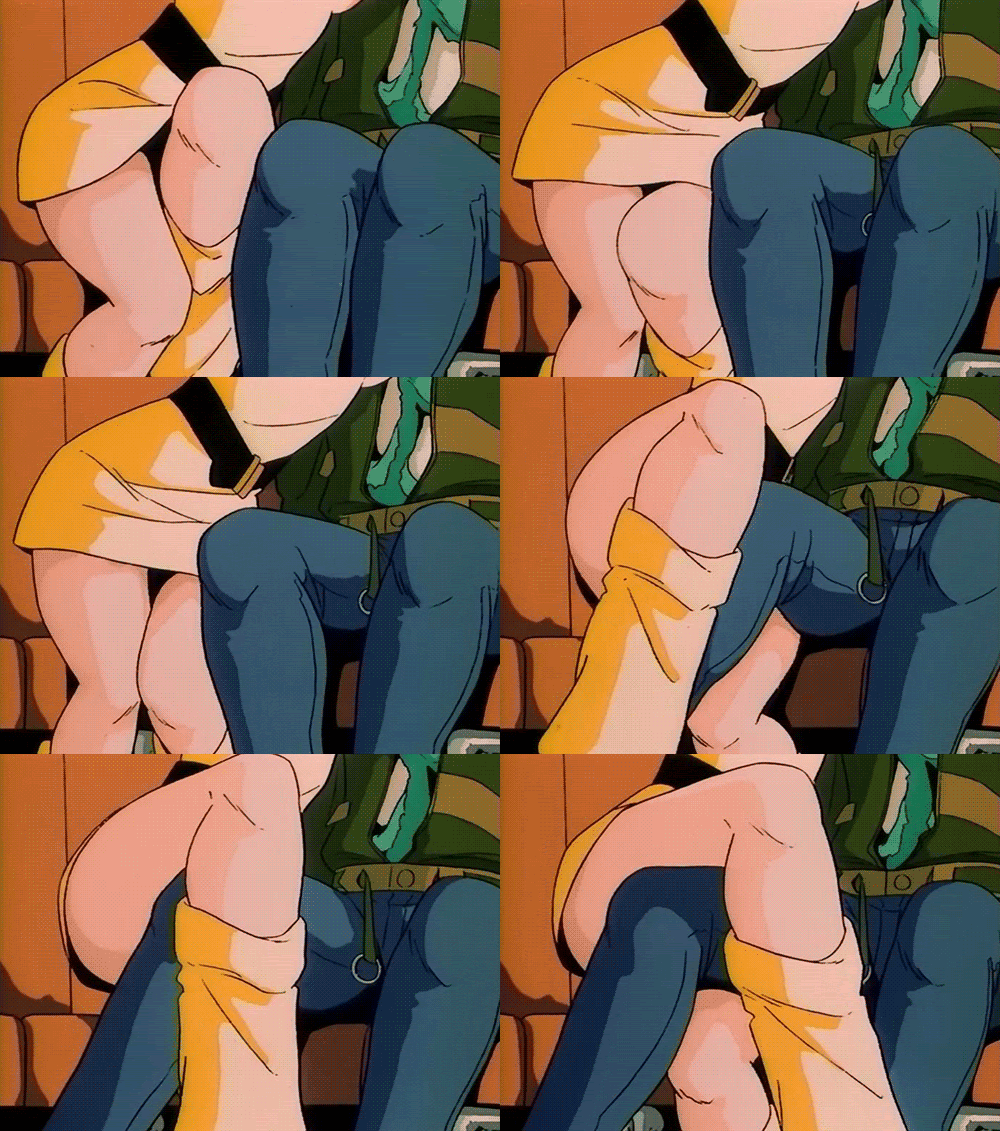
It's been a long while since I reviewed B-movies. The never-ending list of retro Anime I had to post, kept me in the Japanese field for several years, and it will continue for a while, as I'm still revisiting some I haven't reviewed yet. Anyway, streaming services sometimes provide you with a list of interesting more obscure films from decades past. Such is the case of today's review, a horror masterpiece that went under the radar for decades until it was rediscovered and properly issued on VHS format in the early 1990s by American International Pictures, owned by Metro-Goldwyn-Mayer, thus fully available now on Prime Video.
Allegedly, Deranged is based on the crimes of Ed Gein, an American murderer from Plainfield, Wisconsin. Legend has it, Psycho & The Texas Chainsaw Massacre where both based upon the crimes from this man. I'll spare the details so that you can enjoy the film, and Google details yourself. In a nutshell, this Canuxploitation psychological horror story, tries to retell the story from the earlier murderer in the fictional character of Ezra Cobb, masterfully portrayed by Roberts Blossom. Cobb is a middle-aged man from the rural midwest near an unnamed town.
Family dinner.
In-your face horror.
Considering this is a 1974 movie, most of the elements that describe the lead and his victims may be seen today as derivative or stereotypical. Yet, the storytelling is compelling. The locations, soundtrack and few characters translate the idea of being a loner in the middle of nowhere for too long. Roberts Blossom, a classically trained theater actor and poet, really brings to life the disgusting psychopathic aspects of Ezra Cobb, yet he also unveils the scars, fears and weaknesses of a character that at times seems to be the actual victim of the story. You see, Ezra has seen no life outside his farm, and spent most of his life care-taking for his mother Amanda, a religious fanatic who managed to indoctrinate Ezra into abhorring women. Once his mother dies, he has no reason left to live. No one to talk to, no one to cook for, no one to see hours go by while hoping for a recovery that will never come.
A whole year goes by, and Ezra starts having aural hallucinations from his mother demanding to be brought back home, and here is where the movie actually starts. Ezra brings the corpse of her late mother home, but seeing her skin has dried and deteriorated he decides to find "spare parts" in other bodies of recently deceased people. The obituary proves to be more helpful than LinkedIn when searching for a job, and so does the horror story unravels.
Build-your-own mask.
Psychopaths also love boobs.
Deranged costed only US$20,000 to produce, a modest budget even for the 1970s. Yet, the true horror does not lay in the way victims are murdered but more into the process where Mr. Cobb works with, LinkedIn recruitment precision, to find the perfect match. Graphic violence, while moderate, doesn't truly carry the horror we're looking for. Performances are key on this film, where even though characters don't do much beyond what they're needed for, they do reinforce our main character's psychological profile, and having Roberts Blossom as the lead, truly brings this criminal to life.
The original cut of the film featured a scene where the lead killer feeds from a skull. The scene was removed from early releases, and it is sadly removed in the version you can stream on Prime Video, although the scene doesn't add anything new about the deranged Ezra, it graphically depicts his mental state.
Now, as above mentioned in the first paragraph, the story of Ed Gein has been taken to the small and big screen on several occasions, and now that streaming rules-supreme, Netflix did their own revisiting.On September 16, 2024, it was announced that the third season of Monster would focus on convicted murderer and suspected serial killer Ed Gein. On October 4,2024 it was confirmed that the season would be titled The Original Monster, exploring Ed Gein's life as the first "celebrity serial killer" and examining how true crime evolved into a pop culture phenomenon. Principal photography reportedly began the next month. The season was announced to be retitled to Monster: The Ed Gein Story in August 2025.
Devil Hunter Yohko (魔物ハンター妖子) is a Japanese OVA series created by Madhouse, produced by Toho, and released in North America by ADV Films
as their first release. The series was first released on December 1,
1990 and ended on July 1, 1995. It is about a sixteen-year-old girl
named Yohko Mano, voiced by Aya Hisakawa, who banishes demons from the
Earth.
Yes, before you continue reading, this blog is far from being dead, I've just been busy "adulting", hence the lack of updates, but I can assure you I have plenty of Retro Animé series and OVAs waiting for a review, so bare with me.
Dress for the job you want.
Get quality clothes for your battles.
For today's grand return to posting, I'll take you back to the early 90s, a time where bootleg Animé heavily circulated around the world on VHS tape format.
Enter the world of the Mano family, they have been hunting demons for centuries. Yohko's grandma, Madoka was the 107th hunter in the family, until her daughter, Sayoko took her place as the 108th hunter. However, there's one catch. To have the skills and powers of a hunter you have to be a virgin. Unfortunately, Sayoko never took the job because she got knocked up before her mother passed the torch, so the responsibility went straight to her daughter Yohko.
Yohko is a blooming teenage who's found the boy of her dreams Hideki and intends to let her hormones lose. The demons on the other hand, are aware that she is next in line to become the new hunter, so they decide to use all the tricks they can to make her lose her virginity and not become the hero she's meant to be. Will she be the hero her family needs? or will she succumb to the pleasures of sex?
Cutey Honey started the trend, while Yohko preserves the legacy.
Nude transformations and magic.
Lasting only 6 episodes, Devil Hunter Yohko was the first ever Anime to be released in home video by ADV in the USA. It was also probably the first Ecchii animé ever to see American release. This was in the year 1990.
The US had received gory
anime like Akira and Vampire Hunter D. There had also been a very
limited release of hentai like the infamous "Urotsukidoji: Legend of the Overfiend"
found in the adult section of "selected" video stores. There was no internet at this
time, so the only people that had ever seen a hentai were those with
enough personality to walk straight into the adult section and rent a poorly dubbed bootleg while having to cope with the store clerk's look at your face.The Echii genre for those that don't know is a lowbrow
genre that has lots of tits and ass, but isn't actual hentai. It is
essentially softcore and includes shows like Ikki Tousen, Seikon, Desert
Punk, and Highschool of the Dead. This is the grandfather of all those
shows. The trunk of the sleazy Echii tree! It featured copious blood and
nudity without having to buy it in a porn store. This made it a
somewhat popular title back in the early 90s.
This devil hunting collection of OVAs is perfect for
fans of panty flashes, girls with weapons, and 90's anime art style. I first watched this decades ago while I was entering high school, and discovering then obscure Japanese animation with a bunch of good friends. I used to rent it from a
local video place that had lots of anime featuring a decent amount of Ecchi and Hentai stuff. The store clerks didn't give a fuck about kids watching this stuff because they thought these movies were essentially cartoons.
How can you resist love?
How can you resist panties?
If you're into the 魔法少女 (Magic girl genre), you probably have watched it before. If you haven't, go for it! Like most Anime in the genre, the story is very easy to follow. Probably Devil Hunter Yohko, owes it all to Cutie Honey, the one that started it all, and the one we have covered in detail in the past from original Anime to every remake to date.
Plot wise, if you're looking for original ideas, you won't find much here. Nevertheless, don't fix something that's not broken! We all know that the Japanese animation & manga industry have spent decades telling stories about teenagers discovering sex, teenagers dealing with duty over pleasure, and most importantly, teenagers saving the day while fanservicing the viewer. However, Devil Hunter Yohko does come with a valuable lesson as crazy as it may seem. Sayoko discovers that a hunter will not lose her powers as long as she uses protection while having sex. So, the trick is not getting pregnant instead of full celibacy. Believe it or not, Sayoko hands out condoms to her daughter, while encouraging her to have as much sex as she can. While this seems like a cheap plot hole, who could have thought condoms would be the ultimate MacGuffin that enable our hero to save the day and have a good fuck at the same time?
"Don't worry, I have protection"
"Better rub all this cum off"
Quick Episode Guide.
1.Devil Hunter Yohko: Yohko Mano is introduced. Yohko goes
about her daily life; day dreaming about a cute guy named Hideki. Yohko
learns that her family has a long history of being devil hunters. But
this time the demons decide to take out the next devil hunter before she
can fight back. After a failed attempt to take Yohko's virginity
(so that she can't become a devil hunter), the demons decide to use
Hideki as bait. Yohko must become the 108th devil hunter and rescue the
man of her dreams. This first episode is the one that features the most Ecchi themes and scenes. From then on, the adult themes are toned down and reduced to accidental nudity.
2.Devil Hunter Yohko 2: Yohko trains to become a good devil
hunter. Nearby a local construction site destroys a forest in which
sleeping spirits lie. The spirits are disturbed by this and start
harassing the construction workers. Azusa Kanzaki, a Devil Hunter in
training, is introduced. Azusa came to become an apprentice to Yohko.
The two team up to fight against the spirits that are harassing the
workers. From this episode on, there's a comedic twist that I guess, could have worked for a full season.
3.Devil Hunter Yohko 3: Yohko has a dream about a man named
Master Biryu. Yohko is transported to another dimension and learns that
Biryu has been imprisoned. Yohko learns that she must save Master Biryu
(although she develops a crush on him). Meanwhile, Azusa saw Yohko
disappear and attempts to get Yohko back with Yohko's friend, Chi. They
manage to get to where Yohko is, but fail and manage to get themselves
back where they started. She must fight the demon holding Master Biryu
captive in order to free him.
Coitus interruptus by motorbike.
Some demons have powers to get you naked.
4.Devil Hunter Yohko 4-Ever: A tribute to Devil Hunter Yohko,
with a collection of music videos. These videos feature songs from the
series (including three new songs), put to scenes from the anime,
colored manga picture, an original animated video featuring chibified
versions of Yohko and Azusa, and two live videos. A lot of people don't consider this episode as such due to being mostly a cut and paste from the previous episodes.
5.Devil Hunter 5: Hell on Earth: Madoka, Yohko's grandmother,
senses the return of Tokima: the demon who from the time of the first
devil hunter has been the enemy of the Mano family, is approaching.
Tokima appears and possesses Ryuichi Asakura, a man whom Yohko has a
crush on. Tokima tricks Yohko and gets near the clock that keeps his
power sealed, but is repelled by special talismans. The next day, Madoka
ends up with her past youthful body! Tokima possesses Azusa, who takes
the clock. Yohko fights Azusa to try to stop her from destroying the
clock. Yohko is tricked and "killed". The clock is destroyed and the
demon's power released. Yohko is taken to the time of the very first
Devil Hunter, Haruka Mano. The two go back into the present and fight
against Tokima.
6.Devil Hunter Yohko 6: Double Jeopardy: Ayako Mano, who is
nearly identical in appearance to Yohko, is introduced; she has spent
her life training and honing her abilities so that one day she may
defeat Yohko and become the devil hunter of the Mano family, and now she
is ready for the final confrontation. Yohko continues to live her life
and is unaware of Ayako until she starts stealing away every guy that on
whom Yohko has a crush. Then one night while taking a bath, Yohko hears
something outside and gives chase. She then meets up with an Azusa
look-alike. She and Ayako attack the unsuspecting Yohko with crushing
attacks, while Yohko parries the onslaught. The fight stops, but Ayako
vows to finish it. Madoka reveals a certain part of her past that
relates to the encounter. Yohko's teacher, whom she has a crush on, is
used as bait to lure Yohko. Ayako and Yohko meet face-to-face for the
showdown. The fight awakens a demon who sleeps deep within the Earth and
the two must learn to fight together to fend off this powerful
creature.
Ready for the fight.
Another demon hunter?
Devil Hunter Yohko, of course, was a response to the “magical girl” craze popularized by Sailor Moon (though the trope existed long before). While that series, as with most, was aimed at girls and young women, Devil Hunter Yohko
was plainly aimed towards older boys and men, being a darker anime with
substantially more violence and nudity. The heroine is an everyday
girl, who maintains her family’s professions as a demon slayer, and
fights them in a stylish red Chinese dress. Obviously, this meant some developers would take a shot and make a 16 bit videogame port of the OVAs.
Devil Hunter Yohko: The 7 Warning Bells, A Valis-esque action game for the Mega Drive (Sega Genesis here) from obscure
developer Klon, it’s a tie-in to the 90s anime, one which might seem
slapped together at first but reveals more character underneath. Despite its disinterest in telling a story, the game certainly looks like Valis,
or any other Telenet/Wolf Team-developer titles, right down to the
featureless face of the heroine. And like many of their titles, it
doesn’t feel right either, with slightly awkward controls and monotonous
levels that don’t really develop so much as meander (though there are
some branching paths). For example, the first stage is filled with
winding vines, but it’s not entirely clear what parts you can walk on
until you try them out. Neither the enemies nor Yohko react much to
damage – in fact, taking hits is a little bizarre, because there is no
invincibility period, but if you manage to avoid another attack for a
second or so, Yohko will regain a slight amount of health. It’s not
much, though, and you can still find yourself dying in three or so
hits. Two other Devil Hunter Yohko games were made for the PC Engine console as well.
16 bit Yohko.
Fights only, no sex here.
But is this Animé based upon a manga?
Devil Hunter Yohko, like several popular Animé started in animated form before they made the jump to the respected Manga format. Gaku Miyao adapted the OVAs to the format in 1995 in one volume that focused on expanding the story of Yohko's past while facing new demons. Six to be exact.
The manga.
Gaku Miyao's talent.
While a lot of people consider Devil Hunter Yohko a cheap Sailor Moon rip-off that relies on all the Animé tropes and fan service clichés, I can say it's worth a shot.
Mind you, this is chock-full of almost everything that gives anime a
"bad name". You've got the gratuitous nudity and fan service sequences,
the violence, the sexual innuendoes, all focused on a cute little
high-schooler. There's even tentacles on some of those demons she has to
fight- but, no, this show, despite the borderline ecchi first episode,
doesn't go there.
What Devil Hunter Yohko does do is entertain. The
characters are likable and funny, with Aya Hisakawa at the top of her
form as Yohko herself. Konami Yoshida as her sidekick Azusa is also
super-cute. The action sequences are topnotch (I'm apparently not the
only one who thought the swordfight at the end of the first episode was
really cool) and at times, the plot can actually venture into the realm
of genuine cleverness, especially in the fifth OVA.
The animation in the first few episodes has suffered quite a bit
with time, as the first OAV was made in 1991. However, the plotlines and writing remain more than adequate, and
the music for the whole series, mostly J-Pop, is quite good if you're
into that style. (The ending song to the second OAV, "Not So Fast Sexy
Girl", has to be one of the funniest anime songs ever written.) It was
certainly popular enough to merit an entire episode of music videos (OAV
4), which I don't count at all as being part of the storyline (and
neither should any other sentient being, for that matter).
Heroes take showers.
That legendary sideboob scene.
Overall, Devil Hunter Yohko is another early 90s Anime that deserves its place in history, despite the flaws some see in it. Until next time, stay fresh cheesebags!
Now let's finish today's work with our classic video section:
The 80s were a unique decade for the world of Animé, and those who were lucky enough to be there know this to be true. However, "to be there" meant to be in Japan, or have some contacts that would send overseas VHS tapes with the latest the industry had to offer. In the Western world 80s Anime actually happened mostly in the early 90s. Although there were some notable exceptions, the vast majority of Anime and OVAs made in the 80s made their way into the outside world almost a decade later. Such is the case of Call Me Tonight, a 30 minute OVA made in 1986 by studios AIC.
Written and directed by Tatsuya Okamoto (known for his work on Captain Tsubasa, and Fight! Iczer One) based on a story by Toshimichi Suzuki (A.D. Police, Bubblegum Crash, Hades Project Zeorymer) with character designs by Kumiko Takahashi (City Hunter, Card Captor Sakura, Crusher Joe, Dirty Pair, Full Metal Alchemist, Ninja Scroll and a whole lot more!), Call Me Tonight is comedy, horror, romance and a tad of ecchi at the same time.
Buy sex!
Call me tonight!
Like what you see?
While the Urotsukidoji Manga was still half a year away from release in Japan (December 1st 1986) , and seven months away for the OVAs (January 21st 1987), Call Me Tonight was released on July 28th, 1986 in Japan.
Now, I'm not saying Urotsukidoji was inspired by this OVA in any way. As a matter of fact, Call Me Tonight is a very light hearted take on a story that could have been full on hentai madness. Call Me Tonight makes fun of the form while using some of its tactics. It also
wisely steers clear of showing too much--though the show revolves around
sexual situations and includes a small amount of fan service, it uses
restraint often unseen in anime, particularly in this genre. It may
still offend some by its subject matter alone, but it's tasteful in
comparison to much that's out there.
Stickers included in the vinyl soundtrack.
Hardworking sex workers.
Plot
A highschool girl working by night as a hotline
owner, Rumi "Suuko" Natsumi, receives the call for help of a young man,
Ryo Sugiura, who claims to transform into a destructive monster every
time he masturbates. Amused and attracted by Ryo, a shy yet good-looking pulp horror
aficionado, Rumi seduces him during their date on a diner, which proves
him right when he transforms right there. Rumi runs away with him and,
upon observing that he turns into a monster whenever sexually aroused,
yet is capable to contain it by force of will, decides to try to cure
him by habituating him to sexuality. They continue their date into the
city's red light district following this plan.
Unbeknowst to them, they are being followed by yakuza woman Maki Nohara, who witnessed Ryo's transformation (and is also a pulp horror fan herself). Maki's twisted sukeban
sister Oyuki, who happens to be a classmate of Rumi, gets interested in
Ryo by a picture, so she tries to blackmail Rumi into bringing Ryo to
her. When Rumi refuses and ignores her in favor of another romantic date
with Ryo, Oyuki orders her yakuza gang to kidnap them. Taking the
captured couple to an abandoned building, Oyuki leaves Rumi to be
ravished by her men while she has her way with Ryo. Meanwhile,
mistrustful of Ryo's nature and her sister's intentions, Maki sets out
for the place after being warned by her henchman Hayata...
Laserdisc cover art.
VHS cover art.
Review
As above mentioned, a call girl is set to help a man that turns into a monster whenever he's horny. As odd as it may sound, Rumi (the company owner) decides to take the job, and somehow fall in love with the guy. Very romantic, isn't it? The whole
sex tone isn’t a whole lot considering its only half an hour, but its
still very much there for an 80’s title! Which is what this OVA is
really all about, erotic sexual behavior topped off with a bit of Sci-fi
style themes for good measure. Its not really bad in that regards, they
just never really focused on much else regarding the overall story or
character chemistry. As everything pertaining to who the characters
really are, and the love scenes in general...feel very much rushed and
not believable. However I think that’s almost to be expected, because this genre its not really suppose to be about a good
story.
The Animation and character design are very nice to look at, very reminiscent of the time it was made. The art design with both the character
creations as well as monster style art, all scream out 80’s! For me,
watching this title brought back fond memories of when this type of
anime (disregard the erotic parts) was all over the televisions in
Japan. The characters move with good fluidity during some of the
action scenes, even if they are pretty sparse in general. Backgrounds as
a whole were pretty nice to look at, even if some where not quite as
nice as others. And the monster that the main guy changes into...while
not exactly creepy, is pretty cool!
If you can't stand the heat, get out of the kitchen Ryu!
Sex is a monster.
Moving on to the soundtrack, and if you're a fan of what's now been dubbed as "City Pop", "Synthwave" and/or "Retrowave", I'm sure you'll find Call Me Tonight's soundtrack the best part of the OVA. The few background music tracks and the main title song are really good, if you're OK with 80s synth pop music. "Please Call Me Tonight", performed by Emi Natsumi it's really a catchy song worth searching for that long out of print vinyl record.
Character development wise, there is no character chemistry or any depth to them whatsoever,
as many of the characters seem to be tossed into the picture just for
the sake of doing it. Even the whole love attraction of the two main
leads is very much rushed as I had said earlier. Could you really fall
in love with someone you have only known for less than 24 hours?
Especially considering that this guy masturbates to pin-up posters and
changes into a monster? I don’t know about most people, but I certainly
would at least ask for a second date before coming to that conclusion. However, for a one-off story each one dimensional character serve their purpose well. There's Ryu, the troubled victim, Rumi, the strong woman willing to go beyond the call of duty, and then, a bad girl, her gang, a helping sister with a bazooka, and that's pretty much it.
Willing to try some monster sex.
Monsters last longer?
Even though "Call Me Tonight," doesn't really feel well planned out as a
whole, it's also not really all that bad either. And you may find some
decent enjoyment from this, especially for those who like this sort of
erotic style of play, which I have to admit was kind of amusing. Its
main concept actually feels more along the lines of an experimental
title to see if it would catch on in Japan. (perhaps in order to see if
this would make it as a series) So as far as its content appeal goes, it
ends up being a mixed baggage. Some will like it...while others won't. I
personally felt it was worth a viewing of, since it is only one episode
long.
Here's an excellent fan-made trailer by RB Comics Group Production:
I'm really sad to publish this review this late. I'd been planning it for months. Unfortunately, this week I was devastated by the terrible news: Dame Diana Rigg, dead at 82...
Emma Peel is one of the earliest memories I have of seeing an empowered woman do justice by herself with a tremendously avant-garde set of skills. Not that anyone cares but, Today, I'm a 38 years old man, I wasn't even born when the show originally aired, so thanks to the 80s frequent reruns of old TV shows,I got to meet one of the most important female characters of all time.
*Bare in mind, today's review is about The Avengers Seasons 4, 5, & 6. The seasons that had an official international release (over 90 countries) and coincidentally, the seasons that featured Dame Diana Rigg's character.
"But aren't The Avengers* the blockbuster superhero films?"
No. The Avengers we're talking about today, is a British espionage television programme created in 1961. It initially focused on Dr. David Keel (Ian Hendry), aided by John Steed (Patrick Macnee).
Hendry left after the first series; Steed then became the main
character, partnered with a succession of assistants. His most famous
assistants were intelligent, stylish and assertive women: Cathy Gale (Honor Blackman), Emma Peel (Diana Rigg), and Tara King (Linda Thorson). The series ran from 1961 until 1969, screening as 46 minute episodes for its entire run. The pilot episode, "Hot Snow",
aired on 7 January 1961. The final episode, "Bizarre", aired on 21
April 1969 in the United States, and on 21 May 1969 in the United
Kingdom.
The Avengers was produced by ABC Television, a contractor within the ITV network. After a merger with Rediffusion London in July 1968, ABC Television became Thames Television, which continued production of the series, though it was still broadcast under the ABC name. By 1969, The Avengers was shown in more than 90 countries. ITV produced a sequel series, The New Avengers (1976–1977), with Patrick Macnee returning as John Steed, and two new partners. In 2004 and 2007, The Avengers was ranked No. 17 and No. 20 on TV Guide's Top Cult Shows Ever.
Mrs. Peel & Mr. Steed.
Spies with class.
Background.
The show was sold to the American Broadcasting Company (ABC) in 1965, and The Avengers became one of the first British series to be aired on prime-time
US television. The ABC network paid the then-unheard-of sum of $2
million for the first 26 episodes. The average budget for each episode
was reportedly £56,000, which was high for the British industry. The
fourth series aired in the US from March to the beginning of September
1966.
The US deal meant that the producers could afford to start shooting the series on 35mm film.
The use of film, rather than the videotape of the earlier episodes, was
essential, because British 405-line video was technically incompatible
with the US NTSC videotape format. Filmed productions were standard on US prime-time television at the time. The Avengers continued to be produced in black and white.
The transfer to film meant that episodes would be shot using the single-camera setup,
giving the production greater flexibility. The use of film production
and the single-camera production style allowed more sophisticated
visuals and camera angles, and more outdoor location shots, all of which
greatly improved the look of the series. As was standard on British
television filmed production through the 1960s, all location work on
Series 4 was shot mute, with the soundtrack created in post-production.
Dialogue scenes were filmed in the studio, leading to some jumps between
location and studio footage.
Mrs. Peel Lotus.
Mr. Steed mighty steed.
New female partner Mrs. Emma Peel (Dame Diana Rigg)
debuted in October 1965. The name of the character derived from a
comment by writers, during development, that they wanted a character
with "man appeal". In an early attempt to incorporate this concept into
the character's name, she was called "Samantha Peel", shortened to the
awkward "Mantha Peel". Eventually, the writers began referring to the
idea by the verbal shorthand "M. Appeal", which gave rise to the
character's ultimate name.
Emma Peel, whose husband went missing while flying over the Amazon,
retained the self-assuredness of Gale, combined with superior fighting
skills, intelligence and a contemporary fashion sense.
After more than 60 actresses had been auditioned, the first choice to play the role was Elizabeth Shepherd.
However, after filming one and a half episodes (the pilot, "The Town of
No Return", and part of "The Murder Market"), Shepherd was released.
Her on-screen personality was deemed less interesting than that of
Blackman's Gale, and it was decided that she was not right for the role.
Another 20 actresses were auditioned before the show's casting
director, Dodo Watts, suggested that producers Brian Clemens and Albert Fennell check out a televised drama featuring the relatively unknown Rigg (she had earlier guested in an episode of The Sentimental Agent that Clemens had written). Rigg's screen test with Macnee showed that the two immediately worked well together.
A prologue was added to the beginning of all the fourth-series
episodes for the American broadcasts. This was to clarify some initial
confusion audiences had regarding the characters and their mission. In
the opener, a waiter holding a champagne bottle falls dead onto a
human-sized chessboard, a dagger protruding from a target on his back.
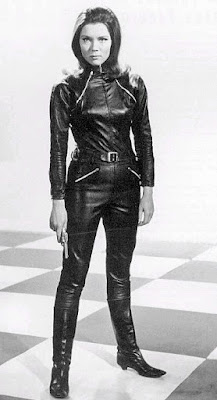
Steed and Mrs. Peel (dressed in her trademark leather catsuit) walk up
to the body as the voice-over explains: "Extraordinary crimes against
the people, and the state, have to be avenged by agents extraordinary.
Two such people are John Steed, top professional, and his partner Emma
Peel, talented amateur. Otherwise known as The Avengers."During this
voice-over, Steed pours two drinks from the wine bottle and Mrs. Peel
replaces her gun in her boot. They clink glasses and depart together as
the screen fades to black and the opening titles begin.
Empowered woman.
Yet very delicate.
Review.
Dame Diana Rigg said in a 2015 interview "Emma Peel was avant-garde". However, she acknowledged, this was the result of mere causality since none of the producers, writers and people involved in the series production thought "ahead of their time". Implying the industry was at its most sexist (she was under payed. Camera men made more than She did!) back then, this product of causality empowered millions of women that saw themselves reflected in Emma Peel's impressive skills. As a matter of fact, I think that's what made the character remain in everyone's hearts for decades to come.
Although Patrick Mcnee was brilliant as John Steed, the masculine secret agent wasn't an original idea, even by the time the series originally aired. On the other hand, Emma Peel was nowhere near a damsel in distress. She knew Kung-fu, Judo, she was an expert in sciences, quick-witted and never, ever had to answer to a man. She drove her own sports car, had a wardrobe that established new standards in fashion, could easily use any weapon at hand, and didn't exploit her physique to get whatever she wanted. She was the archetype of feminine empowerment and, I, a stinky greasy unworthy male, could see that even when I was a small kid. The industry needs more Emma Peels and less [insert whatever name you can think of here].
Now, the combined talents of McNee & Rigg provided our screen with one of the finest couples ever seen on TV, and it shows. They were so good together, producers allowed to improvise their lines and even write their own dialogs whenever they came across a dead body, and boy did they come across dead bodies throughout the 51 episodes they partnered together.
World famous Emmapeelers.
Ready for action!
Setting aside the above mentioned talent of their protagonists, The Avengers was indeed a marvelous series where genre variety played a key role establishing the show as one of the greatest of all time. Besides the relatively obvious espionage episodes full of Soviet spies and her Majesty's traitors, there were cyborgs, mad scientists, horror stories, Aliens, secret societies, absurd yet terribly dangerous characters, corruption, frame-ups, blackmail, eccentric murderers, feminist killers, butlers, Arabian princes, state-of -the-art weapons, food poisoning, high tech murdering houses, and amongst all of that 19 gallons of Champagne!
After Rigg decided it was her time to move on from the series, "because She didn't want to play the part forever". She became the only Bond girl to actually marry the fictional character in "On Her Majesty's Secret Service". She also continued to work in plays (she acted in 38 plays from 1957 to 2018), 51 TV series (including The Avengers & Game Of Thrones), and 18 movies. The Black Narcisus series will be released posthumously this year, as well as the Last Night In Soho film set to release next year.
Patrick McNee died in 2015. Legend has it they remained friends long after the series was cancelled.
The Avengers Trivia
Emma Peel's name was taken from the British movie industry expression
"M-Appeal", or "man-appeal", which is what the show's producers were
looking for in her character. Something that makes total sense considering Dame Diana Rigg said producers made her characer avant-garde by causality.
During her first season, Dame Diana Rigg
was dismayed to find out that the cameraman was being paid more than
she was. She demanded a raise, to put her more on a par with her
co-star, or she would leave the show. The producers gave in, thanks to
the show's great popularity in the U.S.
Series writer Brian Clemens
noted in an interview the sexual chemistry that particularly existed
between Steed and Emma Peel, and the common question of "Will they ever
go to bed together?" Clemens' attitude toward the characters was that
they already had done, and this was the next day. Patrick Macnee and Dame Diana Rigg
confirmed later in interviews that they had decided their characters
had a casual sexual relationship, "but just didn't dwell on it."
The look and character of Steed is an amalgam of Patrick Macnee's
father (a racehorse trainer and dandy), fictional character The Scarlet
Pimpernel, and Macnee's commanding officer in the Navy.
At least two principal actresses and one principal actor in this show appeared in James Bond movies: Honor Blackman as Pussy Galore in Goldfinger (1964), Dame Diana Rigg (Contessa Teresa "Tracy" Di Vicenzo Bond) in On Her Majesty's Secret Service (1969), and Patrick Macnee as Sir Godfrey Tibbett in A View to a Kill (1985).
Dame Diana Rigg was the first person ever to do Kung Fu on-screen. In 1965, Ray Austin
went to his producers and said, "Listen, I want to do this thing called
Kung Fu." They said "Kung what?" and insisted that Emma, like her
predecessor, stick to judo. Instead, Austin secretly taught Rigg Kung
Fu.
Mrs. Peel's maiden name is Knight. We learn more about her childhood and
her relationship with her mother and father in an exhibition on the
"late Emma Peel" in season four, episode twenty-three, "The House That
Jack Built".
According to Patrick Macnee in his book "The Avengers and Me", Dame Diana Rigg disliked wearing leather and insisted on a new line of fabric athletic wear for the fifth season. Alun Hughes, who had designed clothing for her personal wardrobe, was suggested by Dame Diana to design Emma Peel's "softer" new wardrobe. Pierre Cardin was brought in to design a new wardrobe for Macnee.
Emma Peel's revolver is a gold-plated, pearl-handled pocket version of
the Webley Mk IV chambered for .380/200 (a.k.a. .38 Smith & Wesson).
Dame Diana Rigg auditioned for the role of Emma Peel on a whim, without ever having seen this show.
This show was the first British television show sold to an American network.
"The Avengers" became ground-breaking for introducing regular female
characters who were portrayed as being just as tough, brave, and
tenacious as men.
You don't mess with Mrs. Peel.
Style.
Now the influence The Avengers had, and especially Emma Peel's influence inspired several artists to write songs about her. Sit back, and chillax to the following songs.
The Pretenders "Don't Get Me Wrong"
The Cretones "Hey Mrs. Peel"
The Allies "Emma Peel"
Dishwalla "Miss Emma Peel"
Matmatah "Emma".
Slot "Emma Peel"
Sadly, the songs by Pussy Galore, Shark Inferno and Babette Novak didn't have an available video at the time this post was made.
Overall, the three seasons featuring the great Emma Peel, are The Avengers at their best. If you still haven't given them a try, do so now. You won't regret it.
Last but not least, our classic opening and ending section: