Making a review after Joker seemed like an impossible job for weeks. Obviously, that's not the main reason I was away from this blog. The social revolution that started in my home country, made me prioritize my duties, and yet I found the perfect excuse to return to our Animé reviews.
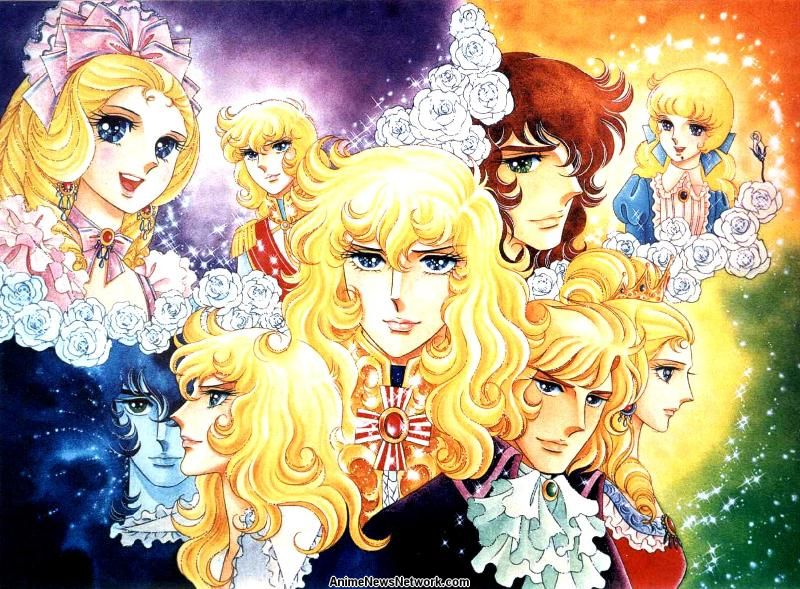
The Rose of Versailles (ベルサイユのばら), also known as Lady Oscar, is a very popular Japanese shōjo manga series written and illustrated by Riyoko Ikeda. It has been adapted into several Takarazuka Revue musicals, as well an anime television series, produced by Tokyo Movie Shinsha and broadcast by the anime television network Nippon TV. The series remains incredibly popular in Italy and some countries of Latin America including Chile, my home country.
Today's
review will focus on the 40 episode Animé adaptation from 1979, which I
for one, think is the most beautifully drawn series from the 70's.
More astonishingly beautiful art.
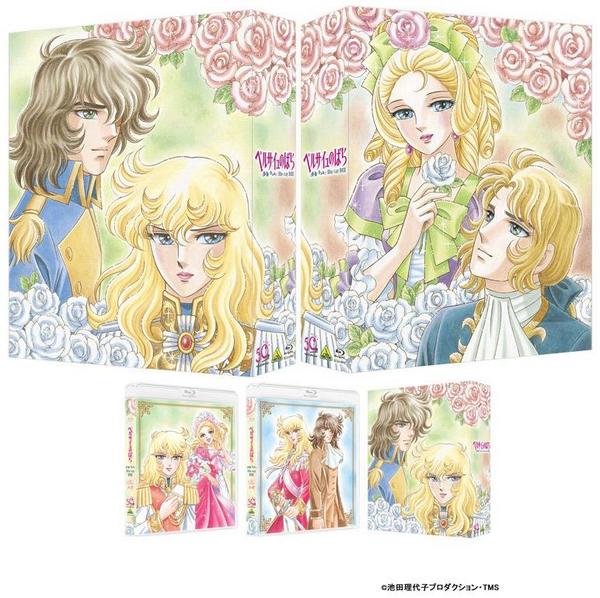
The Blu-Ray box. Go get it!
Background
The Rose of Versailles focuses on Oscar François de Jarjayes,
a girl raised as a man to become her father's successor as leader of
the Palace Guards. A brilliant combatant with a strong sense of justice,
Oscar is proud of the life she leads, but becomes torn between class
loyalty and her desire to help the impoverished as revolution brews
among the oppressed lower class. Also important to the story are her
conflicting desires to live life as both a militant and a regular woman
as well as her relationships with Marie Antoinette, Count Axel von Fersen, and servant and best friend André Grandier.
It features elements of the yuri genre embodied in the relationship between Oscar and her protégée Rosalie Lamorlière, the secret daughter of the scheming Madame de Polignac. Rosalie refers to Oscar as her first love.
Many of the court ladies also greatly adore Oscar, openly admiring her
at parties and become very jealous when she brings female companions to
them.
Rosalie.
Marie Antoinette.
In 1979, The Rose of Versailles was released in Japan as a 40-episode (and 1 recapitulation) animated television series,
which ran from October 1979 to September 1980. Besides Japan, the
series has also been broadcast in several other countries of Europe and Latin America under the title of Lady Oscar. The anime was directed by Tadao Nagahama (episodes 1-18) and Osamu Dezaki (episodes 19-40), who brought a cinematic approach to the series. Shingo Araki was the animation director and co-character designer along with Akio Sugino and Michi Himeno. Kōji Makaino was in charge of the soundtrack. The production staff
included the most recognized animation professionals then, who
contributed in the making of the 40 episodes of the anime. In spite of
the difficulties they had to go through, the staff could continue with
their work and took advantage of the problems. The most important of
said incidents was the change of direction at the middle of the project,
which marked a notable difference between the first half of the anime
(directed by Tadao Nagahama) and the second one (directed by Osamu Dezaki). The anime was finally aired on October 10, 1979 in Japan on the channel Nippon TV. From this point on, the series would be aired every Wednesday until September 3, 1980, with the airing of the last episode.
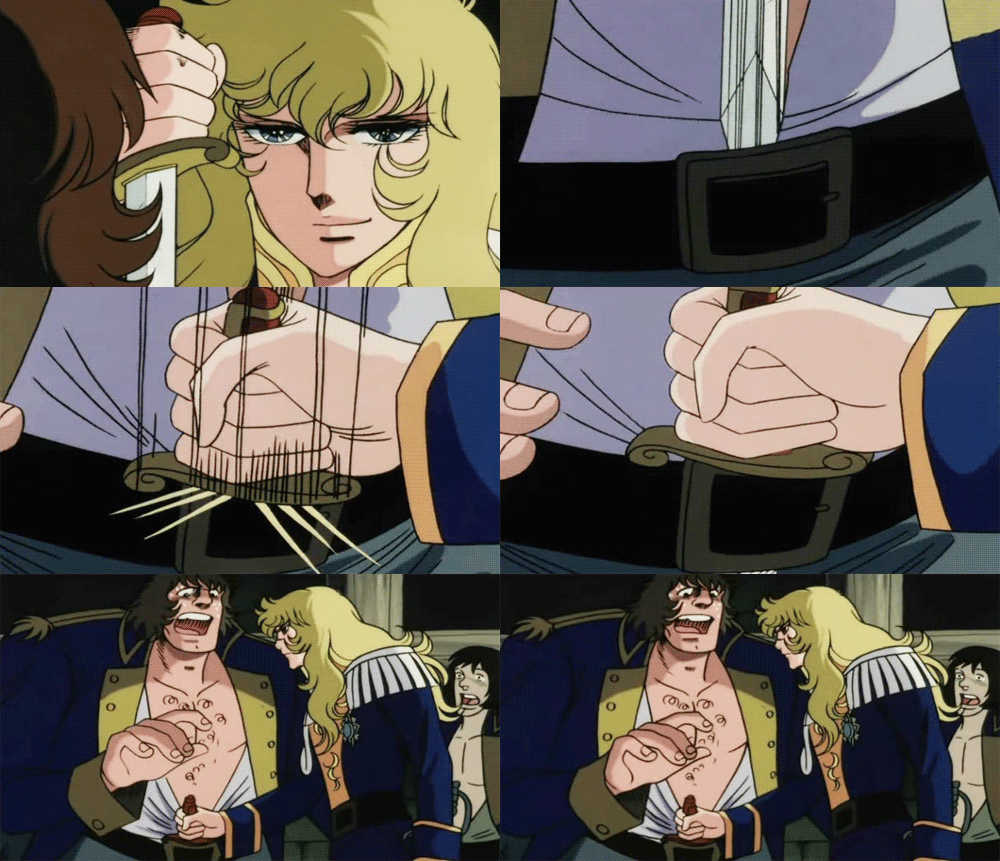
En garde!
Man up! loser!
Review
Do you need to be a history nerd to like The Rose of Versailles? The answer is both yes and no. Set during the french revolution, this Animé is more of a reflection of a certain type of society rather than a historical research. While it is based upon the French revolution, the main focus is on how the characters deal with what's going on from different social perspectives. Historical facts intertwine with fictional characters in such a natural manner, you'll find yourself believing Oscar was actually there when it all happened. The first thing you notice when you start watching Rose
Of Versailles, are the marvelous character designs done by Shingo
Araki. While his style may seem dated to modern Animé fans, I assure you, there's nothing dated with this man. As a matter of fact, I'd say his best work is right here in The Rose of Versailles. Later he'd go on to reprise his skills in Saint Seiya. In addition, the
directing approach is top notch, and I'd say that some scenes are so
well animated that they even defy the commodity of
modern animation from these days. There's this dance scene early on, where every character on screen is doing independent moves!, Hard work at its best!. Unexpectly, Nagahama Tadao died early on in the making of the series
and with him died some of the innovative aesthetics the series had in the
first few episodes, because the acclaimed 70’s director Osamu Dezaki
which came as substitute, didn’t follow that scheme but that's not saying the Animé lacked quality from there on. On the contrary, Dezaki fulfilled his duty with excellence and ended the decade in the
highest note. I especially love how the shots of the camera are taken
from various angles throughout the series. And a very special Dezaki
watermark, the dramatic stills at the end of a scene.
These are hard times.
Duty or truth?
History wise, there are some true events in a few episodes. Especially, the events that lead to the fall of the French monarchy & aristocracy. However, most of the action is seen from the perspective of the fictional characters. And, that's a good thing. The way reality meets fiction is hard to tell if you're not a history connoisseur. Plot wise, we get to see a lot of what made humanity a miserable society. Poverty, exploitation, abuse, rapist priests, corruption, greed, arranged marriage, suicide, pedophile aristocrats, the rich getting richer and more powerful, etc. However, what makes The Rose of Versailles a unique Manga and Animé, is how it tells you the story though a varied set of characters that one way or another, end up having something to do with the french revolution, and how Oscar is the character that emotionally connects with each and every single issue taking place both inside and outside of the Versailles palace. How can Oscar serve her duties and at the same time, give a hand to those suffering in poverty? is that even possible? can she be Marie Antoinette's protector and a servant of the people? Those questions will obviously be answered by the time the Animé enters its final five episodes.
Looks that kill.
Love is just around the bend.
The "bad guys" in the Animé are the aristocrats and monarchs. While the focus is more on the side of aristocrat wannabes manipulating their way into the palace of Versailles, they're still the bad guys, and I can think of a couple of key antagonists. First, Madame Du Barry, who used to be a prostitute,
and thanks to that she manages to enter into the court by becoming the
lover of King Louis XV. When Marie Antoinette becomes princess of France, they become enemies. Maria Theresa of Austria, queen of Austria and mother of Marie Antoinette, sends her advisor, Comte de Mercy,
to France. Mercy advises the princess to stop fighting with Du Barry,
but Marie Antoinette does not obey the warnings until King Louis XV
shows his displeasure with her attitude towards the countess. Marie Antoinette finally speaks to Du Barry. Months later, King Louis XV gets smallpox. Before dying, the bishop,
hearing Louis's confession, and orders the removal of the King's sin,
that is to say, Madame Du Barry. King Louis XV dies and Du Barry is
taken to a convent, where she remains until 1793, the year in which she is guillotined.
Second, Duchess of Polignac, a singer
of the Palace of Versailles, but she does not live there. Marie
Antoinette listens to her and quickly makes her best friend. She
impelled Marie Antoinette to bet in clandestine casinos, without the
permission of Marie Antoinette's husband, King Louis XVI. She
manipulated the queen for her own benefit and made the queen believe
that lies would fix her difficult situations. Following her advice,
Marie Antoinette lied and announced that the heir of France was on way.
In order to remedy the situation, Polignac blamed the death of the heir
on Lady Oscar. However, you can't say you despise Marie Antoinette, or Oscar's father, or some other minor characters working for the "bad guys". The producers not only did an excellent job in transferring the Manga to the screen, but also managed to go the extra mile and make you feel sorry for some of the antagonists, that at times look like innocent bystanders.
Who's the prettiest?
Rosalie, the innocent stereotype.
Interestingly enough, characters like Maximilien Robespierre, Louis Antoine de Saint-Just & Bernard Châtelet (fictional character, the Black Knight) are well represented as men of the people, carefully crafting the revolution, and opposite to Du Barry & Polignac greedy personal motivation, their struggle is for a better future, and that's quite clear whenever they show up in the final episodes, and there's no need for the viewer to do a full research on who these men were during the actual french revolution. The Animé producers wanted to make clear that all the antagonists in the series are the aristocrats & monarchs. Some of which try to sabotage their own kind in order to satisfy their greed.
On the other hand, the Animé does feature positive topics like love, friendship, loyalty and compassion. Oscar François de Jarjayes, André Grandier, RosalieLamorliére and every other good guy adds positive vibes in each episode. While Marie Antoinette starts as a naive princess, she ends up swallowed by her privileges and becomes the very thing the people hated with their guts. Another interesting aspect (for a 1979 Animé) is how love is depicted as more a duty, than a choice. AndréGrandier has loved Oscar since day one but, since he's nothing but a servant, he can't marry her. On the other hand Oscar is secretly infatuated with Marie Antoinette's lover Hans Axel Von Fersen. Moreover, Oscar acts more like a man throughout the first half of the series, and only in the last episodes, she realizes she's loved André her whole life. In addition, but to a minor degree, Rosalie seems to be bisexual. The way she sees Oscar, clearly suggests she felt more than sister love for her. Obviously, nothing ecchi takes place on screen, since this is a classy work ladies &gentlemen!
The queen?, or the people?
Fearsome lady.
Overall, The Rose of Versailles is one classic Animé you don't want to miss. If you have any prejudices with Shoujo manga/animé watch this one and be cured! Here's the opening: Here's the (clean) ending: The opening theme live with Yuki Nishio! Another live version by Hiroko Moriguchi: The live action film trailer:
After reviewing one of the best Animé from the 1980's (Armored Trooper VOTOMS, our previous review!) it's only natural to continue with another fantastic series that is often overlooked, but thanks to the recent Blu-Ray release and a couple of videogame connections, I can say it's time for us to travel back in time to 1987, pack our Zillion guns and defend planet Maris from the Noza! Ladies and gentlemen, I give you 赤い光弾ジリオン AKA, Red Photon Zillion or simply Zillion.
Depending on where you were in 1987 you had two options to find out about RPZ: One your parents bought you a Sega Master System video game console that allowed you to play the two games (Zillion & Zillion II The Tri Formation) made based on the Animé, or the Fantasy Zone games that featured Opa Opa. Two: You actually had a chance of watching the series (first five episodes only) that were released by Streamline Pictures on VHS tapes in the early 90's plus the Burning Night OVA. Chances are, none of those options applied to you, and found out about the series way later with the broad band explosion that spawned hundreds of Animé websites that allowed people to download (early 2000's, no streaming) cult series that were not officially available outside of Japan. Anyway, the greatest mystery is not, how you found out about the series but actually, why has RPZ been under the radar to a lot of people when it's probably one of the most eightish Animé ever.
The neverending battle of good and evil.
The original Zillion VHS tapes from 1990.
Background.
RPZ ran from April 12, 1987 to December 13, 1987 on Nippon Television in Japan and was produced by Tatsunoko Production. After the production of the anime, Tatsunoko Production and Mitsuhisa Ishikawa, the producer of Zillion, established IG Tatsunoko (which later became Production I.G) to obstruct the dispersing of the excellent staffs of Tatsunoko branch which had done actual production. Therefore, Zillion is considered to be Production I.G's first work.
As above mentioned, five of the 31 episodes were dubbed into English and released on VHS in the United States by Streamline Pictures. This anime was featured in the music video for Michael and Janet Jackson's collaboration "Scream". Samples from the English dub of the anime were also featured in Del the Funky Homosapien's single "Cyberpunks".
In October, 2018, Funimation released the complete series and the OVA on a Blu-ray/DVD set with Japanese audio and English subtitles, and today's review was made based on that release.
J.J.
Apple.
Review.
The story takes place on the planet Maris
in the year 2387. Apparently, mankind has abandoned (or destroyed) Earth and moved into this new planet which not only allows humans to live but also, could harvest the seeds of an alien race known as The Noza. Obviously, The Noza need to clean the planet from all living beings in order to plant their seeds and settle down. These aliens are a combination of energy and armor, and no human weapon can harm them, so the odds of conquering the planet seem easy peasy, lemon squeazy. However, mankind is ready to fight back. The White Nuts (J.J., Apple & Champ) are a super trio of trained teenagers that carry the Zillion Weapon System which is powered by the very rare and unique Zillionium mineral. Where does this mineral come from? who crafted it first? are questions that will be answered by the end of the series.
Anyway, the team is led by Mr. Gordon, his assistant Emi and the team's mechanic Dave. Most of the time we see the supporting characters doing what support cast would do, however, Dave is the one that gets the most screen time as he not only designs new gadgets for the trio, but also flies the main ship that helps them carry their mecha and other tools to the battle groud. On the Noza side we have only one personality that stands out: Baron Riks (voiced by the legendary Sho Hayami), the commander, and the tough guy. Much of the series has these three main characters facing off against
the Noza in various ways, trying to turn the tide of the war and save
Maris.
Artwork from the Sega Mark III edition.
The real deal.
While the series runs for 31 episodes, I'd say there are moments where you feel the Animé is episodical, like it wouldn't matter that you didn't watch the episodes in order BUT, and that's big but, the series does move on from that impression after the first ten episodes. Also, some of the early episodes reuse various scenes (ships leaving hangar, soldiers dying, etc) but then again, don't let that waste the fun watching Zillion is. However, what makes Zillion as a series interesting is that things aren’t quite as simple as they initially seem. For instance, there are moments where you'd say "Oh yes, J.J. will fall in love with Apple, I saw that coming miles away!" Wrong! While there are a few moments where Apple seems to be interested in J.J., nothing really happens by the end of the series. Another example would be "OK, the bad guy will die in the final episode, that is so obvious!" Wrong again! I won't explain this point any further to allow you to be surprised. And another example would be "Oh yeah, they have transforming bikes, I'm sure these mecha will play important roles in defining moments!" Wrong again! While the trio does rely on their mecha for a few missions, they are nothing but mere vehicles ridden to save time (remember, the Zillion guns are the ultimate firepower).
Now, what made the series incredibly groundbreaking and relevant (in Japan at least) is the connection the Animé has with the Sega Master System console. In order to promote the power this console had, Sega used the series to promote the Light Phaser peripheral gun which is the same weapon the White Nuts use throughout the entire series. It also featured characters such as Opa-Opa from the Fantasy Zone games as mascots for the White Nuts. The series also received two games on the Master System, that of Zillion and Zillion IIThe Tri Formation. The Zillion guns themselves also ended up as laser tag toys in Japan
and elsewhere and while the series and its impact were rather sizable
in Japan, Sega never thought to bring the series Westward at the time mostly because there wasn't a huge demand for their console due to Nintendo's NES massive popularity in the 1980's.
Sega's Light Phaser.
The Zillion Weapon System.
Moreover, the mecha designs of the series were in charge of Ammonite (Ammo who?) A team of designers (Hiroshi Ogawa , Hiroshi Okura , and Takashi Ono.) that were busy working in the videogame industry back then. Perhaps you can remember one of their greatest arcade hits, Darius. So, not only the characters look great, but also the mecha, weapons and ships look brilliant as well. In addition, most of the action sequences, feature a style that was only seen in the 80's, so in many ways, Zillion is a living tribute of the decade it came from.
The soundtrack department also delivers! If you're into the 1980's Animé animation style and music, Zillion will really make you happy. "Pure Stone", the opening theme by Risa Yuuki, screams 80's all over. Yuuki also sings the two songs used for the endings: "Push!" & "Rock Candy".
The full White Nuts team.
There's always a beach episode!
The Blu-Ray remaster is fantastic. Each episode looks like and sounds like it came out yesterday. High definition perfection!
As a matter of fact when I found out there was a Japanese release of the series I started saving up money (Like I've done for many Japan only releases) to get my hands on a copy of it. Fortunately, for you and I, Funimation released the entire box set plus the Burning Night OVA. Plus, isn't High Definition the best thing that happened to Animé? When DVD came out many years ago, I thought it was the definitive home format for your favorite movies and concerts but once Blu-Ray came out I was amazed once more and my Anime collection has never looked clearer!
Opa-Opa, another Sega character.
8 bit future.
Phew! I guess I got a little carried away by all the happiness the Funimation set brought into my life, but as I was saying a few paragraphs before, Zillion is one of the most entertainment Anime from the 80's. While it's true the animation style may seem dated to non seasoned fans, the simplicity of its story and the greatly animated action scenes, plus the very different personalities of each of the main characters, make the watching experience a delight. As the series approaches its climax, the Noza become even more dangerous, making the job a lot harder for the trio. The Zillonium crystals are a limited resource and by the end of the series, things really start to go south once our heroes run out of it.
Who's Who in Red Photon Zillion?
J.J.
Four leaf clover hero: J.J. survives impossible situations that would
get even Chuck Norris killed simply because of a silly slip-up due
to clumsiness or his pranks and stupidities. (failed) Ladies man: Whenever J.J. is around single
ladies he gets smacked around hilariously or teased to the point of
humiliation as often seen in his flirty talk with Apple. However many
times he has the bad luck of choosing a girl who already is in a
relationship or has an overprotective nearby male acquaintance or
relative and he often gets an (funny but also somewhat painful) ass-kicking.
Badass (?):
A goofball who makes lots of clumsy mistakes who is often tardy at
showing up at work as well as a big prankster..... but he is a fucking
genius at surviving calamities when shit hits the fan. This can be
summed up in the first episode where he takes on a Noza soldier unarmed
and literally spends the whole episode evading an entire company until
Apple and Champ rescue him.
Not your average hero.
Apple
Action Girl: Apple is always ready for action. She's as skilled as her male counterparts. She can shoot with bullseye vision, pilot airplanes, ride the transforming bike and avoid becoming a Mary Sue.
Badass in Distress: Although this doesn't happen in every episode, She is often kidnapped.
Cleavage: Red Photon Zillion is a PG rated Animé which you can enjoy with your grandparents and grandchildren. However, Apple's suit features a prominent cleavage that is never truly exploited in fanservice fashion, but you know it's there.
Apple or Nipple?
Champ
Stereotyped Example:
Implied to have come from a region that bears resemblance to New York, Champ carries some of the American stereotypes media sells, such as being blonde, having blue eyes and a bad boy
attitude. However, his personality is that of an experienced and balanced person that know the difference between right and wrong. Most of the time, you see him as the big brother in the trio. Also, he can shoot anything that moves from very distant places.
Emi Harrison :a primary assistant of Mr. Gord. She has a liking for J.J.
Mr. Gord : The commissioner/commander of the White Nuts.
Dave : A mechanic and assistant pilot, later member of the White Nuts.
Opa-Opa : White Nuts' companion robot and ally, and later member of the White Nuts. Opa-Opa is also another Sega character taken from the Fantasy Zone Sega Master System games.
Champ watches you play NES.
Baron Riks
Handicapped Badass:
Despite being severely weakened near the end of the series as a result
of surviving the explosion of a ship and the upcoming Eclipse, he still
manages to take on entire battalions with his sword, gives J.J.
difficult duels during the final episodes, and even singlehandedly hold
off against Elite Nozha soldiers (who the White Knights had such
difficulty fighting with for an entire story arc) on his own. Moreover, by the climax of the series he ends up saving J.J's life and dying out of exhaustion but, redeeming himself.
Admis : empress of the Noza Empire. Like Baron Riks, she realizes at the very end of the story that they can't destroy the human race in order to let their kind survive.
Navaro : a big Noza soldier, filled with micromissiles,
specially created to fight against the White Nuts, one of the three
Nohza Warriors (N.W.)
Solair: a flying Noza woman, also specially built to fight the White Nuts, the second N.W., shaped somewhat like a wasp.
Gardk: a soldier with stretchable arms, the third Noza Warrior created to counter the White Nuts.
The official toys!
Are you talking to me?
Carl Macek produced Zillion (?)
Moving on, let's address Carl Macek's involvement with the series. Carl who? Carl Macek, the producer that created Robotech and other Animé adaptations in the 80's. If you check My Anime List, you'll see him credited as the producer of the series, which he's not. He was only involved with the Streamline VHS edition, working in the English dub of the first five episodes plus the Burning Night OVA sequel.
Zillion Trivia
-When the series aired on Brazil's local channels back in the 80s , it became such a big a hit that merchandise for the franchise
was officially marketed in the Brazilian market. In fact, Brazil is probably the only country to have completely
dubbed the entire series in a local language and so much of the Zillion
fandom (who didn't get introduced via the Sega games) are from Brazil if
the internet is any indication. The series was also dubbed in Cantonese in Hong-Kong.
-Zillium, the substance powering the main character's guns, of unknown
origin, incredibly powerful and impossible to analyze. During the Grand Finale the protagonist trio discovers that, much like the Mazinpower, the Getter Rays, the Ide energy or the Spiral power-, it is sentient.
Pew Pew!
More pew pew!
- The Burning Night OVA is actually a much darker and edgier vision of Zillion. For starters
One of the antagonists attempts to rape Apple, the plot revolves around
a group of crazy whack cults, and the one-shot ends with Apple's
ex-boyfriend committing suicide after giving J.J. a farewell speech to
look after her.
-In Spain, Zillion was renamed to Zillion, el Caballero Blanco (Zillion, the White Knight). J. J. was renamed Jaime, and Apple was renamed Ana.
-The hairstyles and wardrobe of the characters reflects that the series
was made in the eighties, in spite of being set in the future. - Commissioner Gord was obviously inspired by Batman's commissioner Gordon.
-Some of the mecha designs used in Zillion were allegedly intended to be used in the cancelled Robotech II: The Sentinels TV series that ended becoming a standalone movie.
- Most people that had the Sega Master System games (outside Japan that is), never heard of the Animé adaptation. - Gratuitous English: The DVD box features on its back cover a legend that reads:
"Zillion: It is the one only weapon that can knock the soldier Noza. The demon is extending his hand outtowards us on the green planet of Maris. White Nuts was established to save planet of Maris from danger. The three members J.J., Champ and Apple are all famous shooting experts, and they possess the mysterious Zillion gun which was created by some unknown scientific civilization"
- Gratuitous English 2: "The White Nuts" name could a phonetic mistake. It should be properly named "The White Knights". Nuts proper pronunciation is /nʌts/ while Knights is pronounced /naɪts/. Mostly because establishing a state funded official troop that goes by the "nuts" (crazy, wacko) surname would be very unlikely, unless it was purposely intended to suggest only mental people would volunteer for the job. Moreover, most fans outside Japan tend to call the group "knights" because they're heroes, and well, knights would do heroic shit and stuff, while nuts would end up causing mayhem and shooting the wrong people. Not that it happens in real life though.
The White Nuts aren't nuts, are they?
Save the planet or die trying!
List of episodes
"My
Name Is J.J." (US title: "They Call Me, J.J.") (Original Airdate: April
12, 1987)—J.J. becomes the newest member of the White Knights
"Attack the Enemy of the High Skies" (US title: "Hang Fire")
(Original Airdate: April 19, 1987)—J.J. misunderstands the usage of the
Zillion weapon system
"0.1 Second Chance!" (US title: "Split—Second Chance") (Original Airdate: April 26, 1987)
"Trap of the Shapeless Ninja Squadron" (US title: "Target, The White Knights") (Original Airdate: May 3, 1987)
"Apple Order Violation!?" (US title: "Judgement Call") (Original Airdate: May 10, 1987)
"Take Off, Tricharger" (Original Airdate: May 17, 1987)
"Struggle 'Til Death! J.J. vs. Ricks" (Original Airdate: May 24, 1987)
"Strike the Oceanfloor Base!" (Original Airdate: May 31, 1987)
"Stolen Zillion" (Original Airdate: June 7, 1987)
"Flames! Ricks' Counterattack" (Original Airdate: June 14, 1987)—Apple and Amy are captured by Ricks and his henchmen
"Birth of New Zillion!" (Original Airdate: June 21, 1987)
"Attack! Triple Shoot" (Original Airdate: June 28, 1987)
"Angry Shutter Chance" (Original Airdate: July 5, 1987)
"Nightingale of the Battlefield" (Original Airdate: July 12, 1987)
"Life Or Death!? Confrontation of Fate—Part. 1" (Original Airdate: July 19, 1987)
"Life Or Death!? Confrontation of Fate—Part. 2" (Original Airdate: July 26, 1987)
"Tears! Let's Search J.J." (Original Airdate: September 6, 1987)
"The Beautiful Noza's Challenge" (Original Airdate: September 13, 1987)
"Match! Let's Throw the Coin" (Original Airdate: September 20, 1987)
"Kick with a Broken Heart" (Original Airdate: September 27, 1987)
"Clash! The Sniper" (Original Airdate: October 4, 1987)
"Great Victory from a Lie!" (Original Airdate: October 11, 1987)
"Terror! Demon's Bio Weapon" (Original Airdate: October 18, 1987)
"Great Adventure! Warrior Opa-Opa" (Original Airdate: October 25, 1987)
"Gentle Fugitive Apple" (Original Airdate: November 1, 1987)
"Revenge Demon Ninja!" (Original Airdate: November 8, 1987)
"Extraordinary Rebel Ricks" (Original Airdate: November 15, 1987)
"Mystery!? Zillion Power" (Original Airdate: November 22, 1987)
"Heroic! Ricks Dies!?" (Original Airdate: November 29, 1987)
"Planet Maris on the Corner!" (Original Airdate: December 6, 1987)
"Last Shoot for Victory" (Original Airdate: December 13, 1987).
Fantastic Apple artwork by Waeba Yuusee.
Apples or nipples!
Zillion: Burning Night
Zillion: Burning Night, known in Japan as Red Photon Zillion: Songstress's Nocturne(赤い光弾ジリオン 歌姫夜曲), is the 1988 OVA sequel of the series. The movie was also produced by Tatsunoko. However, the darker and edgier tone changes that were not present in the original series, take our heroes into a very different path that may either surprise or shock viewers.
Plot
In the peaceful aftermath of the Noza wars, the charismatic heroes
known as "White Nuts" have changed career paths to becoming music making
rock stars (!) Maybe they watched Bubblegum Crisis Tokyo 2032 and thought, "If they can, we can". Anyway, their music career would soon be interrupted by a new
threat of colonial settlers. Apple is kidnapped by the sadistic ODAMA
Clan - a family of ruthless killers. Located in a heavily fortified
mountain retreat, J.J. and company attempt a rescue mission with their
laser weapon Zillion. But the former Knights only have a limited supply
of Zillium for the Zillion guns.
Some people consider this 45 minute OVA a straight rip-off of the "Streets of Fire" movie. Some other people think it's a messed up flick that tries to add too many elements into a tight budget and running time. I think it's zilli (on) fun!
Ride the Ridingcepter!
it's Zillion time!
Overall, Red Photon Zillion is a must watch for fans of 1980's Animé. Not only does this Animé do justice to what the 80's were, but it also helped establish a firm relationship between animation studios and video game companies. While the Sega Master System was gigantically surpassed by Nintendo's NES, the future would prove the Animé look added extra interest to video game fans around the world, thus expanding the influence of Manga and Animé to other media. Now, let's move on to the final section of our review, the video section!
Here's the opening:
Here's ending #1:
Here's Ending #2:
Burning Night opening from the original Streamline VHS tape:
Zillion, the videogame:
Zillion II The Tri Formation:
Fantasy Zone, the game featuring Opa-Opa:
Fantasy Zone 2:
"Scream", the Michael & Janet Jackson song featuring some Zillion scenes: Del The Funky Homosapien "Cyberpunks" song featuring audio samples from Zillion, with lyrics that also quote The Transformers, Robotech and other cartoons/animé from the 80's : Brazilian band Wasabi covering "Push!":