Devil Hunter Yohko (魔物ハンター妖子) is a Japanese OVA series created by Madhouse, produced by Toho, and released in North America by ADV Films
as their first release. The series was first released on December 1,
1990 and ended on July 1, 1995. It is about a sixteen-year-old girl
named Yohko Mano, voiced by Aya Hisakawa, who banishes demons from the
Earth.
Yes, before you continue reading, this blog is far from being dead, I've just been busy "adulting", hence the lack of updates, but I can assure you I have plenty of Retro Animé series and OVAs waiting for a review, so bare with me.
Dress for the job you want.
Get quality clothes for your battles.
For today's grand return to posting, I'll take you back to the early 90s, a time where bootleg Animé heavily circulated around the world on VHS tape format.
Enter the world of the Mano family, they have been hunting demons for centuries. Yohko's grandma, Madoka was the 107th hunter in the family, until her daughter, Sayoko took her place as the 108th hunter. However, there's one catch. To have the skills and powers of a hunter you have to be a virgin. Unfortunately, Sayoko never took the job because she got knocked up before her mother passed the torch, so the responsibility went straight to her daughter Yohko.
Yohko is a blooming teenage who's found the boy of her dreams Hideki and intends to let her hormones lose. The demons on the other hand, are aware that she is next in line to become the new hunter, so they decide to use all the tricks they can to make her lose her virginity and not become the hero she's meant to be. Will she be the hero her family needs? or will she succumb to the pleasures of sex?
Cutey Honey started the trend, while Yohko preserves the legacy.
Nude transformations and magic.
Lasting only 6 episodes, Devil Hunter Yohko was the first ever Anime to be released in home video by ADV in the USA. It was also probably the first Ecchii animé ever to see American release. This was in the year 1990.
The US had received gory
anime like Akira and Vampire Hunter D. There had also been a very
limited release of hentai like the infamous "Urotsukidoji: Legend of the Overfiend"
found in the adult section of "selected" video stores. There was no internet at this
time, so the only people that had ever seen a hentai were those with
enough personality to walk straight into the adult section and rent a poorly dubbed bootleg while having to cope with the store clerk's look at your face.The Echii genre for those that don't know is a lowbrow
genre that has lots of tits and ass, but isn't actual hentai. It is
essentially softcore and includes shows like Ikki Tousen, Seikon, Desert
Punk, and Highschool of the Dead. This is the grandfather of all those
shows. The trunk of the sleazy Echii tree! It featured copious blood and
nudity without having to buy it in a porn store. This made it a
somewhat popular title back in the early 90s.
This devil hunting collection of OVAs is perfect for
fans of panty flashes, girls with weapons, and 90's anime art style. I first watched this decades ago while I was entering high school, and discovering then obscure Japanese animation with a bunch of good friends. I used to rent it from a
local video place that had lots of anime featuring a decent amount of Ecchi and Hentai stuff. The store clerks didn't give a fuck about kids watching this stuff because they thought these movies were essentially cartoons.
How can you resist love?
How can you resist panties?
If you're into the 魔法少女 (Magic girl genre), you probably have watched it before. If you haven't, go for it! Like most Anime in the genre, the story is very easy to follow. Probably Devil Hunter Yohko, owes it all to Cutie Honey, the one that started it all, and the one we have covered in detail in the past from original Anime to every remake to date.
Plot wise, if you're looking for original ideas, you won't find much here. Nevertheless, don't fix something that's not broken! We all know that the Japanese animation & manga industry have spent decades telling stories about teenagers discovering sex, teenagers dealing with duty over pleasure, and most importantly, teenagers saving the day while fanservicing the viewer. However, Devil Hunter Yohko does come with a valuable lesson as crazy as it may seem. Sayoko discovers that a hunter will not lose her powers as long as she uses protection while having sex. So, the trick is not getting pregnant instead of full celibacy. Believe it or not, Sayoko hands out condoms to her daughter, while encouraging her to have as much sex as she can. While this seems like a cheap plot hole, who could have thought condoms would be the ultimate MacGuffin that enable our hero to save the day and have a good fuck at the same time?
"Don't worry, I have protection"
"Better rub all this cum off"
Quick Episode Guide.
1.Devil Hunter Yohko: Yohko Mano is introduced. Yohko goes
about her daily life; day dreaming about a cute guy named Hideki. Yohko
learns that her family has a long history of being devil hunters. But
this time the demons decide to take out the next devil hunter before she
can fight back. After a failed attempt to take Yohko's virginity
(so that she can't become a devil hunter), the demons decide to use
Hideki as bait. Yohko must become the 108th devil hunter and rescue the
man of her dreams. This first episode is the one that features the most Ecchi themes and scenes. From then on, the adult themes are toned down and reduced to accidental nudity.
2.Devil Hunter Yohko 2: Yohko trains to become a good devil
hunter. Nearby a local construction site destroys a forest in which
sleeping spirits lie. The spirits are disturbed by this and start
harassing the construction workers. Azusa Kanzaki, a Devil Hunter in
training, is introduced. Azusa came to become an apprentice to Yohko.
The two team up to fight against the spirits that are harassing the
workers. From this episode on, there's a comedic twist that I guess, could have worked for a full season.
3.Devil Hunter Yohko 3: Yohko has a dream about a man named
Master Biryu. Yohko is transported to another dimension and learns that
Biryu has been imprisoned. Yohko learns that she must save Master Biryu
(although she develops a crush on him). Meanwhile, Azusa saw Yohko
disappear and attempts to get Yohko back with Yohko's friend, Chi. They
manage to get to where Yohko is, but fail and manage to get themselves
back where they started. She must fight the demon holding Master Biryu
captive in order to free him.
Coitus interruptus by motorbike.
Some demons have powers to get you naked.
4.Devil Hunter Yohko 4-Ever: A tribute to Devil Hunter Yohko,
with a collection of music videos. These videos feature songs from the
series (including three new songs), put to scenes from the anime,
colored manga picture, an original animated video featuring chibified
versions of Yohko and Azusa, and two live videos. A lot of people don't consider this episode as such due to being mostly a cut and paste from the previous episodes.
5.Devil Hunter 5: Hell on Earth: Madoka, Yohko's grandmother,
senses the return of Tokima: the demon who from the time of the first
devil hunter has been the enemy of the Mano family, is approaching.
Tokima appears and possesses Ryuichi Asakura, a man whom Yohko has a
crush on. Tokima tricks Yohko and gets near the clock that keeps his
power sealed, but is repelled by special talismans. The next day, Madoka
ends up with her past youthful body! Tokima possesses Azusa, who takes
the clock. Yohko fights Azusa to try to stop her from destroying the
clock. Yohko is tricked and "killed". The clock is destroyed and the
demon's power released. Yohko is taken to the time of the very first
Devil Hunter, Haruka Mano. The two go back into the present and fight
against Tokima.
6.Devil Hunter Yohko 6: Double Jeopardy: Ayako Mano, who is
nearly identical in appearance to Yohko, is introduced; she has spent
her life training and honing her abilities so that one day she may
defeat Yohko and become the devil hunter of the Mano family, and now she
is ready for the final confrontation. Yohko continues to live her life
and is unaware of Ayako until she starts stealing away every guy that on
whom Yohko has a crush. Then one night while taking a bath, Yohko hears
something outside and gives chase. She then meets up with an Azusa
look-alike. She and Ayako attack the unsuspecting Yohko with crushing
attacks, while Yohko parries the onslaught. The fight stops, but Ayako
vows to finish it. Madoka reveals a certain part of her past that
relates to the encounter. Yohko's teacher, whom she has a crush on, is
used as bait to lure Yohko. Ayako and Yohko meet face-to-face for the
showdown. The fight awakens a demon who sleeps deep within the Earth and
the two must learn to fight together to fend off this powerful
creature.
Ready for the fight.
Another demon hunter?
Devil Hunter Yohko, of course, was a response to the “magical girl” craze popularized by Sailor Moon (though the trope existed long before). While that series, as with most, was aimed at girls and young women, Devil Hunter Yohko
was plainly aimed towards older boys and men, being a darker anime with
substantially more violence and nudity. The heroine is an everyday
girl, who maintains her family’s professions as a demon slayer, and
fights them in a stylish red Chinese dress. Obviously, this meant some developers would take a shot and make a 16 bit videogame port of the OVAs.
Devil Hunter Yohko: The 7 Warning Bells, A Valis-esque action game for the Mega Drive (Sega Genesis here) from obscure
developer Klon, it’s a tie-in to the 90s anime, one which might seem
slapped together at first but reveals more character underneath. Despite its disinterest in telling a story, the game certainly looks like Valis,
or any other Telenet/Wolf Team-developer titles, right down to the
featureless face of the heroine. And like many of their titles, it
doesn’t feel right either, with slightly awkward controls and monotonous
levels that don’t really develop so much as meander (though there are
some branching paths). For example, the first stage is filled with
winding vines, but it’s not entirely clear what parts you can walk on
until you try them out. Neither the enemies nor Yohko react much to
damage – in fact, taking hits is a little bizarre, because there is no
invincibility period, but if you manage to avoid another attack for a
second or so, Yohko will regain a slight amount of health. It’s not
much, though, and you can still find yourself dying in three or so
hits. Two other Devil Hunter Yohko games were made for the PC Engine console as well.
16 bit Yohko.
Fights only, no sex here.
But is this Animé based upon a manga?
Devil Hunter Yohko, like several popular Animé started in animated form before they made the jump to the respected Manga format. Gaku Miyao adapted the OVAs to the format in 1995 in one volume that focused on expanding the story of Yohko's past while facing new demons. Six to be exact.
The manga.
Gaku Miyao's talent.
While a lot of people consider Devil Hunter Yohko a cheap Sailor Moon rip-off that relies on all the Animé tropes and fan service clichés, I can say it's worth a shot.
Mind you, this is chock-full of almost everything that gives anime a
"bad name". You've got the gratuitous nudity and fan service sequences,
the violence, the sexual innuendoes, all focused on a cute little
high-schooler. There's even tentacles on some of those demons she has to
fight- but, no, this show, despite the borderline ecchi first episode,
doesn't go there.
What Devil Hunter Yohko does do is entertain. The
characters are likable and funny, with Aya Hisakawa at the top of her
form as Yohko herself. Konami Yoshida as her sidekick Azusa is also
super-cute. The action sequences are topnotch (I'm apparently not the
only one who thought the swordfight at the end of the first episode was
really cool) and at times, the plot can actually venture into the realm
of genuine cleverness, especially in the fifth OVA.
The animation in the first few episodes has suffered quite a bit
with time, as the first OAV was made in 1991. However, the plotlines and writing remain more than adequate, and
the music for the whole series, mostly J-Pop, is quite good if you're
into that style. (The ending song to the second OAV, "Not So Fast Sexy
Girl", has to be one of the funniest anime songs ever written.) It was
certainly popular enough to merit an entire episode of music videos (OAV
4), which I don't count at all as being part of the storyline (and
neither should any other sentient being, for that matter).
Heroes take showers.
That legendary sideboob scene.
Overall, Devil Hunter Yohko is another early 90s Anime that deserves its place in history, despite the flaws some see in it. Until next time, stay fresh cheesebags!
Now let's finish today's work with our classic video section:
Now that we've seen the Masters of the Universe revival in the form of not one, but two Netflix animated series (a live action film is in development as we speak), a She-Ra remake, plus the introduction of the Origins toy line in 2020, things couldn't look better for THE ultimate 1980s franchise. For those around when the original show premiered, it's no surprise most of the animation produced during the decade was because the toy industry wanted to get a slice of the most wanted toy for Christmas cake. Producers discovered how easy it was for kids to fall in love with characters they would see on the TV, hence the aggressive marketing model that built the decade, and had every boy and girl playing with at least one MOTU action figure, vehicle or playset.
Today's review is not about the deep psychological and philosophical morale of the story but about She-Ra, the Princess of Power!
As above mentioned, MOTU was a huge success amongst boys. The show had it all: Heroes, robots, futuristic vehicles, monsters,characters with a varied ethnicit,y morale lessons and all the human values parents would root for. These heroes wouldn't kill. These heroes would win the battle of good VS evil through friendship, team work, and a deep sense of truth, justice and...
...Toys!
Perhaps the one thing missing was a strong leading female. Although, Teela & The Sorceress were there most of the time, it was up to men to save the day. Girls also wanted a slice of the cake. They had seen Batgirl in the 60s Batman TV show, Wonder Woman & The Bionic Woman in the late 70s,so it was only a matter of time until they got a woman to be the animated hero to save the day.
The movie that introduced She-Ra to the world.
How to draw She-Ra.
I can't deny the influence these empowered women characters had not only in my childhood but also, throughout my entire life. One day I would fall in love with a woman with all these alpha features. I wasn't interested in the weak type, you know, the "princess in distress" stereotype that served the Film & TV industry for decades, I wanted a woman that could wield a sword, lift some rocks, go on an adventure with me, and probably save my life many times. I'm lucky to say I did marry one of those wonder women. Anyway, when Mattel & Filmation decided it was time to think of the female audience, they coined a lot of ideas, some saw the light, some remained unused. The first thing you need to know, is that the original title was "She-Ro" which was an odd version of the word "He-Ro"(one of the MOTU legendary characters), so they decided to call it "She-Ra" mistakenly assuming "Ra" meant God in Egyptian. The word actually means "Sun" so, it's safe to say Adora is "The sun of Etheria". Adora would also transform with the power of a magic sword. However, producers thought a girl couldn't fight or wield a sword, hence the abundant use of magic during the show. She-Ra wouldn't cut you in two with her sword. Instead, she would use the magical power of the sword to cleverly get rid of the bad guys. To make boys develop an interest in the new show, they made Adora the long lost twin sister of Prince Adam, and they made a movie about it: He-Man & She-Ra: The Secret Of The Sword. The movie was a smart marketing move to see if it made sense to make more toys and a brand new animated series. Of course, boys and girls alike, loved the movie, and were craving the toys before the film was split into the first 5 episodes of She-Ra: Princess Of Power.
While She-Ra took part in a number of adventures, the primary focus of the show was the conflict between the Great Rebellion and the Evil Horde, as the people of Etheria attempted to drive the Horde off their world. Unlike Skeletor's forces on Eternia,
the evil Horde was in a much greater position of power in Etheria, and
commonly took over entire regions and enslaved Etherians.
Most episodes consist of sci-fantasy adventures in the same mold as the
Masters of the Universe. Much like the He-Man series, some of the
initial details, backstories, and designs seen in the toy line differed
from the animated material.
She-Ra artwork from the 2019 DVD box.
Catra, the bad girl.
Like his twin brother, She-Ra also enjoyed of a toy line. Action figures, vehicles, comic books,a clothing line, and all kinds of accessories from lunch boxes to combs. The series ran for two seasons with 93 episodes and two animated movies.
The first three episodes begins with a basic introduction narrated by a deep-voiced male, designed to conceal the twist of She-Ra being Princess Adora as well as He-Man's lost long twin sister:
Where darkness rules fights the champion of light.
Where hope seems lost, there rides the Rebellion.
Together, they stand ready
against the dark evil warriors of the Horde
and their leader, the terrible Hordak.
The Rebellion, armed with hope and ancient powers
against the force and intergalactic army.
This is the story of one who will become leader of the great rebellion:
She-Ra: Princess of Power! (echoes)
Once She-Ra is introduced in episode three (She-Ra Unchained),
episode four and all further episodes begin with a basic introduction
to the premise and lead character narrated by Adora (which deliberately
parallels the intro of He-Man and the Masters of the Universe in both visuals and dialogue):
I am Adora, He-Man's twin sister, and defender of the Crystal Castle.
This is Spirit, my beloved steed.
Fabulous secrets were revealed to me the day I held aloft my sword and said,
"For the honor of Grayskull! I am She-Ra!"
Only a few others share this secret.
Among them are Light Hope, Madame Razz and Kowl.
Together, we and my friends of the Great Rebellion strive to free Etheria from the evil forces of Hordak!
Hordak, a real bad guy.
She-Ra won her battles by outsmarting their enemies.
Although She-Ra was cancelled before the originally planed finale for season 2, I can say her show was vastly superior than the original He-Man series. The animation had improved a lot since the early 80s, and the foreign inspiration brought by Animé, helped build more detailed characters with natural motion patterns, and detailed backgrounds and vehicles. Even the background music was more varied and complex. To make things more interesting, the show reveals that Hordak mentored He-Man's nemesis Skeletor, whom eventually betrayed
Hordak. According to Skeletor's origin story in the 2002 reboot of
"He-Man of the Masters of the Universe", Skeletor was an evil sorcerer
warlord named Keldor. When he tried to assassinate the Eternian Elders,
his face was burnt with acid. Future Eternian King Randor deflected the
acid with his shield. Hordak saved Keldor, replaced Keldor's head with a
skull, and renamed him Skeletor.
Now, let's bring back to life our long gone Trivia section:
-She-Ra's skirt never flies up despite her acrobatic tendencies. Lou Scheimer specifically asked animation coordinator Dori Littell-Herrick to make sure the lead characters private parts remained unseen.
-The series' writers found that creating action scenes for She-Ra even
more frustrating than with He-Man because not only did they have to
minimize the violence, but they also had to contend with what they
considered sexist pressure against the idea of a female hero being so
forceful against challenges.
-The "Star Wars" films, most notably "Star Wars: Episode VI- Return of
the Jedi" were strong influences behind the cartoon. The cartoon is
about the Great Rebellion fighting to free Etheria from Hordak. Princess
Adora/She-Ra is He-Man/Prince Adam's long-lost twin sister, separated
from Adam when she was kidnapped by Hordak as a baby and Adora/She-Ra
who serves Hordak as the Captain of the Evil Horde sides with the Great
Rebellion when she learns the truth of her past.
The Masterverse is real.
Colorful friends & foes.
-She-Ra was originally scripted to appear in Masters of the Universe (1987) but was dropped from the movie. If She-Ra had appeared in the movie she would had been played by either Brigitte Nielsen or Sybil Danning. Both actresses are natural blondes and have played warriors in other movies.
-The science fiction film Galaxis
(1995) starring Brigitte Nielsen was originally considered to be a
live-action film of "She-Ra", which would be a spin-off of "Masters of
the Universe" and the plot of the film would had been similar to
"Masters of the Universe". The film would had been about She-Ra, as
leaves Etheria and goes to Earth, as she sets out to Hordak, whom has
also gone to Earth find a mystical crystal, which is believed to destroy
all life on Eteria, Earth and the known universe.
-The character models for Adora and She-Ra were designed by artist Diane Keener,
based on various different concepts provided by the design departments
of both Filmation and Mattel. The design was approved by Lou Scheimer on September 19, 1984.
-Adora was originally named "Eve" in order to go with the "Adam & Eve" concept. However, since they were twins, they skipped the idea to avoid any incestuous misconceptions.
Horde Trooper & Grizzlor.
Hordak, dictator of Etheria.
Now, returning to our review, what 80s parents liked the most about She-Ra is that it was one of the few animated
kids' action series with a female at the center of the story. As such,
it can be seen today as an early example in media of the girls can do anything concept. Moreover, many of the female characters on She-Ra
are the wisest and most powerful, while males are often minor
characters or villains. Something that is definitely in line with today's social affairs. Each episode centered on a positive social lesson
such as the benefits of generosity.
The ACT & 22 Minute Commercials.
Ronald Reagan instituted the deregulation of advertising at the start of
the 1980s. This allowed companies to market as much as they wanted to
children, leading to an explosion of new toys, cartoons, junk food, fast
food, and breakfast cereals. Meals, movies, entertainment — they’re usually all determined by what the kids want. Children can influence 95% of selecting a restaurant, 89% in what beverages a family buys, and 80% of where a family vacation will be. This is all fine and good for daytime television, but targeting children
was seen as harmful. Action For Children’s Television (ACT) was formed
in 1968 in Massachusetts as a grassroots foundation to improve the
quality of children’s programming. However, as above mentioned, this ACT only had power until 1979, which is when Reagan opened the gates to every form of marketing possible. manufacturers
could now do whatever the hell they wanted. This is why you see an
explosion of toys, cartoons, candy, fast food items, and junk food in
the 1980s.
There
was a 300% increase in cartoons that had licensed characters. As much
as we loved these shows, let’s be realistic: They were nothing more than
22-minute commercials to sell toys and products. Shows based on any toy you could think of were put into production
(example: “Rubik, The Amazing Cube”). Not only that, but it also enticed
the broadcasters to schedule these shows in exchange for part of the
profit from the toy sales.
The
1980s were not just a time of crimped hair, spandex, and leg warmers,
but a time when some huge pop-cultural shifts happened. We look back on a
lot of the entertainment from the decade with nostalgia, but all of it
was completely commerce-driven.
We
can thank Ronald Reagan for pretty much creating the 80s as we know it.
If you were a kid growing up then, you loved it without knowing you
were a pawn of huge corporations.
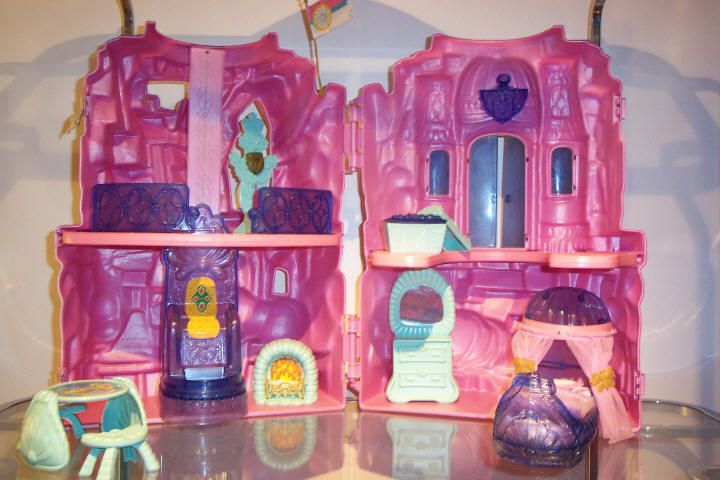
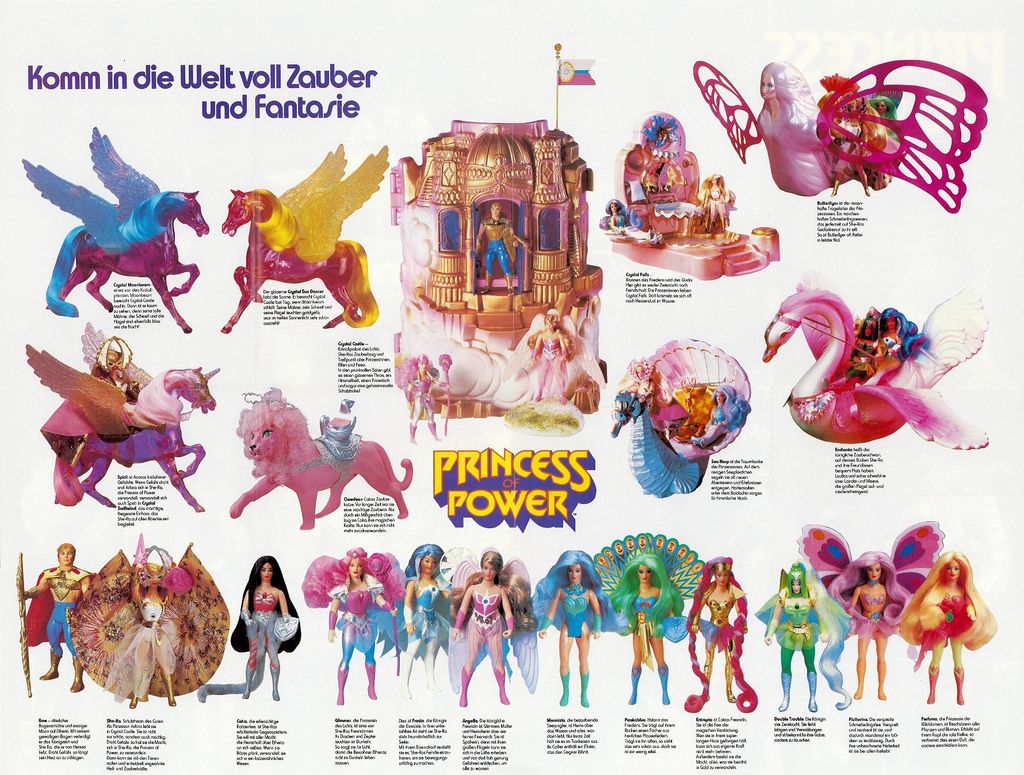
Crystal Castle playset.
Collect 'em all!
Now, why would I bring up the ACT and Reagan's deregulation of advertisement? Because that's what ultimately killed most of these wonderful shows. Especially, Masters Of The Universe & She-Ra, which I can unmistakably defend for they had heart, stories and values that went beyond other shows like, G.I. Joe where in each of its 95 episode run, you'll see at least 4 new characters and vehicles per episode. With She-Ra & He-Man there were also the mini comics which expanded on the origin of each character. Obviously, this was also a clever way to market their toys, nevertheless, you can still re-watch these shows because there are stories taking place, unlike Transformers which seeing them now as an adult, are as boring as a televised golf game.
MOTU fever has recently been revitalized, but now I'm sure the strategy will work for longer period of time, since most of its consumers are fully functioning adults with money to buy that toy they never had as a kid. They say life it's cyclical and this 80s toy revival more than proves it.
ロードス島戦記AKARecord of Lodoss War has got to be one of the most beautiful Anime ever made in terms of animation & soundtrack. If you were a fan of RPG, watched the Conan films, played Legend of Zelda, Golden Axe & Final Fantasy, enjoyed Dungeons & Dragons and read J.R.R. Tolkien's The Lord Of The Rings, this Animé is definitely for you.
This is a direct-to-video animation series produced back in 1990, which unfolds over thirteen half-hour episodes. Adapted from the fantasy novels of the same name by Japanese author Ryo Mizuno, Lodoss is a classic good-vs-evil story, exploring the chronicles of six adventurers: these include Parn, a young, inexperienced warrior eager to (literally) jump at any chance to clear his father's tarnished name; Deedlit, a spunky, mystical high elf who tries (with varying degrees of success) to prove her love to Parn; Etoh, a loyal, good-natured cleric; Slayn, a gentle wise mage; Ghim, a gruff and tough dwarf; and Woodchuck, a wanted criminal who nonetheless provides loyalty (and occasional chagrin) to his pals.
Your RPG heroes come to life!
...to defeat powerful dragons!
The story is hardly original, and the plot tends to jump around ; from one event to the next (for instance, the first episode starts off in the middle of the heroes' quest; chronologically, it'd be best to see eps 2-5, 1, and then 6-13)--yet the overall show is so engrossing that this fault (in addition to a few others I'll come to in a moment) becomes irrelevant.
It's the characters which make Record Of Lodoss War so much fun, and much of the best scenes belong to Parn and Deedlit; especially in a royal banquet episode where she forces Parn to dance with her (one of my favorite sequences from the show). As is typical of a elf-dwarf rivalry, Ghim and Deed bicker about each other's differences yet maintain a somewhat begrudging level of self-respect. It's Parn, however, whose plight stays with you long after the show approaches its climax. Eager to discover whether his father died in disgrace or not, he finds a father figure in Kashue. (This gets on Deedlit's nerves; she continually competes with the king for Parn's attention--a running gag that plays out unfortunately for only a couple of episodes.) In the latter episodes, we meet two new characters who don't get much screen time but are no less fully realized. Shiris, the hotheaded young mercenary who vies with Deedlit for Parn's affections is strongly depicted, as is her partner (and secret love), Orson, the moody Berserker, who becomes an angry, uncontrollable monster at the sight of Shiris in trouble.
Friendship and loyalty.
Darkness and all that's bad.
Even the bad guys are richly developed. Ashram, as mentioned, isn't driven so much by malice as he is by what he believes is right; in fact, he becomes the most three-dimensional of the villains for that reason alone. For support, he has a Dark Elf accomplice named Pirotess (the opposite of Deedlit) who'll do anything to prove her loyalty to him... including sacrificing herself. Karla, incidentally, is no ordinary villainess. Her primary goal is to bring to Lodoss the balance she feels has been so greatly disturbed... yet her psychologically unbalanced persona leads her to cause far worse chaos with deadly consequences. She is shifty, cunning, manipulative -- an almost deadly combination. Wagnard, on the other hand, is just plain evil -- every bit the equivalent of Kefka from Final Fantasy III who cackles fiendishly as he puts his dark plans into action. When we first meet him, he appears to be a nondescript character, but when he becomes possessed by Kardis, he becomes frighteningly villainous. (Every scene he's in sends shivers down my spines.)
Its the strength of the characters and their chemistry as well as the compelling (if jumpy) plot that make Lodoss as a whole that one can overlook its occasional shortcomings, notably the animation, which, although gorgeously drawn, uses a low cel count resulting with some stiff movements. Taking into account that this is an older show, however, this doesn't really detract all that much (although there are some later episodes where some of the same footage is reused, for cost cutting purposes).
Deedlit & Pirotess.
Amazing artwork!
No fantasy adventure would be complete without a stirring soundtrack, and Record of Lodoss War delivers this in style. The musical score by Mitsuo Hagita is mostly symphonic, although it is (obviously) generated by electronics. Yet the compositions were so beautifully arranged that I still think the soundtrack is great. Equally lovely are the opening and ending theme songs, Adesso e Fortuna ; and Fantasia of the Wind, both of which are excellently sung in Japanese by Sherry. As a nice bonus, these songs were even translated for the English version; the woman who sings the dubbed songs, Lisa DeSimone, sings with an equally splendid voice.
I remember, and this is a blurry memory, the first time I read about this Animé it was when I got one of those Animé magazines that were so popular in the 90s, I'm not sure which one exactly, but I think it was either Newtype or Otaku. Anyway, the mag featured a bonus CD-ROM which included music (in MP3 format), a selection of pictures from the Anime shows of the time, and of course a video section with openings of various shows. Obviously, Record of Loddos War opening was there with 4 songs from the soundtrack. This must have been, circa 1996 and it was my first exposure to today's anime in review. Luckily for me, I had several otaku friends that had quite a decent collection of Anime VHS tapes, so during 96's summer we watched Record Of Loddos War for the first time.
Graphic violence! Dark and gritty Anime!
Is that a nipple?
Record of Lodoss War has received its share of detractors over recent years, probably due to its cheap production values and/or inconsistent plotting. However, it is important to remember that these shortcomings; are mainly because it's an older Anime series. While Lodoss may show its age in places, its infectious appeal and complexity rings true even after other shows of its ilk, and like most classics, it can stand against the test of time.
here's the opening featuring the beautiful "Adesso E Fortuna" song:
Here's the ending with the equally beautiful "Fantasia Of The Wind" song:
Here's a 30 minute walkthrough of "Record Of Loddos War: Deedlit In Wonder Labyrinth" the new videogame made by fans, that despite being in early access stage, it's already available on Steam for PC gaming enthusiasts:


+-+32.jpeg)

+-+50.jpeg)

+-+17.jpeg)
+-+7.jpeg)
+-+25.jpeg)
+-+1.jpg)
+-+38.jpeg)